Attributes of God
Senior 6 · General and Religious Studies
Attributes of God
Lesson 2 of 5
25 min
Kinyarwanda speakers often call God Ishoborabyose, "the one who can do all things". Five times a day the call to prayer from Rwanda's mosques begins Allahu akbar, "God is greater". Both phrases point to the same two attributes: God's unlimited power and God's unlimited presence.
They are also the attributes that raise the hardest questions. If God can do anything, can God make a stone too heavy for God to lift? And if God is everywhere and all-powerful, why is there so much suffering? This lesson sets out what the scriptures teach and how believers and critics have argued about it.
Definition
Omnipotence: being all-powerful; able to do all things that are possible and consistent with God's nature. From Latin omnis (all) and potens (powerful).
Omnipresence: being present everywhere at once, not limited by space.
Pantheism: the belief that God and the universe are the same thing. Christianity and Islam reject it: God is present everywhere but distinct from creation.
Problem of evil: the question of how an all-powerful, all-good God can allow evil and suffering.
Theodicy: an attempt to justify belief in a good and powerful God in the face of evil. From Greek theos (God) and dike (justice).
Free will: the ability of a person to choose between real alternatives.
| Attribute | The Bible (World English Bible) | The Qur'an (Pickthall, 1930) |
|---|---|---|
| Omnipotence | "I am God Almighty." (Genesis 17:1) "There is nothing too hard for you." (Jeremiah 32:17) "With God all things are possible." (Matthew 19:26) | "Lo! Allah is Able to do all things." (2:20) "Blessed is He in Whose hand is the Sovereignty, and He is Able to do all things." (67:1) |
| Omnipresence | "Where could I go from your Spirit? Or where could I flee from your presence? If I ascend up into heaven, you are there." (Psalm 139:7–8) "'Don't I fill heaven and earth?' says Yahweh." (Jeremiah 23:24) | "Unto Allah belong the East and the West, and whithersoever ye turn, there is Allah's countenance." (2:115) "He is with you wheresoever ye may be." (57:4) "We are nearer to him than his jugular vein." (50:16) |
Both traditions describe God's power through creation: the universe exists because God wills it. But "all-powerful" needs care. Thomas Aquinas argued that omnipotence means the power to do whatever is logically possible. A "square circle" is not a thing that God fails to make; it is a contradiction, not a thing at all. Many classical Muslim theologians said the same in their own terms: God's power concerns what is possible, not what is self-contradictory.
Omnipotence also works together with God's other attributes. The Bible says "God is not a man, that he should lie" (Numbers 23:19). God's inability to lie is not weakness; it follows from God's perfect truthfulness.
Omnipresence does not mean that God is spread out like air, a little in each place, or that the trees and rivers are God (pantheism). Solomon, dedicating the temple, prays: "heaven and the heaven of heavens can't contain you; how much less this house that I have built!" (1 Kings 8:27). God is wholly present everywhere and contained nowhere. Many Muslim scholars explain "He is with you wheresoever ye may be" as God being with every person by knowledge, hearing, sight and power, while remaining above and distinct from creation.
Worked example 1: the paradox of the stone
Argument: "Either God can create a stone too heavy for God to lift, or God cannot. If God can, there is something God cannot lift. If God cannot, there is something God cannot create. Either way God is not omnipotent."
Step 1, identify the hidden claim. The argument assumes omnipotence means doing anything that can be put into words.
Step 2, apply the definition. On the Aquinas definition, omnipotence is power to do whatever is logically possible. "A stone too heavy for an all-powerful being to lift" describes a contradiction, like a square circle.
Step 3, conclude. Failing to do a contradiction is not a lack of power, so the paradox does not disprove omnipotence. A critic may reply that defining omnipotence this way makes it easier to defend; that is a fair point to note in an evaluation.
Worked example 2: omnipresence and everyday conduct
During an examination the invigilator leaves the room for ten minutes. Two candidates who believe in God discuss whether to share answers. One says, "Nobody is watching."
Christian reasoning. Psalm 139 teaches that there is no place hidden from God, and Hebrews 4:13 that "all things are naked and laid open before the eyes of him to whom we must give an account".
Islamic reasoning. "He is with you wheresoever ye may be. And Allah is Seer of what ye do" (57:4). Islamic ethics calls this awareness ihsan: worshipping God as if you see him, knowing that he sees you.
Conclusion. For a believer, omnipresence removes the idea of an unwatched moment and supports honesty. A non-believer could reach the same decision through fairness to other candidates; the reason differs, the action is the same.
Figure 1 shows the challenge. The Greek philosopher Epicurus is reported to have asked it more than two thousand years ago, and the Scottish philosopher David Hume restated it in 1779. Believers have answered in several ways.
Critics reply that these answers do not explain natural evils such as earthquakes, or the scale of suffering, such as the deaths of children. Some conclude that God does not exist, or is not both all-powerful and all-good. After the 1994 Genocide against the Tutsi, many Rwandan believers asked "Where was God?" with deep pain, and churches and mosques have had to face this question in their care for survivors. Many survivors speak both of that pain and of faith that helped them live on; both experiences deserve respect.
Tip
Define, then defend. In philosophy-of-religion questions, first state the definition you are using ("omnipotence means power to do whatever is logically possible"), then test the argument against it. Most paradoxes depend on an unstated definition.
Warning
Omnipresence is not pantheism. Saying "God is everywhere" does not mean "everything is God". Mixing them up is a common error, and it misrepresents both Christian and Islamic teaching.
Important
Discuss. Which response to the problem of evil do you find strongest, and which weakest? Would your answer be different for suffering caused by people and suffering caused by nature?
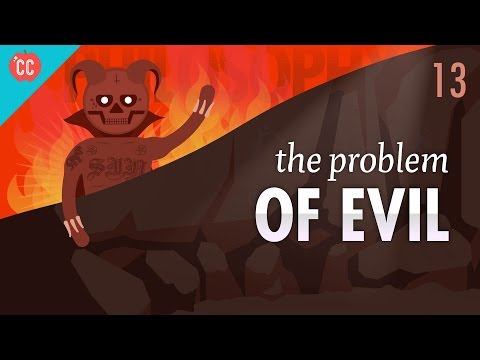
Crash Course Philosophy: "The Problem of Evil", #13, presented by Hank Green (about 10 minutes). Watch for how the problem is set out as a logical argument, and for the free-will and soul-making responses.
Practice
Sources and credits
Written by Ganzaa: Figure 1, the table, the worked examples and the exercises.