Physical Conditioning
Senior 3 · Physical Education
Physical Conditioning
Lesson 2 of 4
25 min
Carry a full 20-litre jerrycan of water from the tap to your house. The first few metres are easy; by the end your fingers, forearms and shoulders are burning. Lifting it once needs strength. Carrying it all the way, or doing the trip several times, needs muscular endurance. These are different qualities and you train them differently. In Senior 1 you learned the technique of squats, push-ups and sit-ups; this lesson turns them, with planks and light weights, into a training plan you can measure.
Definition
Muscular strength: the greatest force a muscle or group of muscles can produce in a single effort. Example: the heaviest load you can lift once.
Muscular endurance: the ability of a muscle to contract again and again, or to hold a position, without tiring. Example: 30 push-ups in a row, or a 60-second plank.
Repetition (rep): one complete movement of an exercise. Set: a group of reps done without rest, for example 3 sets of 12 reps (written 3 × 12).
Progressive overload: making the work slowly harder as the body adapts, by adding reps, sets, load or time, so that the muscles keep improving.
| Exercise | Main muscles | Key points | Make it easier / harder |
|---|---|---|---|
| Push-up | chest (pectorals), triceps, front of shoulders | Hands slightly wider than shoulders; body straight; lower until the elbows reach about 90°; push up and breathe out | Hands on a wall or bench; knees down / feet on a bench; slower lowering |
| Squat | front of thighs (quadriceps), buttocks (gluteals), hamstrings | Feet shoulder-width; push the hips back as if sitting on a chair; knees follow the line of the toes; chest up; heels down | Squat to a chair; hold a weight at the chest (goblet squat) |
| Curl-up (sit-up) | abdominals | Knees bent, feet flat; arms crossed on the chest; lift the shoulder blades by curling the trunk; do not pull on the neck | Smaller range; slower, or hold at the top for 2 s |
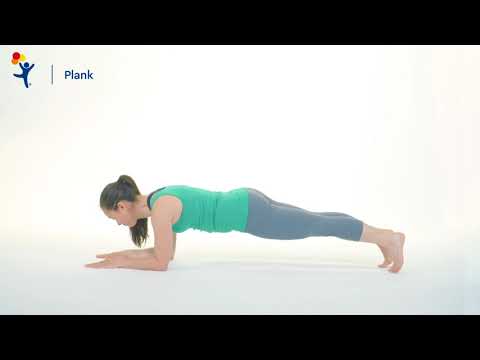
| Plank | abdominals and all the trunk ("core") muscles | Forearms flat, elbows under the shoulders; body straight from head to heels; breathe normally | Knees down; longer hold; lift one foot |
| Light weights: biceps curl, shoulder press | biceps; shoulders and triceps | Stand tall, knees soft; move slowly (about 2 s up, 2 s down); elbows close to the body for the curl | Water bottles; sand-filled bottles; dumbbells |
No gym? A 1.5-litre bottle full of water weighs about 1.5 kg; filled with dry sand it weighs roughly 2.4 kg. Two bottles make a pair of light dumbbells.
Figure: the forearm plank from the side. The dashed line runs from shoulder to ankle. In a good plank the trunk lies along it; sagging or raised hips both break the line.

The World Health Organization's 2020 guidelines advise 5 to 17-year-olds to do activities that strengthen muscle and bone on at least 3 days a week, as part of an average of 60 minutes of moderate-to-vigorous activity a day. Strength training is safe for teenagers when an adult supervises, good technique comes first, and the load rises slowly. Choose the dose by your goal:
| Goal | Reps per set | Sets | Rest between sets | Load |
|---|---|---|---|---|
| Muscular endurance | 15 to 25, or 20 to 60 s holds | 2 to 3 | 30 to 60 s | body weight or light |
| Strength (S3 level) | 8 to 12, last two hard but clean | 2 to 3 | 1 to 2 min | moderate, never a maximum lift |
In a circuit, alternate body parts so that one group of muscles rests while another works: for example push-up (upper body), squat (legs), curl-up (trunk), bottle shoulder press (upper body), lunge (legs), plank (trunk).
Worked example
Worked example 1: measuring progress. Gatete does a one-minute push-up test. In week 1 he manages 18 push-ups; in week 6 he manages 24. Find the percentage improvement.
His muscular endurance in the chest and arms has improved by about a third.
Worked example
Worked example 2: applying overload. Umutoni does goblet squats with a 4 kg sand bottle: 3 sets of 12. Her training volume is sets × reps × load:
When 3 × 12 feels easy, she should change one thing at a time: 3 × 15 with 4 kg gives kg, a rise of 25%. Adding reps before load keeps her technique safe.
Video: "Core Exercise: Plank", Children's Hospital Colorado. A one-minute demonstration of the plank. Check the straight line from head to heels against the figure above.
Tip
Breathe out on the effort. Breathe out as you push up, stand up or curl up, and breathe in as you lower. Counting the reps out loud stops you holding your breath.
Warning
Common mistakes and safety. Holding your breath while straining raises blood pressure sharply: keep breathing. Do not jerk a weight up with a swing of the back. Never try a one-repetition maximum (the heaviest weight you can lift once) without a qualified coach. Do not pull on your neck during curl-ups. Stop if you feel a sharp pain, as opposed to the normal burning of a tired muscle.
Practice
Remember
Sources and credits
This lesson adapts CC BY-SA material and is shared under CC BY-SA 4.0.