Football Game Situation
Senior 3 · Physical Education
Football Game Situation
Lesson 2 of 3
25 min
Watch a well-drilled team without the ball: the players move together like a sheet pulled by its corners, the nearest player closes the ball down, and the others shift across behind him. One defender who runs in the wrong direction, or steps up a second late, leaves a gap that a good attack will find. In Senior 2 you practised pressing and tackling; now you organise a whole unit and learn the two Laws that defenders use and abuse most: offside (Law 11) and fouls and misconduct (Law 12).
Definition
Pressure: the nearest defender (the first defender) closes down the player with the ball to slow the attack and stop a forward pass.
Cover: the second defender stands a few metres behind and to the side of the first, ready to tackle if the attacker gets past.
Balance: the other defenders mark dangerous spaces and players on the far side.
Compactness: keeping the team's lines close together, about 25 to 35 m from front to back, so there is little space between them.
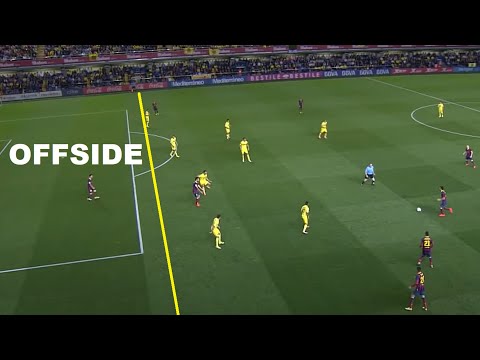
Offside position (Law 11): a player is in an offside position if any part of the head, body or feet is in the opponents' half and nearer to their goal line than both the ball and the second-last opponent. Hands and arms do not count.
Being in an offside position is not an offence. A player is penalised only if, at the moment a teammate plays or touches the ball, he is in an offside position and becomes involved in active play: by playing or touching the ball, by interfering with an opponent, or by gaining an advantage, for example from a rebound off the goalpost. There is no offside offence if the player receives the ball directly from a goal kick, a throw-in or a corner kick. The sanction is an indirect free kick to the defending team.
Figure: at the moment A passes, attacker B is beyond the line of the second-last opponent and nearer the goal line than the ball, so B is in an offside position; C is behind the line and onside.
| Sanction | Examples |
|---|---|
| Direct free kick (a penalty kick if the defender commits it inside his own penalty area) | Charging, jumping at, kicking, pushing, striking, tackling or tripping an opponent carelessly, recklessly or with excessive force; holding; handling the ball deliberately; impeding with contact |
| Indirect free kick | Playing in a dangerous manner; impeding without contact; dissent; a goalkeeper handling a deliberate kick-pass or throw-in from a teammate |
| Yellow card (caution) | Unsporting behaviour, dissent, persistent offences, delaying a restart, a reckless tackle |
| Red card (sending-off) | Serious foul play, violent conduct, spitting or biting, denying an obvious goal-scoring opportunity, a second caution |
Laws as in the IFAB Laws of the Game 2026–27.
Video: "Offside Rule Explained (in 3 minutes)", Footy PhD. Pause at each example and decide, before the answer appears, whether the player is in an offside position and whether he is penalised.
Worked example
Worked example: offside or not? Mugisha (attacker) is 2 m nearer the goal line than every outfield defender, and the goalkeeper is on his line, when his teammate shoots. The ball rebounds from the crossbar to Mugisha, who scores.
Tip
Two questions for offside. First: where was he when the ball was played, not when he received it? Second: did he become involved? Both answers must be "offside" and "yes" for a foul.
Warning
Common mistakes and safety. Sliding in from behind, or tackling with the studs showing, is reckless or dangerous and can break an ankle: stay on your feet. A defender who steps up late leaves an attacker onside; one who steps up alone leaves a gap. If a player is hit on the head, stop play: a suspected concussion means no return that day.
Practice
Remember
Sources and credits
This lesson adapts CC BY-SA material and is shared under CC BY-SA 4.0.