Triad Chords
Senior 3 · Music
Triad Chords
Lesson 3 of 4
30 min
A song in C major uses the notes of the C major scale. If you build a triad on each of those seven notes, using only notes from the scale, you get the seven chords that "belong" to the key. Most of the chords in a simple song in C major come from this family of seven. Musicians number them with Roman numerals, so that the same numbers work in every key.
Definition
Diatonic triad: a triad built on one degree of a scale using only the notes of that scale. Example: in C major, D–F–A is the diatonic triad on the second degree.
Roman numeral (chord numeral): the number of the scale degree a triad is built on, written I to VII. Upper case shows a major triad (IV), lower case a minor triad (ii), a small circle a diminished triad (vii°) and a plus sign an augmented triad (III+).
Degree names: 1 tonic, 2 supertonic, 3 mediant, 4 subdominant, 5 dominant, 6 submediant, 7 leading note.
Build a triad on every note of C major, using white keys only, then measure the thirds as you did in lesson 2:
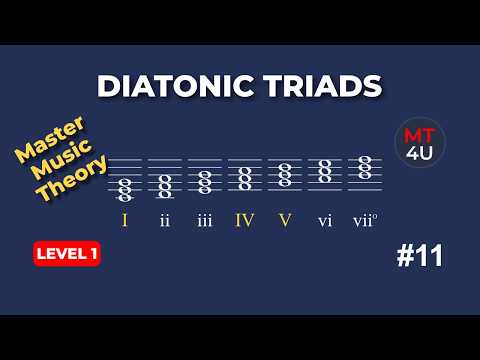
The pattern is major, minor, minor, major, major, minor, diminished: I ii iii IV V vi vii°. Every major key has the same pattern, because every major scale has the same tones and semitones (S2). In G major the key signature already sharpens every F, so the triads on D and on F♯ are spelled D–F♯–A and F♯–A–C without writing a single sharp beside the notes.
In the natural minor scale of A (A B C D E F G) the triad on the fifth degree is E–G–B, a minor chord. It does not pull strongly home to A, because G is a whole tone below A. So composers raise the seventh note, G, to G♯: the harmonic minor scale you met in S2. The leading note G♯ is a semitone below A and leads into it. Every triad that contains the seventh degree changes:
| Degree | Name | C major | Numeral | A minor (harmonic) | Numeral |
|---|---|---|---|---|---|
| 1 | tonic | C–E–G, major | I | A–C–E, minor | i |
| 2 | supertonic | D–F–A, minor | ii | B–D–F, diminished | ii° |
| 3 | mediant | E–G–B, minor | iii | C–E–G♯, augmented | III+ |
| 4 | subdominant | F–A–C, major | IV | D–F–A, minor | iv |
| 5 | dominant | G–B–D, major | V | E–G♯–B, major | V |
| 6 | submediant | A–C–E, minor | vi | F–A–C, major | VI |
| 7 | leading note | B–D–F, diminished | vii° | G♯–B–D, diminished | vii° |
The harmonic minor is the only place in this unit where you meet an augmented triad as a diatonic chord: III+ (C–E–G♯). In practice the dominant V (major) and the tonic i (minor) are the minor-key chords you will use most.
Worked example 1: name the triad on the fourth degree of G major
Worked example 2: find V in D minor (harmonic)
Video: "Diatonic Triads Explained: Chords in Major & Minor Scales", Music Theory 4U. It builds the triads of C major and of A minor and labels them with Roman numerals. Its minor-key chords come from the natural minor, so compare them with the harmonic-minor column above and spot the three that change.
Tip
Major key in one line: "I ii iii IV V vi vii°". The three upper-case numerals, I, IV and V, are the three major triads, and they are next lesson's primary chords.
Warning
Common mistake: forgetting the key signature. In G major the triad on D is D–F♯–A (major), not D–F–A. In a minor key, forgetting to raise the seventh turns V into a minor chord. Read the key signature first, then build.
Practice
Remember
Sources and credits