Motifs and Patterns on the Computer
Senior 3 · Fine Arts
Motifs and Patterns on the Computer
Lesson 4 of 4
25 min
The wallpaper below was designed in London in 1862. Look at the blue bird in the top left corner, then look at the bottom left corner: the same bird, in exactly the same pose. Everything between the two birds is one repeat. The printer carved that one unit into wooden blocks and printed it again and again until a whole roll was covered. Your computer does the same job in a second. In this lesson you will learn the main ways to repeat a motif, how to make the joins disappear, and how to build a small collection of patterns for a real purpose.

Definition
Repeat unit (tile): the smallest part of a pattern that, repeated, makes the whole pattern.
Seamless: repeating with no visible joins between tiles.
Rhythm: the sense of movement created by regular repetition, like a beat in music.
Colourway: one version of a pattern in a particular set of colours. The same pattern is often sold in several colourways.
Pattern collection: a set of patterns designed to be used together, sharing a theme, a source and a palette.
| Repeat | How each tile is placed | Effect |
|---|---|---|
| Block (full drop) | straight rows and columns | orderly and strong; can look stiff, with clear lines across and down |
| Half-drop | every other column moved down by half a tile | diagonal rhythm; hides the grid; common in wallpaper and fabric |
| Brick | every other row moved across by half a tile | like a brick wall; gentle horizontal flow |
| Mirror | tiles flipped left-right and up-down in turn | new shapes appear where copies meet; very balanced |
| Rotation | tiles turned each time, in groups of four | pinwheel or medallion shapes; lively movement |
Notice in Figure 1 how mirror and rotation create completely new shapes, such as bow-ties and pinwheels, from the same small triangle. That is why designers try every repeat before choosing one.
A pattern made only of motifs that sit fully inside the tile is easy, but it often shows the grid. Letting motifs cross the edges hides the grid, but then the tile must be seamless. In Inkscape: select the part that overflows, duplicate it, and move the copy by exactly the tile width (use Object, Transform, Move, with the tile width typed in). Do the same for the top and bottom edges. Then test by placing four copies together.
Inkscape can repeat a tile for you in three ways: Object, Pattern, Objects to Pattern (fills any shape with your tile); Edit, Clone, Create Tiled Clones (rows and columns with shifts, flips and rotations, so it can make every repeat in Figure 1); and the Tiling path effect.
Start from a brief: the purpose, the product, who will use it, the size and any colour limits. Example: "Four coordinated designs for cushion covers and table runners for a guesthouse in Musanze; inspired by Rwandan crafts; earthy palette; motif no bigger than 8 cm."
A typical small collection has:
Present the collection on one board (A3 or a screen page): title and brief, your source sketches, the motif, each pattern as a swatch, the palette with colour codes, a mock-up of the product (for example the pattern placed on a cushion shape), and a credit line for the source. Export the patterns as PNG at 300 dpi and the board as PDF.
| Criterion | Strong | Needs work |
|---|---|---|
| Source and meaning | clear, respectful link to a named cultural source | no source, or symbols used carelessly |
| Motif | simple silhouette; passes the small-size test | too detailed; unreadable when small |
| Repeat | seamless; chosen repeat suits the purpose | visible seams, gaps or bunching |
| Collection | hero, coordinates and blender share palette and theme | patterns look unrelated |
| Presentation | labelled board, mock-up, correct export | missing parts; blurred or wrongly sized files |
Worked example 1: setting the offset
Habimana's tile is 40 mm wide and 60 mm high. (a) For a half-drop, how far down does every other column move? (b) For a brick repeat, how far across does every other row move?
(a) Half the tile height: down.
(b) Half the tile width: across.
Mixing these up is a common error: a half-drop uses the height, a brick uses the width.
Worked example 2: how many tiles?
A sheet of gift wrap is 50 cm by 70 cm, and Ishimwe's tile is 10 cm square. How many whole tiles cover the sheet in a block repeat? If she shrinks the tile to 5 cm, how many are needed?
10 cm tile: tiles.
5 cm tile: tiles. Halving the tile size multiplies the number of tiles by 4, and the pattern looks busier from a distance.
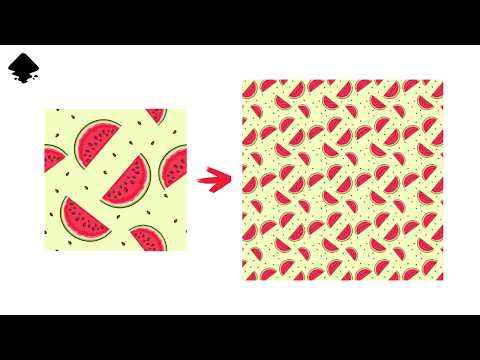
<em>Create Seamless Pattern Tiles with Inkscape</em>, from the Logos By Nick channel. Watch how motifs that cross the tile edge are copied to the opposite side, and compare it with Figure 2.
Warning
Gaps and lines at the joins. If a thin white line shows between tiles, the tile is a fraction too small or the motif copies were moved by the wrong amount. Use exact numbers, never drag by eye.
Accidental stripes. In a block repeat, a strong motif lines up into stripes. Try a half-drop, or add a small second motif to fill the gaps.
Tip
Half-drop = half the height; brick = half the width. And always test a repeat with at least 3 by 3 tiles before you judge it.
Practice
Name the five repeat types in this lesson and describe how tiles are placed in a half-drop.
What is a colourway?
A tile is 30 mm wide and 50 mm high. Give the offset for a half-drop and for a brick repeat.
How many 8 cm square tiles cover a cloth 64 cm by 40 cm in a block repeat?
A motif crosses the right edge of a 60 mm tile. Where exactly must the copy of the overflowing part go?
Gisa's block-repeat pattern shows strong vertical stripes she did not intend. Analyse the cause and suggest two fixes.
Collection task. Write a brief, then produce a collection of four designs (hero, coordinate, blender, border) from your motif, in one palette, and present it on a board with a product mock-up.
1. Block, half-drop, brick, mirror, rotation. In a half-drop, every other column is moved down by half the tile height.
2. One version of a pattern in a particular set of colours.
3. Half-drop: mm down. Brick: mm across.
4. tiles.
5. On the left edge, moved exactly 60 mm to the left of the original, at the same height.
6. In a block repeat, identical motifs line up in straight columns, so strong motifs read as stripes. Fixes: change to a half-drop or brick repeat; add a smaller secondary motif in the gaps; reduce the contrast or size of the motif.
7. Check against the rubric: named source, readable motif, seamless repeats, shared palette, labelled board and correct exports.
Show your collection to someone who did not make it. Which pattern do they notice first, and is that the one you intended to be the hero?
Further reading
Sources and credits