Key Theories of Social Psychology
Senior 6 · Psychology
Key Theories of Social Psychology
Lesson 4 of 5
25 min
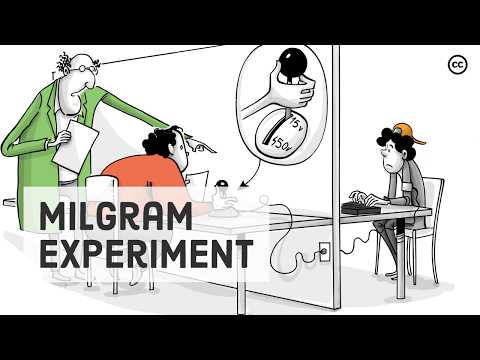
In 1961 Stanley Milgram, a young psychologist at Yale University in the United States, placed an advertisement in a local newspaper offering US$4.50 for one hour in a "study of memory". The men who came, aged 20 to 50 and from many occupations, met a second "volunteer", a pleasant middle-aged man, and drew lots for roles. The draw was fixed: the real participant was always the teacher; the other man, an actor working for Milgram, was always the learner.
The learner was strapped into a chair in the next room, with an electrode on his wrist. The teacher sat in front of a shock generator with 30 switches from 15 to 450 volts, labelled from "Slight Shock" to "Danger: Severe Shock" and finally "XXX". Every time the learner made a mistake on a word-pair memory test, the teacher was to give a shock one step higher. No real shocks were given, but the teacher did not know that.
The learner made many mistakes. At 300 volts he pounded on the wall, and after 315 volts he fell silent. If the teacher hesitated, the experimenter, calm and in a grey laboratory coat, used four standard prods in turn: "Please continue", "The experiment requires that you continue", "It is absolutely essential that you continue" and "You have no other choice, you must go on."
Before the study, Yale psychology students predicted that only about 1% of people would go to the end. In fact, all 40 men in the first published study went to at least 300 volts, and 26 of 40 (65%) went all the way to 450 volts. Many sweated, trembled, laughed nervously or protested, yet continued (Milgram, 1963).
Definition
Obedience: carrying out a direct order from a person seen as a legitimate authority.
Agentic state: Milgram's term for a state of mind in which a person sees himself or herself as the instrument of another's wishes, and so no longer responsible for the action. Its opposite is the autonomous state, in which people act on their own judgement and feel responsible.
Legitimate authority: power that people accept as rightful because of a person's position in a social hierarchy, such as a teacher, officer or scientist.
Milgram ran more than twenty variations (published in 1974 in Obedience to Authority). Some of them:
| Variation | % who went to 450 V | What it suggests |
|---|---|---|
| Learner in the same room as the teacher | 40% | Seeing the victim reduces obedience |
| Teacher must press the learner's hand onto a shock plate | 30% | Physical closeness reduces it further |
| Experimenter gives orders by telephone | 20.5% | Authority must be present to be obeyed |
| Run-down office in Bridgeport, not Yale | 47.5% | The institution's prestige mattered somewhat |
| Orders given by an "ordinary man", not the scientist | 20% | Legitimacy of the authority matters |
| Two other "teachers" (confederates) refuse to go on | 10% | Disobedient peers free people to resist |
Diana Baumrind (1964) argued that participants were deceived and put under severe stress without proper consent. Milgram replied that participants were debriefed and that, in a follow-up questionnaire, 84% said they were glad to have taken part. Today's ethics codes would not allow the study as it was run, and it is one of the main reasons those codes exist.
Burger (2009) ran an ethical partial replication in the United States, stopping at 150 volts, the point after which most of Milgram's obedient participants never stopped. 70% of his participants were willing to continue past 150 volts, compared with 82.5% in Milgram's comparable condition, a difference that was not statistically significant. Obedience levels found in other countries have varied with the procedure, but high levels of obedience have often been found.
Important
Obedience does not remove responsibility. After the Second World War, international law set out the principle that acting on a superior's orders does not free a person from responsibility "provided a moral choice was in fact possible to him" (Principle IV of the Nuremberg Principles, adopted by the UN International Law Commission in 1950). Courts that tried crimes of the 1994 Genocide against the Tutsi, from the International Criminal Tribunal for Rwanda to Rwanda's national courts and the Gacaca courts, held individuals responsible for their acts. Milgram's work helps explain pressures towards obedience; it is not an excuse, and his own results showed that many people did refuse.
Sprouts: "The Milgram Experiment: Obedience to Authority" (short animation). Watch for the set-up and the 65% result, then compare the video's account with the criticisms in section 3: does it mention the participants' doubts or the role of the prods?
Warning
Common errors. The participants did not give real shocks; they believed they did. And "65% obeyed" refers only to the baseline study: obedience ranged from about 10% to over 90% across Milgram's variations, which is the more important finding.
Tip
Structure for a 12-mark "evaluate Milgram" answer: aim and procedure (brief) → baseline result → two variations and what they show → two ethical points → two validity criticisms (Orne and Holland, Perry) → one replication (Burger) → a conclusion on what the studies really show.
Practice
Sources and credits
Written by Ganzaa: the text, the diagram (Figure 1), the table and the exercises.