Intragroup and Intergroup Dynamics
Senior 6 · Psychology
Intragroup and Intergroup Dynamics
Lesson 1 of 4
25 min
Around 1913 the French agricultural engineer Max Ringelmann asked men to pull on a rope, alone or in groups, while he measured the force. Groups pulled harder than individuals, but not in proportion: eight men together pulled with much less than eight times the force of one man.
Part of the loss could be poor coordination. But in 1979 Bibb Latané, Kipling Williams and Stephen Harkins asked students to shout and clap as loudly as they could, alone or in groups, and then blindfolded them and played noise through headphones so they only believed others were shouting with them. Each person still produced less sound when he thought he was part of a group. People were not only less coordinated in groups: they tried less hard.
The study of such forces inside groups is what Kurt Lewin called group dynamics.
Definition
Intragroup dynamics: the processes that operate among the members of one group: how norms, roles, status, cohesion and decisions develop and affect behaviour.
Intergroup dynamics: the processes that operate between two or more groups (Lessons 2–4).
Social loafing: the tendency of people to put in less effort when working collectively on a task where individual contributions are pooled, than when working alone.
Groupthink: a way of thinking in a highly cohesive group in which the desire for agreement overrides a realistic appraisal of alternatives (Irving Janis, 1972).
Steven Karau and Kipling Williams (1993) combined 78 studies and found social loafing to be a reliable effect. Their collective effort model says people work hard when they expect their effort to make a difference to an outcome they value. Loafing is reduced when:
Their review also found less loafing among women and in collectivist cultures than among men and in individualist cultures. A teacher who gives one mark to a group report invites loafing; one who also assesses each member's part reduces it.
Group discussion tends to push members' views to a more extreme position in the direction they already leaned (Serge Moscovici and Marisa Zavalloni, 1969). People hear new arguments that support their side, and they want to appear at least as committed as others. Polarisation can make cautious groups more cautious, and angry groups angrier, which is one reason why closed online groups can harden opinions.
Irving Janis (1972) studied disastrous decisions by expert government teams, such as the United States' failed invasion of Cuba at the Bay of Pigs in 1961, and proposed groupthink (Figure 1).
Janis recommended remedies: the leader should hold back his or her own view at first; one member should play "devil's advocate"; outside experts should be invited; the group should split into sub-groups; and a "second-chance" meeting should be held before a final decision.
How strong is the evidence? Janis built the theory mainly from historical case studies chosen because they ended badly, so it is easy to see groupthink in hindsight. Laboratory tests have given mixed results: a review by James Esser (1998) found that cohesion alone does not reliably produce poor decisions, while directive leadership and closed procedures matter more. The remedies are widely used and sensible, but the full model has not been confirmed.
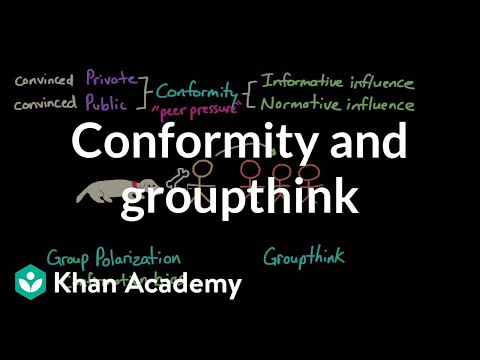
Khan Academy (MCAT series): "Conformity and groupthink". Watch for the link between conformity (Unit 1) and groupthink, and for the warning signs of groupthink.
Warning
Cohesion is not the villain. A frequent exam error is to write that "cohesive groups make bad decisions". Cohesion usually helps performance; groupthink arises when cohesion combines with a directive leader, isolation and pressure to agree.
Tip
From effect to remedy. For each intragroup problem, learn one remedy: social loafing → identify each person's contribution; polarisation → bring in opposing views; groupthink → devil's advocate and the leader speaks last.
Important
Discuss. A school prefects' council always agrees with the head boy, who speaks first. Which symptoms of groupthink might appear, and how would you redesign its meetings?
Practice
Sources and credits
Written by Ganzaa: the text, the diagram (Figure 1) and the exercises.