Intragroup and Intergroup Dynamics
Senior 6 · Psychology
Intragroup and Intergroup Dynamics
Lesson 2 of 4
25 min
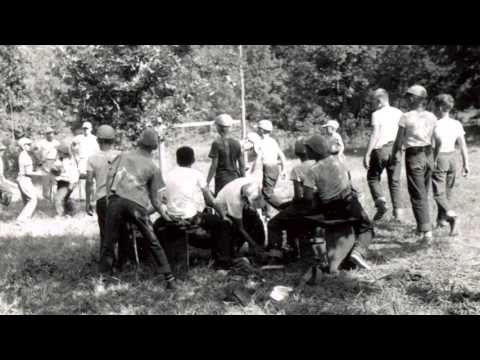
In the summer of 1954 the Turkish-American psychologist Muzafer Sherif and his colleagues ran a summer camp at Robbers Cave State Park in Oklahoma, United States. Twenty-two 11- and 12-year-old boys, carefully matched to be similar, were taken in two separate buses to two separate sites. For about a week, neither group knew the other existed. Each group hiked, swam and cooked together, chose a name (the "Rattlers" and the "Eagles"), made a flag and developed its own norms and leaders.
Then the researchers told each group about the other and set up a tournament of games, with prizes only for the winners. Within days the boys were calling each other names, burning each other's flags and raiding each other's cabins. Ordinary, well-adjusted boys had become hostile groups, simply by competing for something only one side could have (Sherif and colleagues, 1961).
Definition
In-group: a group to which a person belongs and with which he or she identifies ("us").
Out-group: a group to which a person does not belong ("them"). The terms come from the sociologist William Graham Sumner (1906).
Ethnocentrism: judging other groups by the standards of one's own, and seeing one's own group as the centre of everything and superior (Sumner, 1906).
Group boundary: whatever marks who belongs and who does not, such as language, dress, rituals, symbols, membership rules or territory.
Every group draws boundaries. Some are physical (a school compound, a village), some social (rules for joining, such as paying a cooperative's membership fee) and many symbolic: uniforms, songs, slogans, greetings, ways of speaking. The anthropologist Fredrik Barth (1969) argued that what keeps a group distinct is often the boundary itself, which members actively maintain, more than any fixed set of cultural traits inside it. People and customs cross boundaries, yet the boundary persists.
Inside the boundary, groups develop shared values (what matters: winning, loyalty, honesty, faith) and a group culture: stories, rituals, in-jokes and ways of doing things that newcomers must learn. A school's motto, its houses and its graduation ceremony are parts of its culture that build identity.
Groups can relate to one another in several ways: cooperation (working together for shared goals), competition (seeking the same scarce goal), conflict (trying to harm or defeat the other), accommodation (agreeing to coexist despite differences), and, for a minority group living within a larger society, one of four strategies described by John Berry (1997):
In a study of more than 5,000 immigrant young people in 13 countries, Berry and colleagues (2006) found that those who followed an integration strategy were, on average, the best adapted psychologically and socially, and those who were marginalised the worst. A family moving to Kigali from abroad, a student from a rural district joining a city boarding school, or refugees settling in a host community all face these choices, and the host group's attitudes affect which strategies are possible.
Sherif's explanation became realistic conflict theory: hostility between groups grows when they compete for scarce resources, and falls when they must cooperate for goals neither can reach alone (Lesson 4). The study is famous, but it needs careful evaluation:
Cummings Center for the History of Psychology: "5 Minute History Lesson, Episode 3: Robbers Cave". Watch for how the study was set up and for what historians have learned about it from the archives.
Warning
"In-group" is relative. The same people can be an in-group in one situation and an out-group in another: pupils from two schools are rivals at a football match but one in-group at a national science fair. Always say from whose point of view you are speaking.
Tip
Berry's grid in two questions: "Do I keep my own culture?" and "Do I mix with the wider society?" Yes-yes = integration; no-yes = assimilation; yes-no = separation; no-no = marginalisation.
Important
Discuss. Your school has "houses" that compete in sports and debates. Using the Robbers Cave study, explain what could go wrong, and suggest one school-wide activity that would act as a check on rivalry.
Practice
Sources and credits
Written by Ganzaa: the text, the diagram (Figure 1) and the exercises.