Cereals
Senior 3 · Agriculture
Cereals
Lesson 3 of 4
25 min
Let's begin
Two neighbours plant maize on the same day, on the same kind of soil. One harvests about 2 tonnes per hectare, the other more than 4. In Lesson 2 you saw that this "yield gap" separates Rwanda's small and large farms. Very little of it is luck: it comes from a chain of practices, from the seed in the bag to the dryness of the grain in the store. Break any link and the yield falls. This lesson follows maize through every link.
Definition
Cultural practices: the operations a farmer carries out to grow a crop, from land preparation to storage.
Certified seed: seed produced under inspection so that it is true to its variety, clean and of tested germination.
Plant population: the number of plants per hectare.
Top dressing: applying fertiliser (usually nitrogen) next to a growing crop, weeks after planting.
Physiological maturity: the stage when the grain has finished filling; in maize a black layer forms where the grain joins the cob.
Integrated pest management (IPM): controlling pests by combining good farming, field checks, biological and physical methods, and using pesticides only when needed.
Maize grows best with 500 to 1,200 mm of rain spread over the season, especially around flowering; warm temperatures (about 18 to 30 °C); and a deep, well-drained, fertile loam. Many Rwandan highland soils are acid, and maize does poorly below about pH 5.5, so these soils need lime and manure.
Clear and dig or plough to 20 to 30 cm before the rains, so planting can start with the first good rain. Dig along the contour on slopes (Unit 1). Work in well-rotted manure or compost.
Buy certified seed of a variety recommended by the Rwanda Agriculture and Animal Resources Development Board (RAB) for your altitude, from an agro-dealer. Hybrid seed gives high yields but must be bought fresh every season; open-pollinated varieties can be kept for a few seasons if kept pure.
Figure 3. (a) Maize spacing; (b) where to put the seed and the fertiliser.
| Problem | Signs | Control |
|---|---|---|
| Fall armyworm (Spodoptera frugiperda) | Ragged holes and wet, sawdust-like droppings in the funnel (whorl) of young plants | Scout weekly; crush egg masses and larvae; plant early and at the same time as neighbours; push-pull (Desmodium between rows, Brachiaria round the field); approved insecticide only if damage is widespread, as advised by RAB |
| Stem borers | "Shot holes" in leaves, tunnels in stems, dead heart | Destroy old stalks; push-pull; rotation |
| Maize streak virus | Narrow yellow streaks along the veins; stunting | Resistant varieties; early planting; no maize next to old maize |
| Maize lethal necrosis | Leaves dry from the edges; whole plant dies early | Certified seed; rotation with non-cereals; remove infected plants |
| Storage weevils and borers | Holes in grain, flour dust in the store | Dry grain well; clean store; hermetic bags |
Fall armyworm reached Rwanda recently. The Ministry of Agriculture and Animal Resources (MINAGRI) reports that it was first found at the end of February 2017 in the Mushishito marshland, Nyamagabe District, and within that season had infested 15,699 ha, about a quarter of the maize and sorghum planted in Season 2017B.
Scouting: walk across the field in a W pattern and look closely at 10 plants in a row at each of 5 points (50 plants). Count the plants with fresh damage. Checking every week tells you whether damage is rising before it is too late.

Warning
Pesticide safety (FAO and WHO guidance)

Worked example 1: plant population and fertiliser per hole
Problem. Maize is planted at 75 cm by 25 cm, one seed per hole. (a) Find the plant population per hectare. (b) The farmer is advised to apply 100 kg of DAP per hectare (illustrative rate). How many grams go in each hole?
Solution.
Answer: about 53,333 plants per hectare and about 1.9 g of DAP per hole.
Worked example 2: how much does drying weigh?
Problem. A farmer shells 1,000 kg of grain at 25% moisture and dries it to 13%. What will it weigh?
Solution. The dry matter does not change; only water is lost.
Answer: about 862 kg. The 138 kg lost is water. A buyer who pays for wet grain by weight is paying for water, which is why traders and cooperatives test moisture.
Tip
Exam technique: list cultural practices in the order they happen: prepare, seed, plant, fill gaps, weed, feed, protect, harvest, dry, store. For each one, add why: "Plant at the onset of the rains, so the crop uses the whole season's rain."
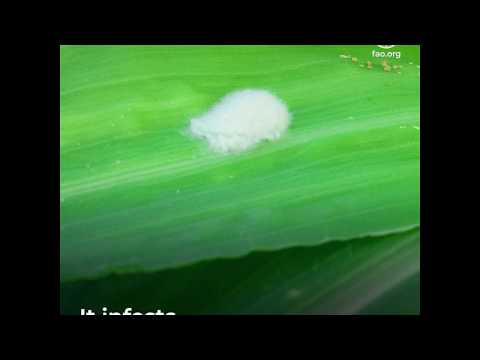
Food and Agriculture Organization of the United Nations (FAO): "Fall Armyworm". Note how the pest damages young maize, and the farmer-based control methods FAO recommends before any spraying.
Practice
Key points
Sources and credits
Written by Ganzaa: the text, Figure 3, the table and the worked examples. The DAP rate in Worked example 1 is illustrative; follow RAB or your extension officer's recommendation.