Fodder
Senior 3 · Agriculture
Fodder
Lesson 1 of 3
22 min
Let's begin
A dairy cow in a shed near Musanze may never walk to a pasture in her life. Every leaf she eats is cut in a field, carried to her trough, and weighed against the milk she gives. Rwanda's Ministry of Agriculture and Animal Resources (MINAGRI) counted about 1.73 million cattle in 2025, together with about 2.08 million goats and 454,000 sheep, all of them plant eaters (MINAGRI, Annual Report 2024–2025). Land is scarce, so most of their feed must come from small plots of crops grown only to be eaten by animals. Those crops are fodder.
Definition
Forage: any plant material eaten by livestock, whether grazed or cut.
Fodder: forage that is cut and carried to the animals, fed fresh (green chop) or conserved as hay or silage. A fodder crop is grown for this purpose, e.g. Napier grass.
Pasture: land covered with grasses and legumes on which animals graze.
Zero grazing: keeping animals in a shed or yard and bringing all their feed and water to them.
Dry matter (DM): what is left of a feed when all its water is removed; animals' needs and fodder yields are compared in DM. Fresh Napier grass is roughly 80% water and 20% DM.
Hay: fodder cut and dried for storage. Silage: green fodder stored airtight so that it ferments and keeps.
| Type | Examples | Main value |
|---|---|---|
| Fodder grasses (perennial) | Napier (elephant) grass, Guatemala grass, Setaria, Brachiaria, Rhodes grass (Chloris), para grass, Panicum | bulk energy feed; cut many times a year for several years |
| Fodder legumes | Desmodium, lucerne, Stylosanthes, Mucuna | rich in protein; fix nitrogen in the soil |
| Fodder trees and shrubs | Calliandra, Leucaena, Gliricidia | protein-rich leaves in the dry season; stakes and firewood |
| Cereal fodder crops (annual) | fodder maize, fodder sorghum, oats, millet, barley | fast, high yield; ideal for silage and hay |
| Crop residues | maize stover, bean haulms, sweet potato vines, banana leaves and stems | cheap extra feed after harvest |
A good fodder grass gives a high yield of leafy material, is palatable (animals like it) and nutritious, grows back quickly after cutting, lives for several years, resists drought, pests and diseases, is easy to propagate, and covers the soil well.

Rwanda's cattle are mostly kept under zero grazing: they are fed cut-and-carry fodder, mostly Napier grass, in sheds (MINAGRI, Livestock Development Strategy 2024–2029, 2024). Even in the four Eastern Province districts where grazing was once widespread (Nyagatare, Gatsibo, Kayonza and Kirehe), MINAGRI's instructions say that only 30% of farm land is used for zero-grazing dairy cattle and 70% for crops such as maize, beans and soybeans that also support feed production. MINAGRI reports that over 20,000 ha were being cultivated for forage, and that in one year 23,080 calliandra trees and 10,670 leucaena trees were distributed, 54.6 t of Napier cuttings and Brachiaria and Panicum splits were produced, and 3,127 farmers were trained in forage production and conservation (MINAGRI, 2024).


Worked example 1: how much fresh Napier does a cow eat?
Problem. A 400 kg dairy cow eats dry matter equal to about 3% of her body weight each day. Fresh Napier grass is about 20% dry matter. How much fresh Napier does she need daily if it is her only feed? (Typical rounded values.)
Solution.
Answer: about 60 kg of fresh Napier a day: a heavy load to cut and carry every day, which is why fodder is grown close to the shed.
Worked example 2: how much land feeds one cow?
Problem. Well-managed Napier grass yields about 20 t of dry matter per hectare per year (illustrative). How much land is needed to feed the cow in Worked example 1 for a year?
Solution.
Answer: about 0.22 ha, roughly a plot of 47 m by 47 m, if the yield is kept up with manure and good cutting. A poorly managed plot yielding half as much needs twice the land.
Warning
Common mistakes. (1) Comparing feeds by fresh weight: wet fodder is mostly water, so always compare dry matter. (2) Feeding only grass: grass alone is low in protein; add legumes or fodder-tree leaves. (3) Treating "fodder" and "pasture" as the same: pasture is grazed where it grows; fodder is cut and carried.
Tip
Memory hook: "Grass for bulk, legumes for protein, trees for the dry season, cereals for the silo."
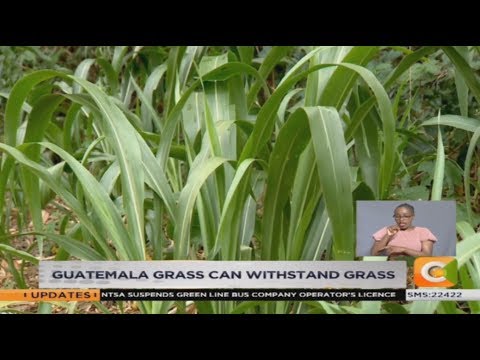
Citizen TV Kenya, Smart Farm: "Dairy farmer shifts to high yielding Guatemala grass". Notice how the grass is grown near the cowshed, cut and carried, and why the farmer chose it.
Practice
Key points
Sources and credits
Written by Ganzaa: the text, the table and the worked examples. Intake and yield figures in the worked examples are typical or illustrative values.
This lesson adapts CC BY-SA material and is shared under CC BY-SA 4.0.