Livestock: Fish and Bees
Senior 3 · Agriculture
Livestock: Fish and Bees
Lesson 3 of 4
25 min
Let's begin
For centuries Rwandan beekeepers have hung hollow logs and woven cylinders in trees and waited for a swarm to move in. Many still do: in 2022 RAB counted about 300,000 traditional hives in the country, against about 75,000 Langstroth hives and 60,000 Kenya top-bar hives. MINAGRI now encourages beekeepers to move to modern hives (Annual Report 2024–2025). To see why, you need to know how each type of hive works, and how a good hive is made and placed.
Definition
Beehive: a container in which a colony of bees is kept.
Fixed-comb hive: a hive whose combs are fixed to the walls and cannot be lifted out, such as a log hive. Movable-comb hive: one in which each comb hangs from a removable bar or frame, so it can be inspected and returned.
Top bar: a wooden bar laid across the top of a hive, from which bees build one comb. Frame: a rectangular wooden support for a comb in a Langstroth hive.
Bee space: a gap of about 6 to 9 mm that bees leave open as a passage; they fill smaller gaps with propolis and bigger ones with comb. Hives are built around it.
Queen excluder: a grid with gaps that workers can pass through but the larger queen cannot, so she cannot lay eggs in the honey boxes.
| Feature | Traditional (log, bark, basket, clay pot) | Kenya top-bar hive (KTBH) | Langstroth (frame) hive |
|---|---|---|---|
| Combs | fixed to the walls | movable, each hanging from a top bar | movable, built in frames, often on a wax foundation sheet |
| Materials and cost | local and cheap | timber or local materials; moderate cost | precise sawn timber; costly; needs an extractor |
| Inspection | almost impossible | easy: lift one bar at a time | easy: lift one frame at a time |
| Harvesting | combs cut out, brood often destroyed, bees disturbed | only honey combs taken; brood left | honey supers removed; combs spun in an extractor and reused |
| Honey quality and yield | low; honey mixed with brood and pollen | good; more honey than traditional hives | highest and cleanest |
| Skill needed | little | moderate | most |
Figure 11. (a) A Kenya top-bar hive in cross-section. (b) The parts of a Langstroth hive.


Worked example 1: how many top bars?
Problem. A top-bar hive is 96 cm long inside, and each bar is 3.2 cm wide. How many bars are needed to cover the top with no gaps?
Solution.
Answer: 30 top bars. If the division does not come out exactly, make the last bar a little wider rather than leave a gap: bees would build comb into any gap wider than the bee space.
Worked example 2: is a modern hive worth it?
Problem. A beekeeper's traditional hive gives about 5 kg of honey a year. A top-bar hive costing 40,000 Frw is expected to give about 15 kg. Honey sells at 5,000 Frw per kg. (All values illustrative.) How long will the top-bar hive take to pay for itself?
Solution.
Answer: under a year. The cleaner honey usually sells at a better price too, which shortens the payback time further.
Warning
Common mistakes. (1) Top bars of the wrong width, or gaps between them: bees join combs together and the hive can no longer be inspected. (2) Placing hives next to a path, a house or a cowshed: people and animals get stung. (3) Painting or treating the inside of a hive: bees reject strong smells and chemicals. (4) Hives standing on the ground: ants, termites, toads and damp ruin the colony.
Tip
Memory hook: "Fixed comb, fixed fate; movable comb, managed colony." Only a movable-comb hive (top-bar or Langstroth) lets you inspect, manage and harvest without destroying the brood.
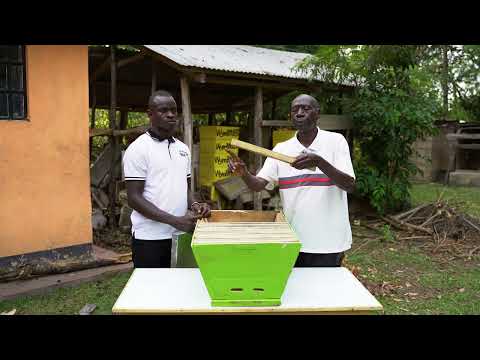
GIZ Kenya and Somalia: "Kenya Top Bar Hive". Look for the sloping sides, the top bars and the entrance, and compare them with Figure 11a.
Practice
Key points
Sources and credits
Written by Ganzaa: the text, the table, Figure 11 and the worked examples. Hive dimensions are typical values; prices and yields in Worked example 2 are illustrative.
This lesson adapts CC BY-SA material and is shared under CC BY-SA 4.0.