Chicken and Pig Rearing
Senior 3 · Agriculture
Chicken and Pig Rearing
Lesson 4 of 4
22 min
Let's begin
In April 2021 a Rwandan photographer caught a familiar scene: a man cycling to market with live chickens tied to his bicycle (photo below). Every time birds or pigs move between farms and markets, and every time a visitor walks from one pen to another, diseases such as Newcastle disease and African swine fever can travel too. Most of these diseases have no cure. What protects a farm is a set of everyday habits: sanitation, keeping the farm clean, and biosecurity, keeping disease out and stopping it from spreading.

Definition
Farm sanitation: keeping animal houses, equipment, feed, water and surroundings clean, so that pathogens and parasites cannot build up.
Biosecurity: all the measures that keep diseases out of a farm and stop them spreading within it or to other farms.
Disinfectant: a chemical that kills pathogens on surfaces, such as a chlorine bleach solution or a commercial farm disinfectant. It works only on surfaces that are already clean.
Isolation (quarantine): keeping new or sick animals apart from the rest, for long enough to see whether they carry disease.
All-in, all-out: putting a whole batch of animals of the same age into a house together and removing them all together, so the house can be emptied, cleaned and rested between batches.
Figure 16. Layout of a biosecure small farm.

Worked example 1: mixing a footbath
Problem. A disinfectant label says: "Use 20 mL of concentrate per litre of water." The footbath holds 15 L. How much concentrate is needed?
Solution.
Answer: 300 mL of concentrate in 15 L of water. Too weak a mix does not kill pathogens; too strong wastes money and can burn skin. Wear gloves when mixing.
Worked example 2: how many broiler batches a year?
Problem. A farmer rears broilers for 6 weeks, then needs 2 weeks to clean, disinfect and rest the house. How many complete batches can he raise in a year (52 weeks)?
Solution.
Answer: 6 batches. Cutting the rest period to squeeze in a seventh batch is tempting, but diseases then pass from one batch to the next, and losses usually cost more than the extra batch earns.
Warning
Safety with disinfectants and dead animals. Read the label; wear gloves, boots and eye protection when mixing; never mix chlorine bleach with other chemicals or acids (poisonous gas); store disinfectants locked away from children, feed and water. Handle carcasses with gloves and wash your hands afterwards: some animal diseases infect people.
Tip
Memory hook: "Keep it out, keep it in, keep it clean." Keep disease out (fence, footbath, isolation, visitor control), keep it in if it arrives (isolate, report, safe disposal), and keep everything clean (daily sanitation, all-in all-out).
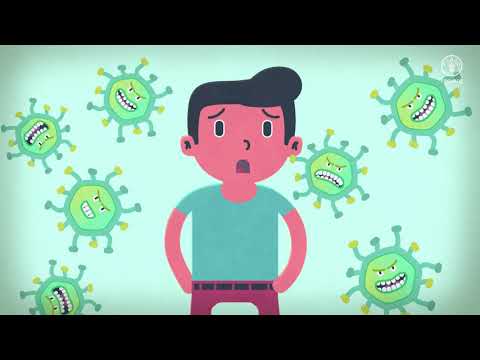
Food and Agriculture Organization of the United Nations (FAO): "Biosecurity is key to stop African Swine Fever - Be a Champion Farmer!". List the biosecurity habits shown and match each to a rule in this lesson.
Practice
Key points
Further reading
Sources and credits
Written by Ganzaa: the text, Figure 16 and the worked examples. The isolation period and rest period are typical values; follow your veterinarian's advice.
This lesson adapts CC BY-SA material and is shared under CC BY-SA 4.0.