Cooperative Farming
Senior 3 · Agriculture
Cooperative Farming
Lesson 3 of 3
22 min
Let's begin
Two rice cooperatives farm neighbouring marshlands. One has a store full of dried, graded paddy, a contract with a mill and members who come to every meeting. The other has empty scales, unpaid loans and members who sell their rice secretly to passing traders. Both have the same law, the same land and the same crop. What makes the difference is how they are run. In Season A 2024 only about 5% of Rwandan farmers who used improved seed got it through a farmers' cooperative (NISR, Seasonal Agricultural Survey 2024): well-run cooperatives could do much more for their members. This lesson looks at how a cooperative is formed and at the factors that decide whether it succeeds.
Definition
Bylaws: the written rules of a cooperative, adopted by its members, on matters such as membership, shares, meetings, elections and the sharing of surplus.
Constituent Assembly: the first meeting of a new cooperative, held before it gains legal personality (Law N° 057 of 2024, Article 10).
Share capital: the money members pay for their shares, which the cooperative uses to start and run its business.
Reserve fund: part of the surplus kept back to strengthen the cooperative, not shared out.
Side-selling: a member selling produce privately, outside the cooperative, after it has arranged a contract or given inputs on credit.
Audit: an independent check of a cooperative's accounts and records.
Figure 23. Steps in forming a cooperative under Law N° 057 of 2024 (Articles 9 and 10).
| Factor | Why it matters | Warning sign |
|---|---|---|
| A real shared need and clear goals | members stay committed when the cooperative solves a problem they all have | members do not know what the cooperative is for |
| Voluntary, active members | people who chose to join attend meetings, deliver produce and pay their shares | empty meetings; side-selling |
| Honest, capable leaders | elected leaders who are trained, accountable and replaced by vote when needed | the same leaders for years; decisions made in secret |
| Transparency and good records | accurate weighing, receipts, books and regular audits build trust | missing money; no accounts shown to members |
| Enough capital | shares, savings and loans pay for stores, inputs and equipment | no money to pay members on delivery |
| Good business management | a business plan, a skilled manager and costs kept below income | buying equipment that is never used |
| Reliable markets | contracts with mills, processors, exporters and institutions | produce left unsold or sold at a loss |
| Education and training | members and leaders understand the bylaws, the business and their rights | members cannot read the accounts or the rules |
| Legal registration and autonomy | legal personality lets the cooperative sign contracts and borrow; members, not outsiders, control it | a donor, trader or official makes the decisions |
| Cooperation and support | unions, extension services, banks and government programmes add strength | the cooperative works alone and stays small |

Worked example 1: raising share capital
Problem. A new vegetable cooperative has 25 founding members. The bylaws require each member to buy 4 shares of 10,000 Frw (illustrative values). How much share capital will it raise?
Solution.
Answer: 1,000,000 Frw, which might buy a solar dryer, crates and scales. Members who own a share of the cooperative's capital have a reason to see it succeed.
Worked example 2: using a surplus
Problem. In a year a cooperative earned 5,400,000 Frw and spent 4,700,000 Frw. Its bylaws (illustrative) put 20% of any surplus into a reserve fund and share the rest among members. How much goes to the reserve and how much to members?
Solution.
Answer: 140,000 Frw to the reserve and 560,000 Frw shared among members. The reserve protects the cooperative in a bad year, so it does not have to borrow or close.
Warning
Common mistakes. (1) Starting a cooperative only to receive a grant: when the grant ends, so does the cooperative. (2) Electing leaders for popularity rather than honesty and skill. (3) Paying members late, which pushes them into side-selling. (4) Keeping no written records. Remember also that under Article 11 only people of at least 16 years may become members of a primary cooperative.
Tip
Exam technique: for "factors that influence the success of a cooperative", give each factor with its reason, for example: "good leadership, because honest, trained leaders manage funds well and keep members' trust". Group them as people (members, leaders), money (capital, records, audits), market (buyers, quality) and rules (registration, bylaws, autonomy).
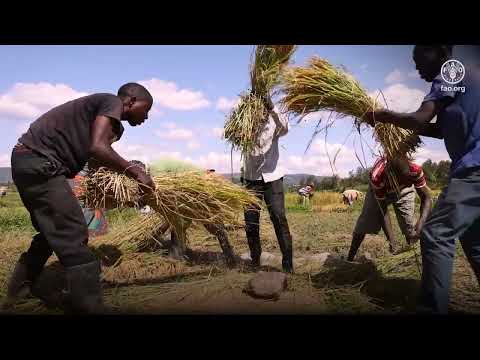
Food and Agriculture Organization of the United Nations (FAO): "Transform Rice production through the Farm Field School (FFS) in Rwanda". Notice how rice farmers learn and decide together in groups: education and cooperation in action.
Practice
Key points
Further reading
Sources and credits
Written by Ganzaa: the text, the table, Figure 23 and the worked examples. Share values and the reserve percentage are illustrative; each cooperative's bylaws set its own.