The Inter-War Period
Senior 6 · History (Languages)
The Inter-War Period
Lesson 2 of 4
25 min
Look closely at the photograph: a crowd fills the pavement and spills into the street outside a bank in New York in 1931. These people are not queuing to borrow. They have heard that the bank may fail, and each one wants to take out his or her savings before the money runs out. If everyone does that at once, even a healthy bank collapses.

Definition
Depression: a long and severe fall in economic activity, with falling prices, closed businesses and mass unemployment. The World Economic Depression (or Great Depression) lasted from 1929 to the late 1930s.
Speculation: buying shares or goods only to sell them quickly at a higher price. In the 1920s many Americans bought shares "on the margin", paying a small part and borrowing the rest.
Bank run: a rush of depositors withdrawing their money because they fear a bank will fail.
Protectionism: shielding a country's producers from foreign competition with tariffs (taxes on imports) or quotas.
| Cause | Explanation |
|---|---|
| An unstable boom in the United States | Factories and farms produced more than people could buy (overproduction), while wealth was spread very unequally. Farm prices were already falling in the 1920s. |
| Speculation and the Wall Street Crash | Share prices rose far above the real value of companies, pushed up by borrowed money. In October 1929 confidence broke: prices crashed on 24 October ("Black Thursday") and 29 October ("Black Tuesday"). |
| Bank failures | Banks that had lent to speculators collapsed; bank runs destroyed savings and cut the credit businesses needed. |
| Europe's dependence on American loans | Under the Dawes Plan (1924) American loans helped Germany pay reparations, and the payments helped Britain and France repay war debts to the United States. When American lenders recalled their money, the circle broke; in May 1931 Austria's largest bank, the Credit-Anstalt, failed. |
| Protectionism | The US Smoot–Hawley Tariff (1930) raised import duties; other countries retaliated, and world trade shrank further. |
Figure 1. Unemployment rose from about one American worker in thirty to one in four in four years, eased, and rose again in 1938.
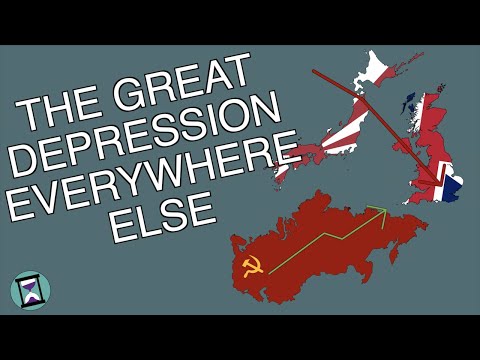
History Matters, "How did the Great Depression affect the rest of the world?" (short animated documentary, about 4 minutes). Watch for how an American crisis travelled to Europe and beyond, and list the links in the chain.
Warning
The Crash was not the whole cause. The Wall Street Crash of October 1929 was the spark. The Depression became deep and worldwide because of overproduction, bank failures, the recall of American loans and protectionism. Write the chain, not just the spark.
Tip
Follow the money in a circle. American loans to Germany → German reparations to Britain and France → their war-debt payments to America. When the first link broke in 1929, every link broke.
Important
Discuss. Was the Depression a cause of the Second World War, or only a condition that made other causes stronger? Keep this question in mind for unit 4.
Practice
Sources and credits
Written by Ganzaa: the chart, the tables, the analysis and the exercises.