Logarithmic and Exponential Equations
Senior 5 · Mathematics
Logarithmic and Exponential Equations
Lesson 4 of 4
25 min
When a quantity changes by the same percentage in each equal time interval, it follows an exponential model, and logarithms answer the question "how long?". This lesson applies the model to four things: a growing town, a radioactive medicine, an ancient piece of charcoal and an earthquake. The last one goes further: the magnitude of an earthquake is itself a logarithm, and so is the planning question "how likely is a large earthquake in the next 30 years?".
Definition
Exponential growth or decay model: , where is the starting value and is the factor per unit of time. If the quantity grows by (as a decimal) each unit, ; if it shrinks by , .
Half-life of a radioactive substance: the time in which half of any sample decays. Then .
Example: a town of 85,000 people growing by 3.2% a year has after years.
Worked example 1: a growing town
A town has 85,000 people and grows by 3.2% a year (illustrative figures). (a) Find its population after 8 years. (b) After how many years will it pass 150,000? (c) Another town grew from 60,000 to 75,000 in 6 years. What was its yearly growth rate?
Solution
Iodine-131 is used in hospitals to diagnose and treat thyroid disease. Its half-life is 8.02 days, so a dose loses half its activity every 8.02 days, whatever its size (Figure 1). To find a time, take logarithms of :
Worked example 2: a medical isotope
A hospital receives iodine-131 with an activity of 200 MBq (megabecquerels). (a) Find its activity after 30 days. (b) How long until it falls to 5% of its first value?
Solution
Living plants and animals take in carbon, including a small, steady share of radioactive carbon-14. When they die, the intake stops and the carbon-14 decays with a half-life of about 5730 years. Measuring the fraction that is left in wood, charcoal or bone gives the time since death. The method works for remains up to about 50,000 years old; after that too little carbon-14 is left to measure.
Worked example 3: dating charcoal
Charcoal from an old furnace contains 79% of the carbon-14 found in living wood (illustrative figure). Estimate its age.
Solution
A sensible answer: less than one half-life, since more than half the carbon-14 is left.
The Richter (local) magnitude of an earthquake is a logarithm. If a standard seismograph 100 km from the centre records a largest wave of amplitude , and is a fixed reference amplitude, then
Each step of 1 in magnitude means 10 times the amplitude. The energy released grows faster: approximately ( in joules), so each step of 1 multiplies the energy by . Scientists now usually quote the closely related moment magnitude, but the logarithmic idea is the same.

Worked example 4: comparing two earthquakes
Earthquake P has magnitude 5.8 and earthquake Q has magnitude 4.3. (a) How many times larger is P's recorded amplitude? (b) How many times more energy did P release? (c) A seismograph records an amplitude 2000 times . What is the magnitude?
Solution
In a given region, small earthquakes are common and large ones rare. Seismologists summarise this with the Gutenberg–Richter law , where is the average number of earthquakes per year with magnitude at least , and and are found from the region's records ( is usually close to 1). If is the probability of at least one such earthquake in a year, and years are independent, then the probability of at least one in years is
Engineers use numbers like these to decide how strongly to build schools, bridges and dams.
Worked example 5: the chance of a large earthquake
In a region with (illustrative values), take the yearly probability of an earthquake of magnitude 5 or more to be . (a) Check for . (b) Find the probability of at least one such earthquake in 30 years. (c) After how many years does that probability first exceed 50%?
Solution
Warning
A magnitude is not a measure you can add. Two earthquakes of magnitude 5 do not make a magnitude-10 event: the energy only doubles, which adds to the magnitude. And "once in 10 years on average" does not mean "exactly every 10 years": the probability of none at all in 10 years is still .
Tip
Check the size of the answer. A decay time to fall below half must exceed one half-life; a fraction above must give an age below one half-life. Rough estimates like these catch most calculator slips.
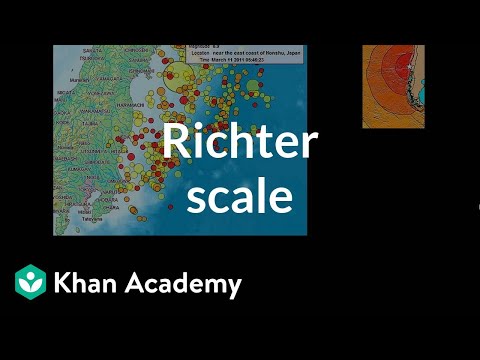
Khan Academy: Richter scale. Watch how the scale compares earthquakes through the logarithm of the wave amplitude, so that one unit of magnitude means ten times the amplitude.
Practice
Data in questions 1, 7 and 8 are illustrative. The last two are harder.
Further reading for this unit
Sources and credits