Damped and Forced Oscillations
Senior 5 · Physics
Damped and Forced Oscillations
Lesson 2 of 3
25 min
Strike a tuning fork and hold it in the air: you hear a faint note that lasts for many seconds. Strike it again and press its stem onto a wooden table: the note is suddenly much louder, but it dies away much sooner. The table is not adding energy; it is helping the fork give its energy away faster, as sound spreading from a large vibrating surface. Where the energy of a damped oscillator goes, and how fast it leaves, decides how long a bell rings, how sharply a radio tunes and how quickly a bridge stops swaying.
From Unit 1, an oscillator's total energy is . With light damping the amplitude decays as , so
The energy decays exponentially at twice the rate of the amplitude. When the amplitude has halved, only a quarter of the energy is left.
Differentiate the mechanical energy with respect to time and use the equation of motion :
So the oscillator loses energy at the rate : fastest where it moves fastest (through equilibrium) and not at all at the extremes, where it is momentarily at rest. This lost mechanical energy does not disappear; the damping force does work on the surroundings, and the energy ends up as internal energy (a tiny rise in temperature of the air, the oil or the spring) and as sound.
Worked example 1: amplitude and energy
A 0.20 kg mass on a spring of stiffness starts with amplitude 10 cm. Some time later its amplitude is 5.0 cm. How much mechanical energy has been converted to other forms?
Solution
and . The energy converted is : 75% of the energy has gone while the amplitude has fallen by only half.
How good is an oscillator at keeping its energy? The fraction lost in one period is
Engineers turn this round and define the quality factor :
A high means light damping: a tuning fork, a bell or the quartz crystal of Unit 1 rings for many cycles. A low means heavy damping: a car suspension, designed to stop bouncing within about one cycle, has of order 1. A useful rule: the amplitude falls to (37%) of its starting value in about cycles.
Definition
The quality factor of an oscillator is times the ratio of the energy stored to the energy lost per cycle. For light damping . Example: the spring in Worked example 1 of Lesson 1 (, ) has .
Aim: to show that the amplitude of a damped oscillator decays exponentially, and to find , and .
Apparatus: a spring, a 400 g slotted mass on a hanger, a light card about 10 cm square fixed under the mass, a clamp stand, a metre rule clamped vertically beside the mass, a stopwatch (or a phone video, which you can step through frame by frame).
Method:
Illustrative results (, ):
| / s | / cm | |
|---|---|---|
| 0 | 10.0 | 2.30 |
| 8 | 7.4 | 2.00 |
| 16 | 5.5 | 1.70 |
| 24 | 4.1 | 1.41 |
| 32 | 3.0 | 1.10 |
| 40 | 2.2 | 0.79 |
The points lie on a straight line, which confirms exponential decay. Its gradient is , so . Then . With , . Repeat with a larger card: rises and falls.
Warning
Safety. Wear eye protection when loading springs: an overloaded spring can snap or fly off its support. Do not stretch the spring beyond its elastic limit, keep the masses low over the bench, and keep your feet clear of the hanging load.
Worked example 2: energy lost per cycle
Using the results of Experiment 2.1, find (a) the fraction of the energy lost in one cycle, (b) the time for the energy to halve.
Solution
(a) : about 6% per cycle. (Check: .)
(b) gives , about 11 oscillations. The amplitude takes twice as long, 18 s, to halve.
Warning
Common mistakes. (1) Using the amplitude's decay rate for the energy: energy decays as , twice as fast. (2) Saying the damped energy is "destroyed": it is transferred to internal energy and sound. (3) Plotting against and trying to read from a curve; plot to get a straight line. (4) Mixing , and : write down which one the question asks for.
Tip
"Energy goes as amplitude squared" settles most damping questions in one line: amplitude down to 0.9 means energy down to , so 19% of the energy has gone.
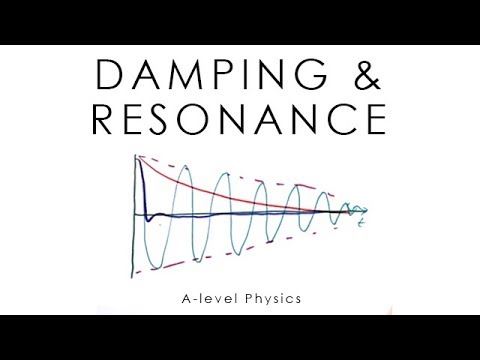
Damping and resonance: A-level Physics (Science Shorts). Watch for how the amplitude envelope shrinks under light, critical and heavy damping, and how damping changes the resonance peak you will meet in the next lesson.
Practice
Key points
Sources and credits
The experiment and its illustrative results, the three diagrams, the worked examples and the practice exercises are written by Ganzaa.