Propagation of Mechanical Waves
Senior 5 · Physics
Propagation of Mechanical Waves
Lesson 4 of 4
25 min
The inanga, Rwanda's trough zither, has strings stretched along a carved wooden trough. When the player plucks a string, a pulse runs to each end, reflects, and comes back; within a fraction of a second the string settles into stationary waves whose frequencies decide the note you hear, while the hollow trough helps the vibration reach the air. A guitar, a violin and a piano work the same way. Why does a shorter, tighter or thinner string give a higher note? This lesson answers with two results: the speed of a wave on a string, and the condition that the stationary wave must fit between the fixed ends.

Send a small pulse along a string under tension with mass per unit length . Watch it from a frame moving with the pulse at speed : the pulse stands still and the string streams through it at speed . Near the top of the pulse, a short element of length follows an arc of radius , subtending an angle at the centre, so .
The tension pulls on each end of the element along the string. The horizontal components cancel, and the vertical components add to a force towards the centre:
This force provides the centripetal acceleration of the element's mass :
Both and cancel, so every small pulse, of any shape, travels at the same speed. A tighter string gives a larger restoring force and a faster wave; a heavier string has more inertia and a slower one.
Both ends are clamped, so both must be nodes. A stationary wave can fit only if the length holds a whole number of loops, each long:
The lowest, , is the fundamental frequency or first harmonic. The others are whole-number multiples: . The frequencies above the fundamental are also called overtones (the 2nd harmonic is the 1st overtone, and so on). A plucked or bowed string vibrates in several modes at once; the fundamental sets the pitch, and the mixture of harmonics, different for an inanga, a guitar and a violin, gives each instrument its quality or timbre.
From :
| Law | Keeping fixed | Statement |
|---|---|---|
| length | , | : halve the length, double the frequency (an octave up) |
| tension | , | : four times the tension doubles the frequency |
| mass per unit length | , | ; for a wire of radius and density , , so |
This is how string players tune and play: they tighten a peg to raise the tension, press a finger down to shorten the vibrating length, and use thicker strings for the low notes.
Definition
The harmonics of a string fixed at both ends are its natural frequencies , . The fundamental () is the lowest; the higher harmonics are whole-number multiples of it. Example: a string with fundamental 110 Hz also vibrates at 220 Hz, 330 Hz, 440 Hz, and so on.
Worked example 1: tuning a guitar string
The highest string of a guitar has a vibrating length of 0.65 m and a mass per unit length of . What tension gives a fundamental of 330 Hz?
Solution
. Then , roughly the weight of a 7.5 kg mass, on one thin string.
Worked example 2: harmonics and changing tension
(a) For the string of Worked example 1, list the first three harmonics. (b) A guitarist touches the string lightly at its midpoint while plucking. Which harmonic sounds loudest, and why? (c) If the tension rises by 21%, by what percentage does the fundamental rise?
Solution
(a) 330 Hz, 660 Hz, 990 Hz.
(b) The finger forces a node at the midpoint. Only modes with a node there survive: . The lowest of these, 660 Hz, is loudest: the note jumps up an octave. Guitarists call this a natural harmonic.
(c) : , so the frequency rises by 10%.
Aim: to verify that at constant tension, and to find the speed of waves on the wire and its mass per unit length.
Apparatus: a sonometer (a wire over a hollow wooden box, with two movable bridges and a pulley), a 5.0 kg load (tension ), a set of tuning forks of known frequency, small paper riders, a metre rule.
Method:
Illustrative results ():
| / Hz | / m | / |
|---|---|---|
| 256 | 0.433 | 2.31 |
| 288 | 0.383 | 2.61 |
| 320 | 0.347 | 2.88 |
| 384 | 0.289 | 3.46 |
| 426.7 | 0.258 | 3.88 |
| 512 | 0.217 | 4.61 |
The points lie on a straight line through the origin, confirming . Since , the gradient equals , so , and , about 1 g per metre.
Warning
Safety. A sonometer wire is under large tension and can snap: wear eye protection, add load gently rather than dropping masses onto the hanger, and keep feet clear of the hanging load. Strike tuning forks on a rubber pad, never on the bench or the sonometer.
Warning
Common mistakes. (1) Using for the fundamental: it is . (2) Using the mass of the whole string, or its density, instead of in ; convert g per m to kg per m. (3) Thinking : it is . (4) Confusing the speed of the wave on the string with the speed of the sound it makes in air: they share the frequency, not the speed or the wavelength.
Tip
For any string question, write the master formula first. Then every "what happens if" question is a ratio: cross out what stays fixed and compare what changes.
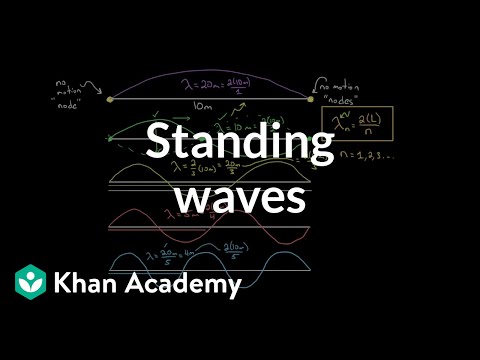
Standing waves on strings (Khan Academy). Watch how the requirement of a node at each end picks out the allowed wavelengths 2L, L, 2L⁄3 and so on, and leads to fₙ = nv ÷ 2L.
Practice
Key points
Further reading
Sources and credits
The experiment and its illustrative results, the four diagrams, the worked examples and the practice exercises are written by Ganzaa.