Magnetic Field and Magnetic Forces
Senior 5 · Physics
Magnetic Field and Magnetic Forces
Lesson 1 of 4
25 min
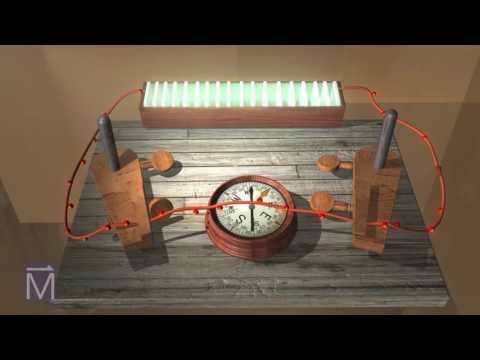
In April 1820, during a lecture in Copenhagen, Hans Christian Ørsted noticed that a compass needle swung when he switched on a current in a nearby wire. It was the first evidence that electricity and magnetism are connected: an electric current produces a magnetic field. Within months André-Marie Ampère, Jean-Baptiste Biot and Félix Savart had found the laws that give the size of that field. Those laws, which this lesson develops, are used today to design every electromagnet, loudspeaker, MRI scanner and electric motor.

A magnetic field is the region round a magnet or a current in which a magnetic force acts on another magnet, on a moving charge or on a current. It is a vector quantity, the magnetic flux density , measured in teslas (T); its exact definition, from the force on a moving charge, comes in the next lesson. Field lines show its direction (the way the north pole of a small compass points) and their spacing shows its strength.
Every magnetic field is produced by moving electric charge:
| Source | Typical B |
|---|---|
| Earth's surface | about T |
| Fridge magnet | about T |
| Strong neodymium magnet | about 1 T |
| Hospital MRI scanner | 1.5 T to 3 T |
Ørsted's field forms circles round the wire. Their direction is given by the right-hand grip rule: grip the wire with your right hand, thumb pointing along the conventional current, and your fingers curl in the direction of the field.
The size of the field is given by Ampère's law: around any closed path, the sum of (the component of along the path times each small length) equals times the current enclosed,
where is the permeability of free space. For a circle of radius centred on a long wire, is the same all the way round and always along the path, so :
The field is proportional to the current and inversely proportional to the distance.
Definition
Magnetic flux density is the vector that measures the strength and direction of a magnetic field; its unit is the tesla (T). The permeability of free space is the constant that links a current to the field it produces in a vacuum (air is almost the same). Example: 1.0 A in a long wire gives T at 1.0 cm.
Worked example 1: a wire beside a compass
A long straight wire carries 10 A. (a) Find the field 5.0 cm from it. (b) Compare it with the Earth's field (about T near the equator). (c) Two such wires, 10 cm apart, carry 5.0 A in opposite directions. Find the field midway between them.
Solution
(a) T.
(b) It is comparable with the Earth's field, so a compass placed there swings well away from north, as in Ørsted's lecture.
(c) Each wire gives T at the midpoint. By the grip rule, opposite currents give fields in the same direction between the wires, so they add: T. (With currents in the same direction the two fields would cancel there.)
For shapes without enough symmetry for Ampère's law, the Biot–Savart law gives the field of each small piece of a wire carrying current , at distance :
where is the angle between and the line to the point. At the centre of a circular loop of radius , every piece is at distance and at right angles to the radius (), and every piece's field points the same way, along the axis. Adding the pieces, :
For a flat coil of turns, .
A solenoid is a long coil. Inside it the fields of the turns add to give a strong, almost uniform field along the axis; outside, the field is weak and has the shape of a bar magnet's field.
Apply Ampère's law to a rectangle of length with one side inside the solenoid along the axis and the other far outside. Only the inside side contributes, , and the rectangle encloses turns, where is the number of turns per metre. So , and
The field is independent of the solenoid's radius and of the position inside it, except near the ends, where it falls to half. Filling the solenoid with soft iron multiplies the field by hundreds or thousands: that is an electromagnet.
Worked example 2: a coil and a solenoid
(a) A flat circular coil of 50 turns and radius 10 cm carries 2.0 A. Find the field at its centre. (b) A solenoid 40 cm long has 800 turns and carries 3.0 A. Find the field inside it.
Solution
(a) T.
(b) turns per metre; T, about 150 times the Earth's field, and uniform over most of the inside.
Worked example 3: designing a field
A student wants a field of T at 2.0 cm from a long straight wire. What current is needed? Explain why the experiment should be done with the wire running north–south.
Solution
A.
A wire running north–south makes a field that is east–west at a compass placed beside or below it, at right angles to the Earth's horizontal field, so the needle's deflection shows the effect clearly. (Equal fields at right angles would turn the needle through 45°.)
Warning
Which formula? is for a long straight wire at distance ; is only for the centre of a flat coil; is for inside a long solenoid, with in turns per metre. Mixing them up, or forgetting to convert cm to m, are the commonest errors.
Warning
Safety. Short pieces of thick wire connected straight across a cell or a low-voltage supply carry very large currents and get hot quickly. Use a rheostat or a current-limited supply, and switch off between readings.
Tip
Coil polarity trick: look at the end of a coil. If the current flows anticlockwise, that end is a North pole; if clockwise, a South pole (draw an N or S with arrows on its tips to remember).
What Oersted Discovered with his Compass, National MagLab. Watch the compass needle swing when the current is switched on, and reverse when the current is reversed.
Practice
Key points
Sources and credits
Written by Ganzaa. The two field diagrams, the worked examples and the practice exercises are by Ganzaa.