Introduction to the Special Theory of Relativity
Senior 5 · Physics
Introduction to the Special Theory of Relativity
Lesson 1 of 4
25 min
Sit in a bus travelling smoothly at a steady 60 km h⁻¹ on the road to Musanze, curtains drawn. Toss a coin straight up: it falls straight back into your hand, exactly as it would at the bus stop. Pour water into a cup: it fills just as at home. No experiment done inside the bus can tell you whether the bus is moving steadily or standing still. Galileo made the same point in 1632, with a ship's cabin full of butterflies and dripping bottles. This simple idea, that steady motion cannot be detected from the inside, is the starting point of the theory of relativity.
Physics describes events: things that happen at a particular place at a particular instant, such as a flash of lightning or a ball hitting the ground. To give an event its coordinates , an observer needs a frame of reference: a set of axes to measure position and a set of clocks to measure time.
An inertial frame is one in which Newton's first law holds: a body with no resultant force on it stays at rest or moves in a straight line at constant speed. Any frame moving at constant velocity relative to an inertial frame is also inertial. A frame that accelerates or rotates (a bus braking, a merry-go-round) is non-inertial: in it, objects appear to be pushed by forces that nothing exerts. The surface of the Earth is very nearly inertial for most experiments.
The Galilean principle of relativity states that the laws of mechanics are the same in every inertial frame. There is no experiment in mechanics that picks out one inertial frame as truly "at rest".
Definition
An event is an occurrence at a definite point in space and instant in time, with coordinates . A frame of reference is a coordinate system with clocks, used by an observer to measure where and when events happen. An inertial frame is a frame in which Newton's first law holds; it moves at constant velocity relative to any other inertial frame. Example: a bus moving steadily in a straight line is an inertial frame; the same bus going round a bend is not.
Let frame S′ move with constant velocity along the -axis of frame S, with the origins together at . An event has coordinates in S and in S′.
At time the origin of S′ is a distance along the -axis, so . In Newton's physics, time is the same for everyone. The Galilean transformation equations are therefore
Differentiating with respect to time gives the Galilean velocity addition rule and shows that accelerations are the same in both frames:
Since the acceleration is the same and masses are the same, holds in both frames: Newton's laws are unchanged by a Galilean transformation, as the principle of relativity requires. Distances and time intervals are also the same in both frames.
Worked example 1: velocities in a bus
A bus moves along a straight road at 15 m s⁻¹. A passenger walks towards the front at 1.5 m s⁻¹ relative to the bus. (a) What is her velocity relative to the road? (b) A car travelling at 25 m s⁻¹ in the opposite direction passes the bus. What is its velocity relative to the bus?
Solution
Take the road as S, the bus as S′, with m s⁻¹.
(a) m s⁻¹ forwards.
(b) m s⁻¹, so m s⁻¹: the car approaches the bus at 40 m s⁻¹.
Worked example 2: transforming an event
Frame S′ moves at 20 m s⁻¹ along the -axis of S, and the origins coincide at . A firework explodes at m, m, s in S. Find its coordinates in S′.
Solution
m; m; s.
In 1865 James Clerk Maxwell showed that electric and magnetic fields can travel as a wave whose speed follows from two constants of electricity and magnetism:
This was exactly the measured speed of light: light is an electromagnetic wave. But the speed relative to what? By the Galilean rule , an observer moving towards a light beam at speed should measure , and one moving away should measure . Physicists assumed that light travels at relative to an invisible medium filling space, the ether, and that the Earth, orbiting the Sun at about 30 km s⁻¹, must move through it.
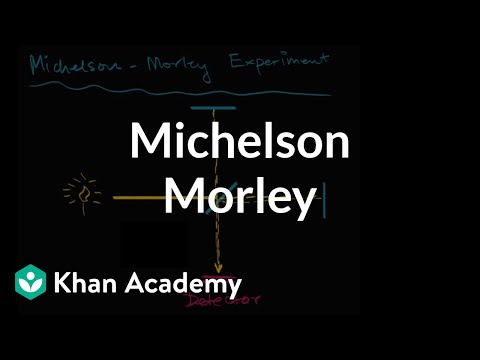
In 1887 Albert Michelson and Edward Morley tried to measure the Earth's motion through the ether. Their interferometer split a beam of light into two beams that travelled along perpendicular arms and back, then recombined them to make interference fringes. A beam travelling along the "ether wind" and back should take slightly longer than one travelling across it. Turning the apparatus through 90° swaps the arms, and should shift the fringes. With arms effectively 11 m long, they expected a shift of about 0.4 of a fringe. They found less than a twentieth of that: no ether wind at all. Repeated at different times of day and year, and with ever greater precision since, the result is always the same: the speed of light is the same in every direction, whatever the motion of the Earth.

Worked example 3: the expected fringe shift
For a Michelson interferometer with arms of length , moving through the ether at speed , the expected fringe shift when it is rotated through 90° is approximately . Calculate it for m, m s⁻¹ and nm.
Solution
A shift of 0.4 of a fringe was easy to see with their apparatus. Its absence was a real result, not a failure of sensitivity.
Warning
"No ether" is not "no light". The Michelson–Morley result does not mean their light was faulty. It means the Galilean rule fails for light. Either Maxwell's theory or Galileo's transformation had to change. Einstein's answer, in the next lesson, was to keep Maxwell and change our ideas of space and time.
Tip
Galileo's rule in one line: positions shift by , velocities shift by , and time and acceleration do not change at all. Everything in relativity is a correction to this line.
Michelson–Morley Experiment introduction, Khan Academy. Watch how the two perpendicular beams were expected to take different times if the Earth moved through an ether.
Practice
Key points
Sources and credits
Written by Ganzaa. The two diagrams, the worked examples and the practice exercises are by Ganzaa.