Alkenes and Alkynes
Senior 5 · Chemistry
Alkenes and Alkynes
Lesson 2 of 5
25 min
Nearly all the world's ethene comes from cracking ethane and naphtha from oil and gas (Unit 2). But in southern Brazil, a plant has made ethene from sugar-cane ethanol since 2010, by passing ethanol vapour over a hot catalyst so that each molecule loses a molecule of water. The ethene is then polymerised to "green" poly(ethene). Removing a small molecule such as water or hydrogen bromide from neighbouring carbon atoms is the standard way to make a C=C bond in the laboratory.
Definition
Elimination reaction: a reaction in which a small molecule (, HX) is removed from two neighbouring carbon atoms, leaving a double bond between them.
Dehydration: elimination of water, here from an alcohol. Dehydrohalogenation: elimination of a hydrogen halide from a halogenoalkane.
Carbocation: an ion with a positive charge on a carbon atom that has only three bonds. Example: , a secondary carbocation.
Zaitsev's rule: when an elimination can give more than one alkene, the major product is the more substituted alkene (the one with more alkyl groups on the C=C carbons), because it is more stable.
An alcohol loses water when heated with concentrated sulfuric acid or phosphoric acid, or when its vapour is passed over hot aluminium oxide:
Phosphoric acid is often preferred: concentrated sulfuric acid is also an oxidising agent and chars the alcohol, giving carbon, sulfur dioxide and carbon dioxide as impurities. The temperature matters: with excess ethanol at about 140 °C the main product is an ether, ethoxyethane (Unit 5). Tertiary alcohols dehydrate most easily, then secondary, then primary.
Figure 2.1: Acid-catalysed dehydration of propan-2-ol, by way of a carbocation. Each full-headed curly arrow shows a PAIR of electrons moving.
The acid is a catalyst: the used in step 1 is given back in step 3. Step 2 is the slow step, and it is easiest when a stable carbocation forms (tertiary > secondary > primary), which is why tertiary alcohols react fastest.
A halogenoalkane heated under reflux with potassium hydroxide dissolved in ethanol loses HX:
Figure 2.2: One-step elimination (E2): the base removes H⁺ from the carbon next to the C–Br carbon as the bromide ion leaves.
The same reagents in water, warmed gently, give mainly the alcohol by substitution instead (Unit 4). In ethanol, and at a higher temperature, the hydroxide ion acts mainly as a base, removing , and elimination wins.
Zinc dust warmed with a 1,2-dihalogenoalkane in ethanol removes both halogen atoms: . This is mainly used to recover an alkene after its double bond has been protected.
Butan-2-ol can lose an H from C1 or from C3:
| H removed from | Alkene | Alkyl groups on C=C | Amount |
|---|---|---|---|
| C3 | but-2-ene, (E and Z) | 2 | major |
| C1 | but-1-ene, | 1 | minor |
2-bromobutane with ethanolic KOH gives the same pattern. Industrially, ethene and propene come from cracking; elimination is a laboratory method.
Worked example
Problem. 2-methylbutan-2-ol, , is heated with concentrated phosphoric acid. Name the two alkenes formed and say which is the major product.
Solution. The OH is on C2. Hydrogen can be lost from C1 (or the identical methyl branch) or from C3.
Being a tertiary alcohol, it dehydrates easily, through the tertiary carbocation .
Worked example
Problem. 9.20 g of ethanol is dehydrated and 2.88 of ethene is collected at room temperature and pressure (molar volume ). Calculate the percentage yield.
Solution. , so mol. One mole of ethanol gives one mole of ethene, so the maximum is 0.200 mol, or .
Yield .
Warning
Safety. Concentrated sulfuric and phosphoric acids are corrosive, and ethene and ethanol are flammable: heat with a heating mantle or sand bath, never an open flame near the vapour. Fit a delivery tube with a safety trap, and remove it from the water before you stop heating so that water cannot suck back into the hot flask. If acid reaches the skin or eyes, rinse with plenty of water for at least 15 minutes and get medical help.
Tip
Zaitsev in one line: "the poor get poorer". The H is removed from the neighbouring carbon that already has FEWER hydrogens, giving the alkene with the most alkyl groups on the double bond.
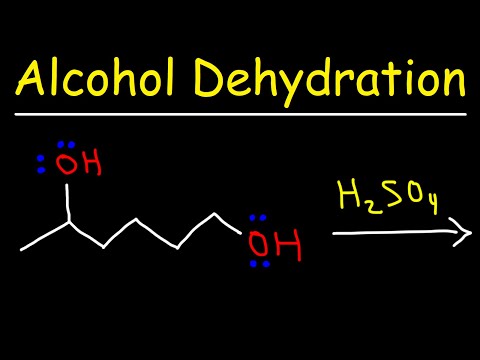
The Organic Chemistry Tutor: Alcohol Dehydration Reaction Mechanism With H2SO4 (17 min). Watch the three steps of the mechanism, how the most stable carbocation forms, and how Zaitsev's rule picks the major alkene.
Practice
Sources and credits