Halogenoalkanes (Alkyl Halides)
Senior 5 · Chemistry
Halogenoalkanes (Alkyl Halides)
Lesson 4 of 4
25 min
From 10 to 15 October 2016, the countries of the Montreal Protocol met in Kigali and agreed the Kigali Amendment, a timetable for cutting the production and use of hydrofluorocarbons (HFCs), the gases in most refrigerators and air conditioners. HFCs had been brought in to replace the chlorofluorocarbons (CFCs) that were destroying the ozone layer. They do not harm ozone, but they are powerful greenhouse gases. The story of these halogenoalkanes, from wonder chemicals to banned pollutants, shows why chemists must think about a compound's whole life, not only its usefulness.
Definition
Chlorofluorocarbon (CFC): a compound of carbon, chlorine and fluorine only, such as dichlorodifluoromethane, . HCFCs also contain hydrogen; HFCs (hydrofluorocarbons) contain hydrogen and fluorine but no chlorine, such as 1,1,1,2-tetrafluoroethane, (HFC-134a).
Ozone layer: the region of the stratosphere, about 15–35 km up, where ozone, , absorbs most of the Sun's harmful ultraviolet radiation.
Silver nitrate solution gives no precipitate with a halogenoalkane on its own, because the halogen is covalently bonded, not present as a halide ion. It must first be released by hydrolysis.
Figure 4.1: Identifying the halogen. The colour of the silver halide, and whether it dissolves in ammonia, tell you which halogen was present.
The nitric acid is essential: without it, the hydroxide ions left over would react with silver ions to give a brown precipitate of silver oxide, hiding the result. Hydrochloric or sulfuric acid cannot be used, because their anions would themselves precipitate with silver ions.
If silver nitrate dissolved in aqueous ethanol is added to halogenoalkanes at about 50 °C, water acts as the nucleophile, and the time taken for the precipitate to appear measures the rate. 1-iodobutane gives a yellow precipitate within a minute or so, 1-bromobutane a cream one more slowly, and 1-chlorobutane only a faint white cloudiness after a long time: the order follows the C–X bond enthalpies. Among isomeric bromobutanes, the tertiary one reacts fastest, because it ionises (SN1).
| Use | Examples | Why that compound |
|---|---|---|
| solvents | dichloromethane (paint stripper, extraction), tetrachloroethene (dry cleaning) | dissolve organic substances; not flammable |
| anaesthetics | halothane, , in use from 1956; chloroform earlier | volatile, inert, act on the nervous system |
| refrigerants, aerosol propellants | CFCs (now banned), then HCFCs and HFCs | boil near room temperature, non-toxic, non-flammable |
| polymers | chloroethene → PVC; tetrafluoroethene → PTFE | Unit 3 |
| fire extinguishers | halons such as (now banned) | very effective, but destroy ozone |
| pesticides | DDT (banned for farming, still allowed for indoor mosquito control under strict rules) | toxic to insects, but persists and builds up in food chains |
| synthesis | bromo- and iodoalkanes | easily substituted: to alcohols, nitriles, amines, Grignard reagents |

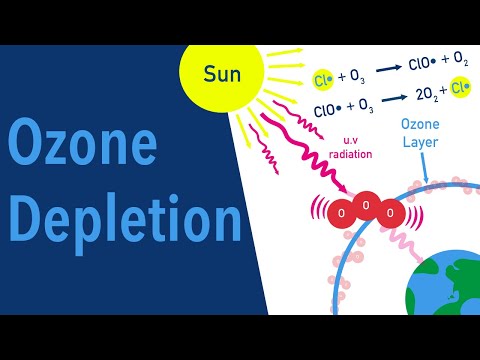
CFCs seemed ideal: unreactive, non-toxic and non-flammable. But their stability is the problem. They are not broken down in the lower atmosphere or washed out by rain, so they drift up into the stratosphere over several years. There, ultraviolet light breaks the C–Cl bond (the C–F bond is too strong), releasing chlorine radicals: .
Figure 4.2: One chlorine atom can go round this cycle many thousands of times, so it acts as a catalyst for ozone destruction.
Because the chlorine atom is regenerated, the US Environmental Protection Agency estimates that one chlorine atom can destroy over 100 000 ozone molecules before it is removed. Thinner ozone lets more UV-B reach the ground, raising the risk of skin cancer and cataracts and damaging crops. Over Antarctica, ozone falls so low each southern spring that an "ozone hole" appears.

The Montreal Protocol, agreed on 16 September 1987, phased out CFCs and halons, first in richer countries and then worldwide. The ozone layer is now slowly recovering; the 2023 scientific assessment for the United Nations expects the Antarctic ozone hole to close around 2066. The replacements, HFCs, contain no chlorine, so they do not destroy ozone, but many trap heat thousands of times more strongly than carbon dioxide. That is why the 2016 Kigali Amendment now phases them down in favour of refrigerants such as ammonia, carbon dioxide and small hydrocarbons.
Worked example
Problem. A halogenoalkane Y, , is warmed with NaOH(aq), acidified with dilute nitric acid and treated with silver nitrate. A cream precipitate forms; it dissolves in concentrated ammonia but not in dilute ammonia. Y reacts with aqueous silver nitrate in ethanol much faster than its unbranched isomers. Identify Y.
Solution. A cream precipitate soluble only in concentrated ammonia is silver bromide, so X is Br. The fastest-reacting isomer of is the tertiary one, which ionises by SN1: Y is 2-bromo-2-methylpropane, .
Worked example
Problem. Evaluate three possible refrigerants for a new cold store: (a CFC), (an HFC) and 2-methylpropane (a hydrocarbon).
Solution. is banned: UV light releases Cl• from it in the stratosphere, which destroys ozone catalytically. has no C–Cl bond, so it does not harm ozone, but it is a powerful greenhouse gas being phased down under the Kigali Amendment. 2-methylpropane harms neither ozone nor, much, the climate, but it is flammable, so the cold store needs leak-proof equipment and no sparks. On environmental grounds the hydrocarbon (or ammonia, or carbon dioxide) is the best choice, provided the fire risk is managed.
Warning
Acidify with nitric acid, and only nitric acid. Hydrochloric acid would add and give a false white precipitate; sulfuric acid can precipitate silver sulfate. Silver nitrate stains skin black and is harmful to the eyes: wear eye protection, and rinse any splash with plenty of water for at least 15 minutes.
Tip
Silver halides: Cl – white, Br – cream, I – yellow; solubility in ammonia falls in the same order (dilute, concentrated, none). In ozone depletion, the radical that does the damage is Cl•, never F•.
Chemistry Student: Ozone Depletion and CFCs: Free Radical Breakdown of O3 into O2 (6 min). Watch how UV light breaks the C–Cl bond and how the two propagation steps regenerate the chlorine radical.
Practice
Further reading
Sources and credits