Nucleic Acids and DNA Replication
Senior 5 · Biology
Nucleic Acids and DNA Replication
Lesson 5 of 5
25 min
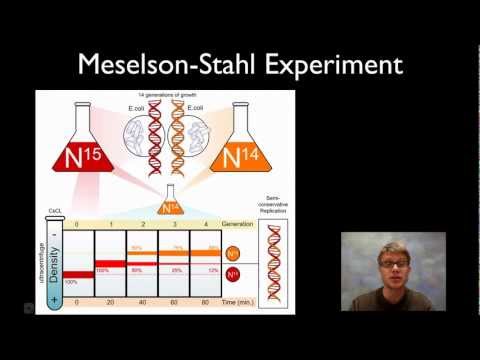
Watson and Crick suggested in 1953 that each strand of DNA serves as a template for a new partner, so that every copy keeps one old strand. This is semi-conservative replication. It was an attractive idea, but other schemes were possible, and an idea is not evidence. In 1958 Matthew Meselson and Franklin Stahl, at the California Institute of Technology, designed an experiment to tell the possibilities apart. It is often called the most beautiful experiment in biology. This lesson also looks at a problem the copying machinery cannot solve at the ends of chromosomes, and how cells deal with it.
Definition
Isotope: an atom of the same element with a different number of neutrons. Nitrogen-15 (¹⁵N) is heavier than ordinary nitrogen-14 (¹⁴N); both are built into the bases of DNA.
Density-gradient centrifugation: spinning a sample at very high speed in a solution, here caesium chloride, that becomes denser towards the bottom of the tube. Each molecule settles at the level where the solution matches its own density, forming a band.
Worked example 1: predicting later generations
Using the semi-conservative model, predict the percentages of hybrid and light DNA molecules after (a) 3 generations, (b) 4 generations in ¹⁴N.
Check against Figure 2: in generation 3 the light band is three times as thick as the hybrid band (75 : 25).
Definition
Telomere: a region of repeated, non-coding DNA at each end of a linear chromosome; in humans and other vertebrates the repeated sequence is TTAGGG.
Telomerase: an enzyme that adds telomere repeats to the ends of chromosomes, using an RNA template that is part of the enzyme.
Bacteria have circular chromosomes, which have no ends. Eukaryotic chromosomes are linear, and their ends cause a problem, the end-replication problem. On the lagging strand, the last Okazaki fragment begins with an RNA primer at the very tip of the chromosome. When that primer is removed, DNA polymerase cannot fill the gap, because it can only add nucleotides to an existing 3′ end and there is none beyond the gap. So each new strand is a little shorter than its template, and the chromosome loses some DNA from its ends at every replication.
Telomeres solve the problem in two ways. They are long runs of a short repeat, several thousand base pairs long in humans, so what is lost at each division is repeat DNA, not genes. And with special proteins they form a cap that stops the cell's repair systems from treating the chromosome ends as broken DNA and joining chromosomes together.
In most human body cells telomeres shorten with every division. In 1961 Leonard Hayflick found that normal human cells grown in culture stop dividing after about 40 to 60 divisions. Short telomeres are one cause of this limit: when the telomeres become too short, the cell stops dividing. Some cells must go on dividing for a lifetime: germ cells that make sperm and eggs, and stem cells. They use telomerase to rebuild their telomeres. Most cancer cells also switch telomerase on, which lets them divide without limit. Elizabeth Blackburn, Carol Greider and Jack Szostak shared the 2009 Nobel Prize in Physiology or Medicine for discovering how telomeres and telomerase protect chromosomes.
Worked example 2: how many divisions?
Illustrative figures: a cell's shortest telomere is 9 000 base pairs long and loses 120 base pairs at each division. The cell stops dividing when the telomere falls to 3 000 base pairs. How many more divisions can it make?
This is close to the Hayflick limit. With telomerase active, the telomere is rebuilt after each division, and the count never runs down.
Bozeman Science: "Meselson-Stahl Experiment". Watch for how each of the three hypotheses predicts different bands, and which result rules out each wrong model.
Warning
Common mistakes
Tip
Answering Meselson–Stahl questions: draw the molecules strand by strand for each generation, colouring old strands and new strands differently, then sort the molecules into heavy, hybrid and light. The bands follow directly.
Practice: the evidence and telomeres
Key points
Further reading
Sources and credits
Figures 1 to 3, the worked examples and the practice questions are written by Ganzaa. The telomere figures in Worked example 2 are illustrative.