Transport in Plants
Senior 5 · Biology
Transport in Plants
Lesson 3 of 4
25 min
Weigh a potted maize plant in the morning and again in the afternoon, and it will be lighter, although it has grown. Almost all the water a plant takes from the soil, often well over nine-tenths of it, is not used in photosynthesis or growth but evaporates from the leaves into the air. This loss is transpiration. It is the "engine" of the cohesion–tension mechanism you met in the last lesson. This lesson shows how to measure it and why its rate changes from hour to hour.
Definition
Transpiration: the loss of water vapour from the aerial parts of a plant, mainly through the stomata of the leaves.
Transpiration stream: the continuous movement of water from the roots, up the xylem, to the leaves, where it evaporates.
Stoma (plural stomata): a pore in the epidermis, mainly of the leaf, bounded by two guard cells that open and close it.
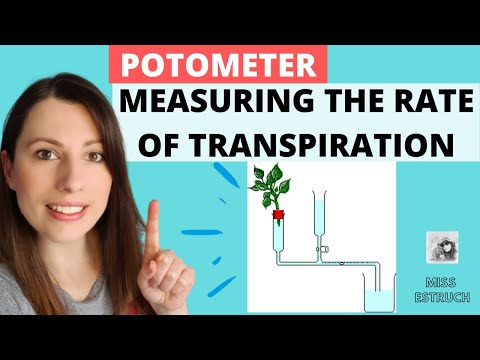
Potometer: an instrument that measures the rate at which a cut shoot takes up water, which is used to estimate its rate of transpiration.
Inside the leaf, water evaporates from the wet walls of the spongy mesophyll cells into the air spaces. The air spaces become nearly saturated with water vapour, so water vapour diffuses out through the stomata to the drier air outside, down a water vapour potential gradient.
Transpiration is often called an unavoidable consequence of gas exchange. To photosynthesise, a leaf must open its stomata to let carbon dioxide in, and whenever they are open water vapour escapes. Yet it also brings benefits:
The cost is that a plant that loses water faster than its roots can absorb it will wilt, close its stomata and stop photosynthesising.
Method (Figure 6):
A potometer really measures water uptake, not water loss. The two are nearly equal, but not exactly: a little water is used in photosynthesis and in keeping cells turgid. A mass potometer, in which the whole plant and its pot stand on a balance, measures the water actually lost, provided the soil surface is covered so that no water evaporates from it.
Worked example 1: from bubble distance to a rate
In a potometer, the bubble moves 36 mm in 5.0 minutes. The capillary tube has an internal radius of 0.50 mm. The shoot's leaves have a total area of 48 cm². Calculate (a) the volume of water taken up, (b) the rate of uptake, (c) the rate per unit leaf area.
Why (c) matters: two shoots of different sizes can only be compared fairly per unit of leaf area. Leaf area can be found by drawing round the leaves on squared paper.
| Factor | Effect on rate | Explanation |
|---|---|---|
| Light intensity | Rises in light | Stomata open in the light for photosynthesis, so more water vapour diffuses out. In the dark most stomata close. |
| Temperature | Rises with temperature | Water molecules have more kinetic energy, so evaporation and diffusion are faster; warm air can also hold more water vapour, so the gradient out of the leaf is steeper. |
| Humidity | Falls as humidity rises | Moist air outside reduces the water vapour gradient between the air spaces and the air. |
| Wind (air movement) | Rises with wind, up to a point | Wind blows away the layer of still, humid air next to the leaf surface, keeping the gradient steep. In very strong wind some plants close their stomata. |
| Soil water | Falls when soil is dry | The plant cannot replace water fast enough; the hormone abscisic acid (ABA) makes the stomata close. |
The structure of the plant matters too: the leaf area, the thickness of the cuticle, and the number and position of the stomata. Many plants have more stomata on the lower surface of the leaf, which is cooler and shaded. The next lesson shows how plants of dry places use these features.
Worked example 2: interpreting a potometer experiment
A class tests one shoot under four conditions, with a capillary of internal radius 0.40 mm, timing each run for 10 minutes. Illustrative results:
| Condition | Mean distance moved by bubble / mm | Rate / mm³ min⁻¹ |
|---|---|---|
| A: shade, still air | 12 | 0.60 |
| B: bright light, still air | 30 | 1.51 |
| C: bright light, fan blowing | 55 | 2.76 |
| D: bright light, shoot covered by a clear plastic bag | 6 | 0.30 |
Control variables: the same shoot, the same temperature, and a 5-minute settling time before each run.
Drops of water on the edges of leaves early in the morning are not transpiration, which is loss of water vapour. They are guttation: liquid water forced out through special pores at the leaf edges, called hydathodes, by root pressure, at times when the soil is wet, the air is humid and transpiration is slow.

Warning
Common mistakes and safety
Miss Estruch Biology: "Potometer Experiment: Measuring the rate of transpiration". Watch how the shoot is cut and fitted under water and the joints sealed, how the bubble is introduced and timed, and how the distance is turned into a volume, as in Worked example 1.
Tip
Exam technique: for every factor, link three things: the factor, what it does to the water vapour potential gradient or to the stomata, and the effect on the rate of diffusion of water vapour out of the leaf. For example: "Higher wind speed removes the humid air near the leaf, so the gradient stays steep and water vapour diffuses out faster."
Practice: transpiration
Key points
Sources and credits
Figure 6, the tables, the worked examples and the practice questions are by Ganzaa. The results in Worked example 2 are illustrative.