Behaviour and Response in Mammals
Senior 5 · Biology
Behaviour and Response in Mammals
Lesson 3 of 4
25 min
High on the slopes of the Virunga volcanoes, a group of mountain gorillas moves slowly through the bamboo. A large adult male with a silver saddle on his back, the silverback, leads the group, decides when it moves and where it rests, and defends it. Females and young keep close to him. When he beats his chest, the whole group pays attention. Living in a group brings safety and help, but it also brings competition, and so group-living animals have evolved ways to communicate, to share out resources and to avoid constant fighting. This is social behaviour.
Definition
Social behaviour: interactions between members of the same species, especially those living in organised groups.
Communication: passing a signal from one animal to another that changes the receiver's behaviour.
Altruism: behaviour that helps another individual at a cost to the helper's own survival or reproduction.
Territory: an area that an animal or group defends against others of the same species.
Dominance hierarchy: a ranking of the members of a group, in which higher-ranking animals get first access to food, mates and resting places.
| Type of signal | Example | Strengths and limits |
|---|---|---|
| Visual | A gorilla's chest-beating; a peacock's tail; the colours of a male sunbird | Fast and precise; needs light and a clear line of sight |
| Sound | Bird song; alarm calls of monkeys | Works in the dark and through vegetation; can give away the caller's position |
| Chemical (pheromones) | Scent marks of antelopes and dogs; ant trail pheromones; moth sex attractants | Lasts a long time and travels far; slow to change |
| Touch | Grooming among primates | Builds bonds; only at close range |
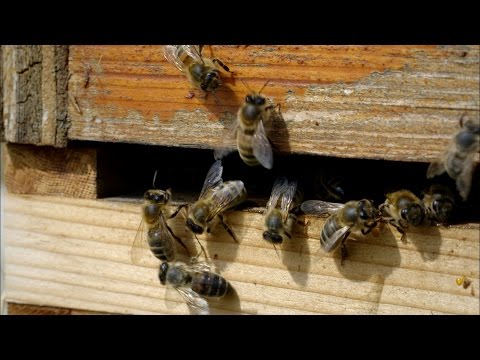
In the 1940s the Austrian zoologist Karl von Frisch decoded one of the most remarkable signals in nature. A foraging honeybee that finds a rich patch of flowers returns to the hive and dances on the vertical comb in the dark (Figure 5).
For food very close to the hive, bees perform a simpler "round dance" that gives no direction.
Worked example 1: decoding a dance
In the morning the sun is due east of a hive (a compass bearing of 90°). A bee's waggle run points 40° to the right of vertical and lasts 2.5 s. In this colony, each second of waggle run means about 1 km (an illustrative calibration; it differs between colonies). Where is the food?
Worker honeybees never breed, yet they work and even die defending the hive; a ground squirrel that gives an alarm call draws a predator's attention to itself. How can natural selection favour behaviour that lowers the helper's own chance of having offspring? The British biologist W. D. Hamilton (1964) gave the answer: relatives share genes. Helping a close relative to reproduce passes on copies of the helper's own genes. This is kin selection. Hamilton's rule says an altruistic act is favoured when
where is the relatedness of the helper to the one helped (the chance that they share a particular gene), is the benefit to the receiver and the cost to the helper, both measured in offspring.
| Relationship | Relatedness |
|---|---|
| Parent and offspring; full siblings | 0.5 |
| Half-siblings; grandparent and grandchild; aunt and niece | 0.25 |
| First cousins | 0.125 |
| Honeybee worker sisters (same mother and father) | 0.75 |
Worker bees are unusually closely related to their sisters, because males develop from unfertilised eggs and pass all their genes to every daughter. Unrelated animals may also help each other when the favour is likely to be returned later (reciprocal altruism), as vampire bats share blood meals with roost-mates who shared with them.
Worked example 2: is helping worth it?
A young bird can either breed this year, raising 1 chick of its own, or help its full sister at her nest instead. Its help would let her raise extra chicks. Each extra chick is the helper's niece or nephew (); its own chick would have . How many extra chicks must the sister raise for helping to be favoured?
Conclusion: helping relatives is favoured when the helper's own chance of breeding is poor, for example when territories are scarce.
Before mating, many animals perform courtship: a sequence of displays, often a chain of stimulus and response between male and female. Grey crowned cranes, which live in East African wetlands including Rwanda's, bow, leap into the air and spread their wings in a dance. Courtship:
A territory guarantees its owner food, a nest site or mates. It is marked by song (many birds), scent (antelopes, dogs) or display, and defended mostly by threat rather than fighting. Territories space animals out, which reduces competition and the spread of disease.
In a dominance hierarchy, each animal knows its rank. Hens establish a "pecking order"; in a mountain gorilla group the dominant silverback leads. Once ranks are settled, disputes are decided by a brief threat and submission instead of injury, and the strongest animals breed most.
| Advantages of living in a group | Disadvantages |
|---|---|
| More eyes to spot predators; defence together | Competition for food and mates |
| Cooperative hunting or foraging | Disease and parasites spread easily |
| Shared care of young; learning from others | A large group is easily seen by predators |

Warning
Common mistakes
BBC Earth: "The Waggle Dance" (Inside the Animal Mind). Watch the dancer's straight waggle run and return loops, and check how the angle of the run relates to the sun, as in Figure 5.
Tip
Exam technique: when asked how a behaviour is adaptive, always link it to survival or reproduction: "courtship ensures mating with the same species, so fertile offspring are produced"; "a hierarchy reduces fighting, so fewer animals are injured".
Practice: social behaviour
Key points
Sources and credits
Figure 5, the tables, the worked examples and the practice questions are by Ganzaa. The dance calibration in Worked example 1 is illustrative.
This lesson adapts CC BY-SA material and is shared under CC BY-SA 4.0.