Netball Rules of the Game
Senior 6 · Physical Education
Netball Rules of the Game
Lesson 2 of 3
25 min
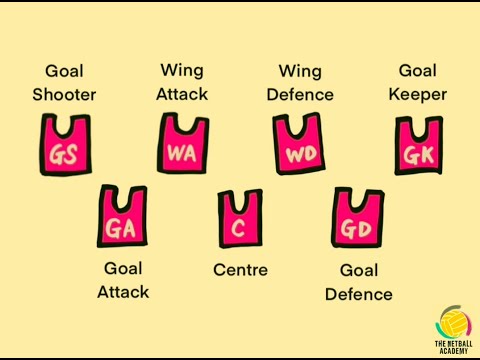
A footballer may go anywhere on the pitch; a netballer may not. The letters on each bib describe a map: the areas of the court where that player may move. Breaking that map is offside, and sending the ball through a third without anyone touching it is over a third. Coaches use the same maps to plan where each player should stand at a centre pass and how the ball should travel into the circle. This lesson sets out the court under Rule 1 of the Rules of Netball, 2024 edition, the areas of each position, the centre pass (Rule 8), offside (Rule 14), out of court (Rule 15) and the tactics that follow from them.
Definition
Transverse lines: the two lines that divide the court into three equal thirds: two goal thirds and a centre third.
Goal circle: the semicircle of radius 4.9 m at each end; only the Goal Shooter and Goal Attack may shoot, from inside it.
Offside: entering, with or without the ball, a court area not allowed for your position.
Throw-in: the restart when the ball goes out of court, taken from outside the line where it went out.
Possession: the action awarded for simultaneous or mutual infringements, to the team that last had the ball.
| Item | Specification (Rule 1) |
|---|---|
| Court | 30.5 m × 15.25 m (100 ft × 50 ft), firm and level, preferably sprung wood; three equal thirds |
| Circles | Goal circles: semicircles of radius 4.9 m centred on the middle of the outside of each goal line. Centre circle: 0.9 m in diameter |
| Lines | 50 mm wide and part of the area they enclose; a line between two areas belongs to both |
| Court surround | 3.05 m wide all round; with the court it forms the field of play |
| Goalposts | 3.05 m high, padded, at the middle of each goal line; ring 380 mm inside diameter on a 150 mm bar; net 380 to 457 mm long |
| Ball | 690–710 mm round, 400–450 g |
| Position | Areas allowed | Main role |
|---|---|---|
| Goal Shooter (GS) | Attacking third, including the goal circle | Scores; holds position in the circle |
| Goal Attack (GA) | Attacking and centre thirds, including the attacking circle | Feeds and scores; second shooter |
| Wing Attack (WA) | Attacking and centre thirds, not the circle | Takes the centre pass, feeds the circle from its edge |
| Centre (C) | All three thirds, but neither goal circle | Takes the centre pass; links defence and attack |
| Wing Defence (WD) | Defending and centre thirds, not the circle | Marks the WA; blocks the centre pass |
| Goal Defence (GD) | Defending and centre thirds, including the defending circle | Marks the GA; intercepts feeds |
| Goal Keeper (GK) | Defending third, including the goal circle | Marks the GS; defends shots; collects rebounds |

Worked example 1: area decisions
Worked example
Worked example 2: planning a centre pass. The opponents' WD is fast and always blocks your WA.
Video: "#LearnNetball Theory: Episode 1 | The court, the players and their boundaries", The Netball Academy. Name each position's areas before the presenter does.
Warning
Common mistakes. The Centre may go in all three thirds but never into either goal circle. Lines belong to both areas they separate: standing on a transverse line is not offside. The centre pass must be touched in the centre third. The ball going over a third and the ball going offside are different infringements, with the free pass taken in different places.
Practice
Remember
Sources and credits
This lesson adapts CC BY-SA material and is shared under CC BY-SA 4.0.