Goalball Rules of the Game
Senior 6 · Physical Education
Goalball Rules of the Game
Lesson 3 of 3
25 min
At the Paralympic Games and every IBSA-sanctioned tournament, a goalball game has eleven officials for the six players on court: 2 referees, 4 goal judges, 1 scorer, 1 timer, 2 ten-second timers and 1 back-up timer (IBSA Rule 9). Why so many? Because the players cannot see, the officials must see everything for them: every bounce, every first contact, every touch of the eyeshades and every second after a block. In a school game, a smaller team of pupils can share these jobs, but each job still has to be done. In this lesson you learn what each official does, where they stand, and the procedures they run at the end of a game.
Definition
Referee: the official in charge of play, with the final decision on safety, the rules and procedures. One works on the officials' table side (the table-side referee) and one on the opposite side (the far-side referee).
Goal judge: an official beside a goal post who retrieves the ball, puts it back into play and helps players on and off the court.
Ten-second timer: a table official who times the 10 seconds from first defensive contact for one team, and times time-outs.
Technical delegate: the person appointed by IBSA to make sure a tournament meets the rules, from the court and ball to protests.
Protest: a formal written complaint that a rule was applied wrongly, decided by a protest committee whose decision is final.
| Official | Number | Main duties |
|---|---|---|
| Referees | 2 | Check eyeshades at the start of each half; start play ("quiet please", whistle, "play"); judge throws, blocks and every infraction and penalty; signal goals with two whistles. The table-side referee runs the coin toss, announces substitutions and explains an official's time-out for clarification to both teams and the audience. |
| Goal judges | 4, one beside each goal post | Retrieve balls that leave the court and drop them at the side line 1.5 m in front of the nearest goal post; help a substituted player off and lead the incoming player to the goal post nearest the bench; keep the goals in position; re-orient a player after a penalty when asked. |
| Ten-second timers | 2, one for each team, at that team's end of the table | Time the 10 seconds from first defensive contact and sound the signal for a ten-seconds penalty; time the 45-second time-outs and medical time-outs, with a signal 15 s before the end; alert the referee to eyeshades and illegal coaching offences; usually supervise eye patching. |
| Timer | 1 | Runs the game clock: 12-minute halves, stopped on the referee's whistle and restarted on "play"; stopped during penalty situations. |
| Back-up timer | 1 | Keeps a second record of the game time in case the main clock fails. |
| Scorer | 1 | Keeps the score sheet: goals, penalties, time-outs and substitutions used by each team; records substitutions made at half time. |
Every official must be impartial. At IBSA events a referee may not officiate a game that involves a team of the referee's own nationality. Referees also must not touch a player without first saying what they intend and getting the player's spoken permission (Rule 41): a blind athlete must never be grabbed or moved without warning.
Coaches and players use three hand signals to the referee: time-out (the hands form a T), substitution (the forearms roll round each other in front of the chest) and penalty declined (the arms crossed over the chest). The referee's spoken calls keep the blind players informed: "quiet please", "play", "out", "blocked out", "dead ball", "ball over", the name of each penalty and the player's number, and "half time" or "game". Only the head coach may speak to a referee about a dispute, and only at an official break in play; if the coach still disagrees, the game is finished and the coach may protest afterwards.

Worked example
Worked example 1: the scorer refuses a time-out. Team A takes no time-out in the first half. In the second half its coach calls time-outs with 10:00, 6:30, 3:00 and 0:45 left. What does the scorer record?
Worked example
Worked example 2: extra throws. Team A's line-up sheet lists 6 players and Team B's lists 5. After three pairs of throws, Team A has scored 3 and Team B 0. Is the game over?
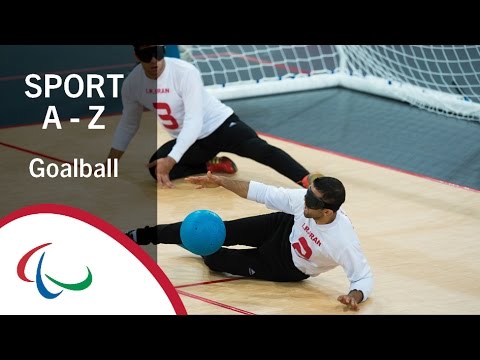
Video: "Paralympic Sport A-Z: Goalball", Paralympic Games. A short introduction to the sport's history and rules. As you watch, list every official you can see and say what each is doing.
Tip
Running a school game. Two referees and four goal judges are the most important. One pupil can be both timer and scorer, and one more can time the 10 seconds for both teams. Rotate the jobs so that every pupil learns to officiate as well as to play.
Warning
Common mistakes. Goal judges do not decide penalties: the referees do. The 10 seconds are timed by the ten-second timers, not by the game timer. Overtime is one 6-minute period, not two halves. Extra throws use the smaller number of players listed, so both teams throw the same number of times.
Practice
Remember
Further reading
Sources and credits
This lesson adapts CC BY-SA material and is shared under CC BY-SA 4.0.