Introduction to Basic First Aid
Senior 6 · Physical Education
Introduction to Basic First Aid
Lesson 1 of 4
25 min
On 12 June 2021, Denmark's Christian Eriksen collapsed on the pitch during a Euro 2020 match in Copenhagen. His heart had stopped. Team-mates and medical staff reached him within seconds, and he was given chest compressions and a shock from a defibrillator on the pitch. He survived and later returned to international football. Most sports injuries are far less serious, a twisted ankle, a cut knee, a bang on the head, but the lesson is the same: what the people nearby do in the first minutes, before an ambulance arrives, can decide how well, and sometimes whether, an injured player recovers. This unit teaches the first aid a PE leader, coach or team-mate should know, following the European Resuscitation Council (ERC) Guidelines 2025 and the International Liaison Committee on Resuscitation (ILCOR).
Definition
First aid: the helping behaviour and first care given by anyone to a person with a sudden illness or injury, including recognising the problem, giving care within one's training and calling for further help (ERC 2025).
First aider: the person giving first aid. Casualty: the person who is ill or injured.
Emergency medical services: the trained ambulance service. In Rwanda this is SAMU, reached free of charge on 912.
Consent: the casualty's permission to be helped. A responsive person may refuse; an unresponsive person is treated as if they would agree.
Responsiveness: how well a person reacts to voice and touch, from fully alert to unresponsive.
First aid manuals often sum up its aims as the three Ps: preserve life, prevent the condition from getting worse, and promote recovery. In sport this means:
Calling 912. Call early, or send someone to call, then switch the phone to speaker so your hands are free. Tell the call-taker where you are (school, district, nearest landmark), what happened, how many people are hurt and how they are, and your phone number. Answer every question and do not hang up until you are told to: the call-taker will tell you what to do while the ambulance is on its way.
Protect yourself and the casualty. Wear disposable gloves when touching blood or body fluids, wash your hands after care, and never give a casualty with a serious injury anything to eat or drink.
| Item | Used for |
|---|---|
| Disposable gloves (several pairs) | Protecting first aider and casualty from infection |
| Sterile gauze dressings and adhesive plasters | Covering wounds and pressing on bleeding |
| Roller and triangular bandages | Holding dressings in place; supporting an injured arm in a sling |
| Instant cold packs (or a clean bag for ice and water) | Cooling bruises and sprains, always wrapped in cloth |
| Clean water, foil blanket, scissors, notebook and pen | Rinsing wounds, keeping a casualty warm, recording what happened and when |
| A charged phone and the address of the venue | Calling 912 and directing the ambulance |
The ERC asks that first aid kits be clearly marked, easy to reach, suited to the risks of the setting, and checked regularly so that used or out-of-date items are replaced.

Worked example
Worked example 1: following the order. During a football match, two players clash heads. One gets up holding his forehead; the other lies still on the grass. What does the PE leader do, in order?
Worked example
Worked example 2: a clear 912 call. A model call for a pupil who has collapsed during a cross-country race:
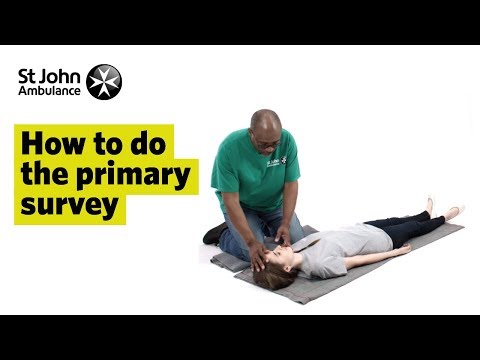
Video: "How to do the Primary Survey - First Aid Training - St John Ambulance", St John Ambulance. A UK trainer shows how to check danger, response, airway and breathing. The video gives the UK emergency numbers: in Rwanda, call 912.
Tip
Before every PE lesson or match, check three things: where the first aid kit is, whether a phone has signal and credit, and the exact address to give to 912. An emergency is the wrong time to find out.
Warning
Safety. Never put yourself in danger to help: a casualty on a road or near a hazard is helped only when the danger is controlled. Do not move a person who may have a head or neck injury unless they are in danger where they lie. Give only the care you have been trained to give, and never send a player with a suspected concussion back to play.
Practice
Remember
Sources and credits
This lesson adapts CC BY-SA material and is shared under CC BY-SA 4.0.