Physical Fitness
Senior 6 · Physical Education
Physical Fitness
Lesson 4 of 4
35 min
A test result on its own is just a number. It becomes useful when you compare it with something, a norm, a standard or your own last result, decide what it means, and turn it into a training plan that you then test again. This last lesson covers the skill-related tests that most sports need, speed, agility, balance and reaction time, and then the whole cycle: test, interpret, set a goal, train with FITT, progressive overload and specificity, retest.
Definition
Fitness profile: a summary of one person's results across several tests, showing strengths and weaknesses.
FITT: the four variables of a training programme: Frequency (how often), Intensity (how hard), Time (how long) and Type (what kind of exercise).
Progressive overload: making the body work harder than it is used to, and increasing the load gradually as it adapts.
Specificity: training improves the components, muscles, movements and energy systems that are actually trained.
SMART goal: a goal that is Specific, Measurable, Achievable, Realistic and Time-bound.
| Component | Test | Protocol in brief | Score |
|---|---|---|---|
| Speed | 30 m sprint | Start standing behind the line; sprint flat out past the 30 m line. Two runs with at least 3 minutes' rest. | Best time, in s |
| Agility | Illinois agility run | See the diagram: 10 m out and back, weave through four cones up and back, 10 m out and back. | Best time, in s |
| Balance | Stork stand | Hands on hips, stand on one foot with the other foot against the inside of the standing knee; on "go", raise the heel. The time stops when the heel touches down, a hand leaves the hip or the foot moves. | Best of 3, in s |
| Reaction time | Ruler drop | A partner holds a ruler with its zero between the subject's open thumb and finger and drops it without warning; the subject catches it. | Mean catching distance ; time |
| Coordination | Alternate-hand wall toss | Stand 2 m from a wall; throw a tennis ball underarm with one hand and catch it with the other, then back. | Catches in 30 s |
| Rating (illustrative, ages 16 to 19) | 30 m sprint, boys | 30 m sprint, girls | Illinois, boys | Illinois, girls |
|---|---|---|---|---|
| Excellent | under 4.0 s | under 4.5 s | under 15.2 s | under 17.0 s |
| Good | 4.0–4.2 s | 4.5–4.6 s | 15.2–16.1 s | 17.0–17.9 s |
| Average | 4.3–4.5 s | 4.7–4.8 s | 16.2–18.1 s | 18.0–21.7 s |
| Below average | over 4.5 s | over 4.8 s | over 18.1 s | over 21.7 s |
Illustrative ratings for teaching only; real norms depend on age, sex, population, surface and timing method.
Worked example
Worked example 1: reaction time from a ruler. A pupil's mean catching distance is 20 cm. Find his reaction time, taking .
Worked example
Worked example 2: how accurate is a hand-timed sprint? A pupil runs 30 m in 4.6 s, timed with a stopwatch.
How much activity? The World Health Organization (2020) recommends that young people aged 5 to 17 do on average at least 60 minutes a day of moderate-to-vigorous physical activity, mostly aerobic, with vigorous activity and muscle- and bone-strengthening activities on at least 3 days a week. For aerobic training, the American College of Sports Medicine describes moderate intensity as about 64–76% of maximum heart rate and vigorous as about 77–95%.
Worked example
Worked example 3: from a profile to a plan. Ange, aged 17, plays football as a midfielder. Her results: shuttle run level 6 (below average on the illustrative table), Illinois agility 17.4 s (good), vertical jump 44 cm (good). Plan her next eight weeks.
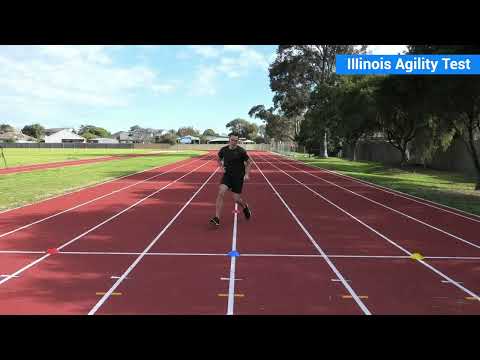
Video: "Illinois Agility Test: Setup, Scoring and Interpretation", MAT. Compare the cone layout with the diagram above, and note the common errors that make a run invalid.
Warning
Common mistakes. Training every component equally instead of the ones the sport needs. Increasing the load too fast, which leads to overuse injuries. Retesting under different conditions and believing the "improvement". Reading one hand-timed result as exact. Treating illustrative or foreign norms as a final verdict on a pupil: the most important comparison is with the pupil's own earlier results.
Practice
Remember
Further reading
Sources and credits