Binary Operations
Senior 4 · Mathematics
Binary Operations
Lesson 3 of 4
25 min
Every twist of a Rubik's cube is a "move". Doing one move and then another is again a move; there is a move that changes nothing; and every move can be undone. The integers under addition, the turns of a clock and the symmetries of a triangle obey the same four rules. Whenever a set and an operation obey them, mathematicians call the pair a group. Recognising a group means that every theorem ever proved about groups applies at once.

Definition
Integers modulo : for an integer , . Addition modulo , written , is the remainder when is divided by ; multiplication modulo , , is the remainder when is divided by .
Example: in , (the clock of Lesson 1, with 12 written as 0); in , .
Definition
Group: a set with a binary operation is a group, written , if
If also for all , the group is abelian (commutative). The number of elements of a finite group is its order.
| Set and operation | Group? | Reason |
|---|---|---|
| Yes, abelian | identity 0; inverse of is | |
| No | 1 has no inverse in | |
| Yes, abelian | identity 1; inverse of is | |
| No | 2 has no inverse: | |
| No | not associative, and no identity | |
| Yes, abelian | identity 0; inverse of is |
Associativity of and is inherited from ordinary addition and multiplication: taking remainders at each step or only at the end gives the same result.
Worked example 1: is a group
| 0 | 1 | 2 | 3 | |
|---|---|---|---|---|
| 0 | 0 | 1 | 2 | 3 |
| 1 | 1 | 2 | 3 | 0 |
| 2 | 2 | 3 | 0 | 1 |
| 3 | 3 | 0 | 1 | 2 |
The table is symmetric, so is an abelian group of order 4.
Worked example 2: multiplication modulo 5 and modulo 4
(a) Is a group? (b) Is a group?
Solution (a) The table has rows 1, 2, 3, 4 / 2, 4, 1, 3 / 3, 1, 4, 2 / 4, 3, 2, 1. It is closed, associativity is inherited, the identity is 1, and every row contains 1: , (since ), , . Yes, it is an abelian group.
(b) The identity would be 1, but the row of 0 is 0, 0, 0, 0: no element gives . Also , and the row of 2 (0, 2, 0, 2) never contains 1. Not a group.
A symmetry of an equilateral triangle is a motion that puts it back exactly onto its own outline. There are six: the identity , the turns (120° anticlockwise) and (240° anticlockwise), and the flips , , in the three axes. The operation is composition: means "do first, then ".
Follow the corner positions to compose. For : the flip swaps positions 2 and 3, then moves 1 to 2, 2 to 3 and 3 to 1. Altogether, 1 goes to 2, 2 goes to 3 then to 1, and 3 goes to 2 then to 3: positions 1 and 2 swap and 3 stays, which is the flip . Working every pair the same way gives the Cayley table (row , column , entry ):
Composition of motions is associative, is the identity, and every row contains (each flip is its own inverse, and ). So this is a group of order 6. But it is not abelian: while . The order of operations matters, just as it does on a Rubik's cube.
Important
Theorem (cancellation and the Latin square). In a group, if then . Hence each element appears exactly once in every row and every column of a group's Cayley table.
Proof. Multiply on the left by : . By associativity, , so and . So the entries in row are all different; a row of different elements from a set of elements contains each element once. Columns are the same, cancelling on the right.
A table with a repeated entry in some row is therefore not a group table. (The converse is false: a Latin square still needs associativity to be a group table.)

Tip
To test a finite table for a group, work in this order: (1) every entry in the set? (2) find : the row that copies the heading; (3) does appear in every row, in symmetric places? (4) is any element repeated in a row? If so, stop: not a group. Associativity cannot be read from a table at a glance; justify it from the operation (inherited from or , or composition of motions).
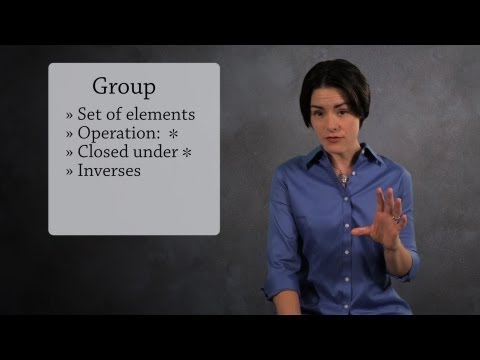
Socratica: Abstract Algebra, the definition of a group. Watch for the four group axioms and for the examples that fail one of them.
Practice
Use Cayley tables wherever they help.
Key points
Sources and credits
Quick check
In the Cayley table of a group, how many times does each element appear in each row?