Limits of Polynomial, Rational and Irrational Functions
Senior 4 · Mathematics
Limits of Polynomial, Rational and Irrational Functions
Lesson 3 of 4
25 min
A stone dropped from a tower falls metres in seconds (taking ). Its average speed between the times and 2 is . To get the speed at , let . Substitution gives , which tells you nothing yet. But for , which tends to . So the stone's speed at 2 s is . This lesson collects the algebra that turns such "undecided" limits into numbers.
Definition
Indeterminate form: a limit whose type, read from the limits of its parts, does not decide its value. The four you will meet are
Example: as , each of , and has the form , but their limits are , and (no single value). The form alone decides nothing; you must transform the expression.
Important
Methods
| Form | Typical expression | Method |
|---|---|---|
| rational function at a root of both numerator and denominator | factorise; cancel the common factor (factor theorem) | |
| contains | multiply top and bottom by the conjugate | |
| rational or irrational, | divide by the highest power of (Lesson 2) | |
| difference of fractions, or of roots | common denominator; or conjugate | |
| product | rewrite as a single quotient |
Worked example 1: factorise and cancel
Find (a) (b) .
Solution Both give , so by the factor theorem (or ) divides the top and the bottom.
Worked example 2: multiply by the conjugate
Find (a) (b) .
Solution Use .
Worked example 3:
Find (a) (b) .
Solution
Worked example 4: and
Find (a) (b) .
Solution
Warning
Cancelling is allowed only because while . The functions and are not equal at (the first is undefined there), but they have the same limit. Also, is not 0: in Worked example 3(a) it was 2.
Tip
With a form in a rational function, you already know a factor: if substituting makes the top and the bottom zero, both are divisible by . Use synthetic division if the factorisation is not obvious.
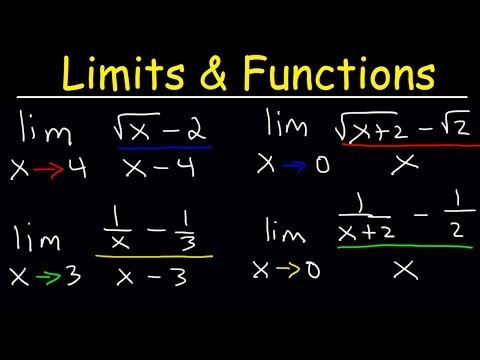
The Organic Chemistry Tutor: Limits of rational functions, fractions and square roots (about 10 min). Watch how each 0 ÷ 0 limit is unlocked by factorising, by a common denominator or by a conjugate.
Practice
Name the indeterminate form before you start each one.
Key points
Sources and credits
Quick check
Match each limit with its indeterminate form.
Tap one on the left, then its partner on the right.