Differentiation of Polynomial, Rational and Irrational Functions and Its Applications
Senior 4 · Mathematics
Differentiation of Polynomial, Rational and Irrational Functions and Its Applications
Lesson 5 of 5
25 min
The first derivative tells you where a graph rises and falls. The second derivative tells you how it bends: whether it curves up like a cup or down like a cap. With both, plus the limits and asymptotes of Unit 7, you can sketch a curve accurately without plotting a table of values. The same tools find the best value of a quantity: the largest area for a given fence, the least metal for a given volume. That is optimisation, the most widely used application of the derivative.
Definition
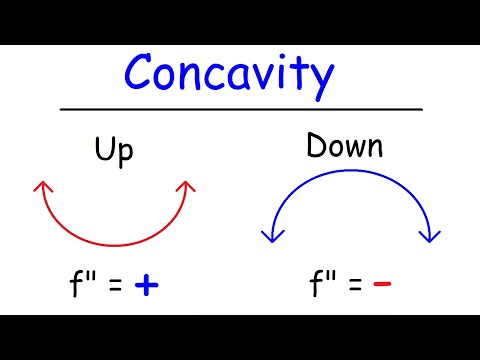
Concave up on an interval: the graph bends upwards (like a cup) and lies above its tangents; this happens where , because the slopes increase.
Concave down: the graph bends downwards (like a cap) and lies below its tangents; this happens where .
Point of inflexion: a point of the curve where the concavity changes. At such a point or is undefined, and changes sign.
Example: : is negative for and positive for , so the origin is a point of inflexion.
Important
Second derivative test. If and
Worked example 1: concavity and the second derivative test
For (Lesson 4), classify the stationary points with and find the point of inflexion.
Solution , . At : , a maximum (). At : , a minimum (). changes sign at : concave down for , up for ; the point of inflexion is , halfway between the turning points.
Important
Curve sketching checklist
Worked example 2: a polynomial
Sketch .
Solution Domain . Intercepts: , so and . As , .
: zero at 0 and 3. for (except at 0) and for . So is a stationary point with no sign change (no turning point), and is the minimum.
: positive for , negative on , positive for . Points of inflexion: , a stationary inflexion, and .
Worked example 3: a rational function
Sketch .
Solution Domain ; the only intercept is . Dividing, : vertical asymptote ( as ) and oblique asymptote , with the curve above it for and below it for .
: local maximum , local minimum .
: negative for (concave down), positive for (concave up); no inflexion, because is not in the domain.
Worked example 4: an irrational function
Sketch , .
Solution Intercepts and ; as . Write :
Minimum ; concave up everywhere, so no inflexion. As , : the curve leaves the origin with a vertical tangent.
To find the greatest or least value of a quantity: (1) draw a diagram and name the variables; (2) write the quantity as a function of one variable, using the constraint; (3) state the domain from the situation; (4) find the stationary points; (5) check which gives the maximum or minimum (second derivative, a variation table, or the values at the ends of the domain); (6) answer the question in words, with units.
Worked example 5: a fence against a wall
A farmer has 120 m of fencing to enclose a rectangular pen against a long straight wall (no fence is needed along the wall). Find the greatest possible area.
Solution Let the two sides perpendicular to the wall be m; the side parallel to it is m. Area , with . at , and : a maximum. The pen is 30 m by 60 m, with area .

Worked example 6: rectangle, square or circle?
(a) Show that among all rectangles with perimeter , the square has the greatest area. (b) Compare it with a circle of the same perimeter, for .
Solution
Worked example 7: the least metal for a can
A closed cylindrical can must hold . Find the radius and height that use the least metal (surface area).
Solution , so . Surface area , .
and : a minimum. Then , exactly twice the radius (since gives ): the best can is as tall as it is wide, using about of metal. Real drink cans are taller and narrower, so their makers are clearly weighing more than the area of metal alone.
Warning
A stationary point is not automatically the answer. Check that it is a maximum (or minimum) of the right kind, that it lies in the domain the situation allows, and compare with the values at the ends of the domain: on a closed interval the greatest value may be at an end.
Tip
In optimisation, most of the marks are for setting up: a labelled diagram, the constraint, and the quantity as a function of one variable with its domain. Once that is right, the calculus is usually a few lines.
The Organic Chemistry Tutor: Concavity, inflection points and the second derivative (about 13 min). Watch how the sign of f″ is read from a number line to give the intervals of concavity and the points of inflexion.
Practice
Questions 1 to 4 are sketches: use the checklist. Questions 5 to 8 are optimisation problems.
Key points
Further reading for this unit
Sources and credits
Quick check
At a stationary point x = c, f″(c) = −5. What can you conclude?