Basic Economic Concepts and Principles
Senior 4 · Economics
Basic Economic Concepts and Principles
Lesson 2 of 5
25 min
A student takes a motorcycle taxi from Nyabugogo to school. To a passenger it is simply a ride. An economist sees much more: a want (to arrive on time), a service that is produced and used at the same moment, a price agreed between two economic agents, resources used up (fuel, the rider's time, the motorcycle), an act of exchange, and even an externality, the noise and exhaust that fall on people who took no part in the deal. Every one of these words has a precise meaning in economics. This lesson builds that vocabulary, because every later unit depends on it.

Human beings need some things to survive and want a great many more. The difference matters, because a government that cannot meet every want must decide which needs come first.
Definition
Need: something a person must have to survive and live decently, such as food, clean water, shelter, clothing and basic health care.
Want: a desire for a good or service beyond what is needed to survive, such as a smartphone, a holiday or a bigger house. Wants are unlimited.
Example: drinking water is a need; bottled mineral water when tap water is safe is a want.
Characteristics of human wants.
Resources are the inputs used to produce goods and services. Economists group them into four factors of production, each with its own reward.
| Factor | Meaning | Rwandan example | Reward |
|---|---|---|---|
| Land | All natural resources: soil, water, minerals, forests, climate | The volcanic soils of Musanze; tin and coltan deposits; Lake Kivu's methane gas | Rent |
| Labour | Human effort, physical and mental, used in production | Rwanda's labour force of about 5.4 million people in 2025 (NISR) | Wages and salaries |
| Capital | Man-made goods used to produce other goods | Tractors, coffee washing stations, computers, roads | Interest |
| Entrepreneurship | Organising the other factors and bearing the risk of a business | A young person who starts a tailoring workshop with a loan | Profit |
Definition
Resources (factors of production): the land, labour, capital and entrepreneurship used to make goods and services. They are scarce (limited compared with wants) and have alternative uses.
Goods are tangible: they can be seen, touched, stored and resold. Services are intangible activities done for someone: they cannot be stored (a moto ride not taken today is lost), they are produced and used at the same time, and their quality varies with the person giving them.
| Classification | Meaning | Example |
|---|---|---|
| Free good vs economic good | A free good is not scarce, so it has no opportunity cost and no price; an economic good is scarce and has a cost of production | Sunlight vs a solar panel |
| Consumer good vs capital (producer) good | Used directly to satisfy wants vs used to make other goods | A loaf of bread vs a baker's oven |
| Durable vs non-durable | Gives service over a long time vs used up quickly | A radio vs a bar of soap |
| Intermediate vs final good | Bought to be processed further vs bought by the final user | Coffee cherries sold to a washing station vs a bag of roasted coffee bought by a family |
| Private good vs public good | A private good is rival (my use reduces yours) and excludable (non-payers can be kept out); a public good is neither | A mobile phone vs street lighting or national defence |
| Merit good vs demerit good | Under-consumed if left to the market because people undervalue it vs over-consumed because people underrate its harm | Vaccination, education vs cigarettes, alcohol |
Worked example 1: one good, two classifications
Classify each item and give the reason.
| Item | Classification | Reason |
|---|---|---|
| A bag of cement bought by a family to repair its own house | Consumer good (final good) | It is bought by the final user, not to be resold or processed |
| The same bag bought by a construction firm to build houses for sale | Capital input (intermediate good) | It is used up in producing another good |
| Street lights on a Kigali road | Public good | One person's use does not reduce another's (non-rival), and passers-by cannot easily be made to pay (non-excludable) |
| Air on a hill in Nyungwe | Free good | It is not scarce: using it gives nothing up |
Lesson: a good is classified by how it is used, not by what it is. That is why exam questions always describe the user.
Definition
Price: the amount of money paid for one unit of a good or service; its value expressed in money.
Value in use and value in exchange: value in use is a good's usefulness; value in exchange is what it will buy in the market. Adam Smith noted that water has a great value in use but little value in exchange, while diamonds are the reverse (the water–diamond paradox). The answer lies in scarcity: price reflects how scarce a good is, not only how useful.
Definition
Economic agents: the decision-makers in an economy. Households own the factors of production and consume; firms hire factors and produce; the government taxes, spends and regulates; the rest of the world buys exports and sells imports.
The two main agents are linked in a circular flow. Real things (factors, goods and services) flow one way; money flows the other way.
| Activity | Meaning | Example |
|---|---|---|
| Production | Creating goods and services that satisfy wants, including moving and selling them | Growing tea, processing it at a factory, transporting it to Mombasa |
| Distribution | (a) Moving goods from producers to consumers; (b) sharing national income among the owners of the factors as rent, wages, interest and profit | (a) Wholesalers and retailers; (b) the wage paid to a tea picker |
| Exchange | Giving one thing in return for another, by barter (goods for goods) or through money | Paying a moto rider by mobile money |
| Consumption | Using goods and services to satisfy wants directly; the final purpose of production | Drinking the tea |
Definition
Externality: a cost or benefit of producing or consuming something that falls on a third party, a person outside the transaction, who is neither paid for the cost nor charged for the benefit.
Worked example 2: putting a number on an externality (illustrative figures)
A brick maker near a wetland pays Frw 60 per brick for clay, firewood and labour. The smoke, the cut trees and the open clay pits impose costs on the village that are estimated at Frw 15 per brick. The kiln makes 20,000 bricks a month.
Social cost per brick:
External cost per month, borne by people who are not paid for it:
Interpretation: the brick maker decides on the basis of the Frw 60 private cost, so bricks are priced too low and too many are made from society's point of view. A tax of Frw 15 per brick, or a rule against kilns near wetlands, would make the producer take the full Frw 75 into account.
A plastic bag costs a shop very little, but once thrown away it blocks drains, chokes soils and harms livestock: classic external costs that neither the seller nor the buyer pays. Rwanda deals with this externality by law. Law N° 17 of 2019 of 10 August 2019 prohibits the manufacturing, use, importation and sale of plastic carry bags and single-use plastic items. A manufacturer who breaks it faces closure and an administrative fine of Frw 10,000,000; a retailer faces a fine of Frw 300,000 (Articles 3, 9 and 12). Compostable items and woven polypropylene can be allowed with prior authorisation.
Definition
Ceteris paribus: Latin for "other things being equal". Economists use it to study the effect of one change while holding every other influence constant.
Example: "If the price of beans rises, ceteris paribus, households buy fewer beans." Without the phrase the statement could fail: if incomes rose at the same time, households might buy more beans even at the higher price.
Warning
Two common slips. (1) "Capital" in economics means man-made means of production such as machines and buildings; money is only a claim on them. (2) A free good is not the same as a good provided free of charge. Primary education in a public school is free to the pupil but is an economic good: teachers, classrooms and books all have an opportunity cost, paid through taxes.
Tip
Match each factor to its reward with "L-L-C-E → R-W-I-P": Land earns Rent, Labour earns Wages, Capital earns Interest, Enterprise earns Profit. Keep the order and the pairs follow.
Important
Discuss. Is a mobile phone a need or a want for a farmer in Gicumbi who sells milk to a collection centre and receives payment by mobile money? What does your answer suggest about the line between needs and wants?
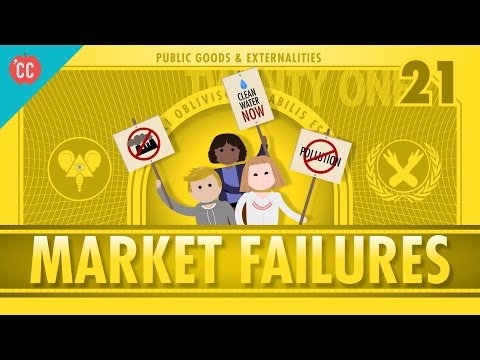
CrashCourse, "Market Failures, Taxes, and Subsidies: Crash Course Economics #21". Watch for public goods (non-rival, non-excludable), the free-rider problem and the polluted-river example of a negative externality.
Practice
Key points
Sources and credits
Written by Ganzaa: the text, the circular-flow diagram, the tables, the worked examples and the practice items. The brick and factory figures are illustrative. The photo is shared under CC BY-SA 4.0.
Quick check
Match each factor of production to its reward.
Tap one on the left, then its partner on the right.