Price Mechanism
Senior 4 · Economics
Price Mechanism
Lesson 2 of 4
30 min
In the fiscal year 2024–25, the Ministry of Agriculture and Animal Resources (MINAGRI) reports that subsidised seeds and fertilisers reached more than 3.5 million farmers through the Smart Nkunganire System, and 110,691.2 tonnes of fertiliser were distributed. Presenting the 2026–27 budget, the Minister of Finance said the government had "prioritized agriculture inputs and irrigation" (MINECOFIN). In the same economy the RRA levies excise duty on beer, cigarettes and fuel, RURA caps the pump price of petrol, and a law bans plastic carry bags. Rwanda relies on the price mechanism, but it does not leave it alone. This lesson asks why governments intervene, what tools they use, and what can go wrong.
| Reason | The market's failure | Rwandan example of a response |
|---|---|---|
| Public goods | Not supplied, because non-payers cannot be excluded | Roads, street lighting and security paid from the budget |
| Merit goods | Under-consumed (education, health care, nutrition) | Public schools and the School Feeding Programme |
| Demerit goods | Over-consumed (alcohol, tobacco) | Excise duties on beer and cigarettes (RRA) |
| Externalities | Social costs and benefits are ignored | Law N° 17 of 2019 banning plastic carry bags |
| Inequality | "For whom" depends on income | Social protection; subsidised inputs for small farmers |
| Price instability | Farm prices swing with harvests | The National Strategic Grain Reserve (Lesson 3) |
| Monopoly | High prices and low output | Regulation of utilities by RURA |
| Strategic goals | The market may neglect long-term goals | Support for irrigation, exports and new industries |
Definition
Indirect tax: a tax on spending on goods and services, collected from sellers. A specific tax is a fixed sum per unit (Frw 183 per litre of petrol); an ad valorem tax is a percentage of the price or value (65% on most beer).
Subsidy: a payment by the government to producers (or consumers) that lowers the cost of producing or buying a good, such as subsidised fertiliser.
Worked example 1: a subsidy on tomatoes (illustrative)
The tomato market of Unit 2 has and , with equilibrium at Frw 300 and 1,000 kg a day. The government pays sellers Frw 60 per kg. Sellers now receive , so
| Before | After | Change | |
|---|---|---|---|
| Price paid by buyers | Frw 300 | Frw 260 | Buyers gain Frw 40 per kg |
| Price received by sellers | Frw 300 | Sellers gain Frw 20 per kg | |
| Quantity | 1,000 kg | 1,080 kg | +80 kg |
Cost to the government: a day. Buyers get two-thirds of the benefit because, at the old equilibrium, supply is more elastic than demand (PES = 1.2, |PED| = 0.6, and ).
Worked example 2: specific or ad valorem?
Compare RRA's two forms of excise on two illustrative products.
Analysis: ad valorem revenue rises automatically with prices (useful during inflation), while a specific tax keeps the same franc amount, so its real value falls as prices rise unless it is revised.
Intervention can also go wrong. Government failure occurs when intervention makes the allocation of resources worse rather than better. Causes include: poor information about costs and benefits; high administrative costs; unintended consequences, such as smuggling when taxes are high; subsidies that reach people who did not need them; delays and red tape; political pressure; and corruption. A good policy answer weighs the market failure against the risk of government failure.
Warning
Do not shift demand for a tax or subsidy on producers. A tax or subsidy paid to or by sellers changes their costs, so it shifts the supply curve. The demand curve stays where it is; buyers simply move along it to the new price.
Tip
For any intervention, answer four questions: What market failure does it fix? Which curve moves, and how? Who gains and who pays? What could go wrong?
Important
Discuss. Is subsidising fertiliser for millions of small farmers a good use of public money? Consider who gains, the cost to the budget, the effect on food prices, and the risk of government failure.
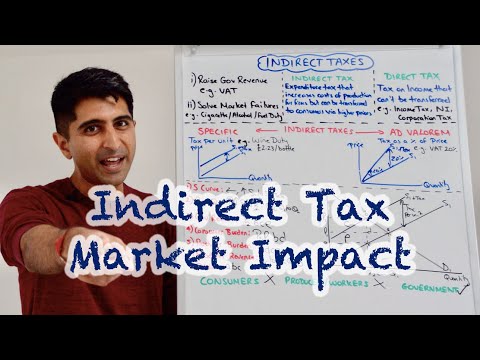
EconplusDal, "Indirect Tax - Full Market Impact". Watch how a tax changes the price paid, the price received, the quantity and the government's revenue; a subsidy works in the opposite direction, as in Worked example 1.
Practice
Key points
Sources and credits
Written by Ganzaa: the text, the subsidy and tax diagrams (the subsidy drawn to scale from its equations), the tables, the worked examples and the practice items. The tomato market and the beer factory prices are illustrative.
Quick check
A subsidy of Frw 60 per kg is paid to tomato sellers. Which curve moves, and which way?