Electron Configurations of Atoms and Ions
Senior 4 · Chemistry
Electron Configurations of Atoms and Ions
Lesson 3 of 5
25 min
Photograph a spinning fan with a slow shutter and you do not see the blades; you see a blurred disc showing where the blades spend their time. The modern picture of an electron is like that blur. In the 1920s experiments showed that electrons behave as waves as well as particles: a beam of electrons is diffracted by a crystal, just as light is diffracted by a grating. A wave is spread out, so an electron in an atom cannot follow a sharp track like Bohr's orbit. In 1926 Erwin Schrödinger wrote an equation for the electron wave. Its solutions describe the regions where an electron is likely to be found, called orbitals, and each is labelled by a set of quantum numbers.
Definition
Atomic orbital: a region of space around the nucleus where there is a high probability (usually taken as 90%) of finding an electron. Each orbital holds at most two electrons.
Orbit and orbital are not the same. An orbit (Bohr) is a fixed circular path; an orbital is a three-dimensional region of probability, with a definite shape and energy.
Every electron in an atom is described by four quantum numbers. The first three describe the orbital; the fourth describes the electron itself.
Table 3.1: The quantum numbers
| Quantum number | Symbol and allowed values | What it tells you |
|---|---|---|
| principal | the shell (main energy level): its size and most of its energy | |
| azimuthal (subsidiary) | the subshell and the shape of its orbitals: s, p, d, f | |
| magnetic | the orientation of the orbital in space; a subshell has orbitals | |
| spin | or | the direction of the electron's spin, often drawn as ↑ or ↓ |
Definition
Pauli exclusion principle: no two electrons in the same atom can have the same set of four quantum numbers. Two electrons in one orbital already share , and , so they must differ in : an orbital holds at most two electrons, with opposite spins.
Combining the rules gives the structure of each shell (Table 3.2). Shell has subshells and orbitals, so it holds at most electrons.
Table 3.2: Shells n = 1 to 4
| Shell | Values of | Subshells | Orbitals in each subshell | Total orbitals | Maximum electrons |
|---|---|---|---|---|---|
| 1 | 0 | 1s | 1 | 1 | 2 |
| 2 | 0, 1 | 2s, 2p | 1, 3 | 4 | 8 |
| 3 | 0, 1, 2 | 3s, 3p, 3d | 1, 3, 5 | 9 | 18 |
| 4 | 0, 1, 2, 3 | 4s, 4p, 4d, 4f | 1, 3, 5, 7 | 16 | 32 |
Because can be at most , there is no 1p, 2d or 3f subshell.
s orbitals () are spherical, centred on the nucleus. There is one s orbital in every shell, and it gets bigger as increases: 2s is larger than 1s.
p orbitals () are dumbbell-shaped, with two lobes on opposite sides of the nucleus and zero probability at the nucleus itself. There are three in each p subshell, at right angles to each other, along the x, y and z axes: , , . They have the same energy.
d orbitals () come in sets of five. Three have four lobes lying between the axes (, , ); has four lobes along the x and y axes; and has two lobes along z with a ring around its middle. In an isolated atom all five have the same energy. f orbitals (), seven per subshell, have more complicated shapes that you do not need to draw.
Worked example 1: which sets are allowed?
Say whether each set is allowed. If it is, name the subshell. (a) (b) (c) (d)
Solution. Check , then , then .
Worked example 2: counting electrons
How many electrons in an atom can have (a) ; (b) and ; (c) , and ; (d) and ?
Solution.
Warning
Common mistakes. (1) runs from 0 to , never up to . (2) The number of orbitals in a subshell is , but the number of electrons is twice that. (3) Do not call an orbital a "path": the electron's position is described only by probability. (4) The three p orbitals of one subshell have the same energy; they differ only in direction.
Tip
Remember s p d f → 1 3 5 7 orbitals → 2 6 10 14 electrons. Shell holds : 2, 8, 18, 32.
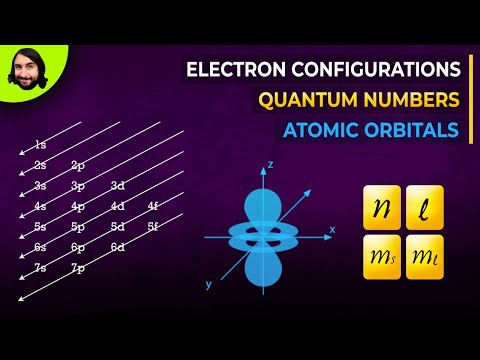
Professor Dave Explains: Quantum Numbers, Atomic Orbitals, and Electron Configurations (9 min). Watch the first part for what each quantum number describes and how the s, p and d orbital shapes follow from them.
Practice
Key points
Sources and credits
Quick check