Formation of Ionic and Metallic Bonds
Senior 4 · Chemistry
Formation of Ionic and Metallic Bonds
Lesson 3 of 3
25 min
An electrician can bend a copper wire round a screw, an aluminium cable can be drawn out into strands thinner than a hair, and both carry an electric current. Hit a crystal of salt and it shatters; hit a copper sheet and it only dents. Both copper and salt are held together by electrostatic attraction between positive and negative charges, so why do they behave so differently? The answer is that in a metal the negative charge is not fixed on separate ions. It is shared by the whole crystal.
Definition
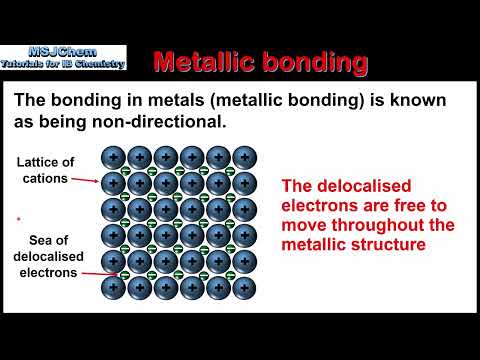
Metallic bond: the strong electrostatic attraction between a lattice of positive metal ions and a "sea" of delocalised electrons that move freely among them.
Delocalised electrons: electrons that are not attached to any one atom or bond, but are free to move through the whole structure. In a metal, they are the atoms' outer (valence) electrons.
Metal atoms have few outer electrons and low ionisation energies. In the solid, each atom releases its outer electrons into a shared pool, leaving a positive ion. The ions are packed closely in a regular lattice, and the delocalised electrons move between them. Every ion is attracted to the electrons around it, and the electrons are attracted to all the ions near them, so the bonding acts in all directions: it is non-directional.
The more delocalised electrons per atom, the higher the charge on the ions, and the smaller the ions, the stronger the attraction. Across Period 3 from sodium to aluminium, all three factors work in the same direction.
Table 3.1: Three Period 3 metals
| Metal | Delocalised electrons per atom | Ion (radius / pm) | Melting point / °C | Boiling point / °C | Electrical conductivity / |
|---|---|---|---|---|---|
| sodium | 1 | (102) | 98 | 883 | 2.1 |
| magnesium | 2 | (72) | 650 | 1090 | 2.3 |
| aluminium | 3 | (54) | 660 | 2519 | 3.8 |
Down Group 1 the ions get larger while the charge stays +1, so the bonding weakens: lithium melts at 181 °C, sodium at 98 °C and potassium at 63 °C.
Worked example 1: explaining the boiling points
Explain why the boiling point rises from sodium (883 °C) to magnesium (1090 °C) to aluminium (2519 °C). Why is the boiling point a better guide to the strength of metallic bonding than the melting point?
Solution. From Na to Al the number of delocalised electrons per atom rises (1, 2, 3), the charge on the ions rises (+1, +2, +3) and the ions get smaller (102, 72, 54 pm). Each change increases the attraction between the ions and the electron sea, so more energy is needed to separate the atoms completely, which is what boiling does.
Melting only loosens the lattice so that the ions can slide past each other; much of the metallic bonding remains in the liquid. Melting points also depend on how the atoms are packed. Boiling breaks the metallic bonding entirely, so it follows bond strength more closely: magnesium and aluminium melt within 10 °C of each other but boil more than 1400 °C apart.
| Property | Explanation from the electron-sea model |
|---|---|
| Good electrical conductors, as solids and liquids | When a potential difference is applied, the delocalised electrons drift towards the positive terminal; they carry the current. |
| Good thermal conductors | The free electrons gain kinetic energy at the hot end and carry it quickly through the metal; vibrating ions pass energy on too. |
| Malleable (can be hammered into sheets) and ductile (can be drawn into wires) | The bonding is non-directional. When layers of ions slide over each other, the electron sea moves with them and every ion is still surrounded by electrons, so the metal changes shape without breaking (Figure 3.2). |
| Shiny (lustrous) when freshly cut | Delocalised electrons absorb light and immediately re-emit it. |
| Usually high melting points and densities | Strong bonding in all directions; ions packed closely together. |

An alloy is a mixture of a metal with one or more other elements, usually other metals. Atoms of a different size distort the regular layers, so the layers can no longer slide easily: alloys are usually harder and stronger than the pure metals. Steel (iron with a little carbon), brass (copper and zinc), bronze (copper and tin) and duralumin (aluminium with copper and magnesium, used in aircraft) are examples.
Worked example 2: aluminium or copper for power lines?
Copper conducts better than aluminium ( against ), but aluminium is much less dense ( against ). For an overhead cable with the same resistance per kilometre, compare the masses of the two metals needed.
Solution. Resistance per length is inversely proportional to (conductivity × cross-sectional area). For equal resistance, the aluminium cable needs a larger area:
Mass per length = area × density, so
Answer: the aluminium cable has less than half the mass of an equivalent copper cable, so it needs fewer, lighter pylons. That is why long-distance overhead lines are aluminium, usually wound round a steel core for strength, while copper is used for the short wires inside buildings.
Warning
Common mistakes. (1) Saying metals conduct because "ions move": in a solid metal it is the delocalised electrons that move. (2) Calling the metallic bond "weak" to explain malleability: the bonds are strong; they are non-directional, which is why layers can slide. (3) Forgetting that the electron sea is made of the atoms' own outer electrons, so its size depends on the group.
Safety. Thin metal wire or foil can get very hot in a conductivity test: use a low-voltage supply and a lamp in series, and do not touch bare wire while the current flows.
Tip
Compare the three giant structures with one question: what can move? In a metal, electrons can move in the solid; in an ionic compound, ions can move only when it is molten or dissolved; in a covalent network such as diamond, nothing can move. Conductivity follows.
Mike Sugiyama Jones (MSJ Chem): Metallic bonding and properties of metals (3 min). Watch for the definition of the metallic bond and the explanation of conductivity and malleability.
Practice
Key points
Further reading
Sources and credits
Quick check
Which particles carry the current when a copper wire conducts electricity?