Trends in Physical Properties of Elements in the Periodic Table
Senior 4 · Chemistry
Trends in Physical Properties of Elements in the Periodic Table
Lesson 2 of 3
25 min
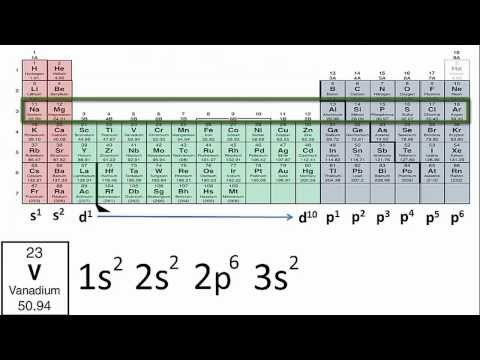
Mendeleev built his table from properties alone. Fifty years later, Unit 2's configurations explained it. The table is really a map of how electrons fill subshells: each row is a new shell, and each region of the table is the place where one type of subshell (s, p, d or f) is being filled. That means you can find any element's position from its configuration, and write the configuration of any element from its position, without memorising either. This lesson shows how.
Definition
Period: a horizontal row. Its number is the principal quantum number of the outermost occupied shell.
Group: a vertical column of elements with the same outer electron arrangement and similar chemical properties. The modern table numbers them 1 to 18.
Block: the region of the table in which the last electron (in the Aufbau order) enters an s, p, d or f subshell.
Table 2.1: The blocks and their elements
| Block | Groups | Outer configuration | Typical elements and behaviour |
|---|---|---|---|
| s | 1 and 2 (and He) | or | reactive metals (Na, K, Mg, Ca); form ions or ; mostly ionic compounds |
| p | 13 to 18 | to | metals, metalloids and non-metals (Al, Si, N, O, Cl, the noble gases); many covalent compounds |
| d | 3 to 12 | transition metals (Fe, Cu, Zn); variable oxidation states, coloured compounds, catalysts | |
| f | lanthanoids and actinoids | filling 4f or 5f | lanthanoids, very similar to each other; actinoids, all radioactive (uranium) |
The width of each block matches the number of electrons its subshell holds: s is 2 columns wide, p 6, d 10 and f 14, so the shape of the table follows from the quantum numbers of Unit 2.
Worked example 1: locating four elements
Find the period, group and block of the elements with Z = 15, 35, 25 and 56.
Solution.
Worked example 2: from position to configuration
An element is in Period 4, Group 16. Write its configuration and atomic number, and predict the charge on its simple ion.
Solution. Period 4, so the outer shell is . Group 16 is in the p-block with outer s and p electrons: . Before 4p fills, the 3d subshell must be full: [Ar] . Electrons: .
Answer: Z = 34, selenium. It needs 2 electrons to complete its octet, so it forms , like oxide and sulfide.
Warning
Common mistakes. (1) Counting the full electrons when finding the group of a p-block element: bromine is Group 17, not Group 27. (2) Taking the period from the last subshell written: in [Ar] the period is 4 (from 4s), not 3. (3) Forgetting that helium () is an s-block element placed in Group 18 because, like the other noble gases, its outer shell is full.
Tip
Read the table like a book, left to right, top to bottom, and you read the Aufbau order: 1s; 2s 2p; 3s 3p; 4s 3d 4p; 5s 4d 5p; 6s 4f 5d 6p. The d-block always sits one shell behind its period number, and the f-block two behind.
Wayne Breslyn: Writing Electron Configurations Using Only the Periodic Table (5 min). Watch how he walks across each block to build a configuration, and use the same method in reverse to place an element.
Practice
Key points
Sources and credits
Quick check
An element has the configuration [Ne] 3s² 3p⁴. Where is it in the periodic table?