Optical Instruments
Senior 4 · Physics
Optical Instruments
Lesson 3 of 4
25 min
On a clear night far from city lights, the Moon covers only about half a degree of the sky, and Jupiter looks like a bright star. Point even a small telescope at them and the Moon's craters and Jupiter's four largest moons appear. A telescope cannot make the Moon itself bigger, and it does not bring it nearer; what it does is make the Moon subtend a larger angle at your eye, and collect far more light than your pupil can. This lesson explains how two lenses do both.
An astronomical (refracting) telescope has two converging lenses (Figure 3.1). The objective has a long focal length and a large diameter; the eyepiece has a short focal length .
Figure 3.1: The astronomical telescope in normal adjustment. The final image is at infinity and inverted.
Magnifying power in normal adjustment. The object (a star, the Moon) is so far away that the unaided eye sees it at the same angle as the objective does. The ray through the centre of the objective is undeviated, so the image , of height , satisfies . The ray from the top of through the centre of the eyepiece leaves at the angle of the final image, with . For small angles , so
A long objective focal length and a short eyepiece give high magnification. Astronomers change the magnification by swapping eyepieces.
Final image at the near point. If the eyepiece is pushed in slightly so that the final image is at , the eyepiece magnifies more (it acts as a magnifier with ), and
This is a small gain, and the eye must strain to focus at its near point, so normal adjustment is the usual setting.
Definition
A telescope is in normal adjustment when the final image is formed at infinity, so that a relaxed normal eye can view it; the focal points of the objective and eyepiece then coincide. The eye ring (exit pupil) is the image of the objective formed by the eyepiece: the small circle through which all the light leaving the telescope passes, and the best place for the observer's pupil. Example: a telescope with and in normal adjustment is 93 cm long and magnifies 30 times.
Worked example 1: looking at the Moon
A telescope has an objective of focal length 100 cm and an eyepiece of focal length 5.0 cm. The Moon subtends 0.52° at the Earth. Find (a) the magnifying power and length in normal adjustment, (b) the angle the Moon's final image subtends, (c) the diameter of the Moon's image in the focal plane of the objective.
The real image of the whole Moon is less than a centimetre across; the eyepiece then views that small image from close up.
Worked example 2: final image at the near point
The same telescope is adjusted so that the final image is 25 cm from the eye. Find the new magnifying power and the new separation of the lenses.
For the eyepiece, : , so . The separation is : the eyepiece moves in by 0.8 cm.
All the light entering the objective must leave through the eyepiece. The eyepiece forms a real image of the objective rim, the eye ring, just beyond itself. Treating the objective as an object at distance from the eyepiece,
This gives a neat way to measure : point the telescope at a bright sky, catch the eye ring on a piece of tracing paper behind the eyepiece, and divide the objective's diameter by the eye ring's diameter. If the eye ring is about the size of the pupil, all the collected light enters the eye.
The amount of light collected is proportional to the area of the objective, so a telescope with an objective of diameter gathers times as much light as the eye. Faint stars and galaxies become visible. A larger objective also gives finer detail (better resolution), because diffraction blurring decreases as the aperture increases. That is why astronomers want large objectives, and why the biggest telescopes use mirrors, which can be made far larger than lenses (Unit 1, lesson 4).
Worked example 3: the eye ring
The objective of the telescope in Worked example 1 is 5.0 cm in diameter. Find the position and diameter of the eye ring, and how many times more light the telescope collects than a dark-adapted pupil 7.0 mm across.
| Type | Objective | Eyepiece | Final image | Length in normal adjustment |
|---|---|---|---|---|
| astronomical (Kepler) | converging lens | converging lens | inverted | |
| terrestrial | converging lens | converging lens, with an erecting lens between | upright | (erecting lens of focal length used at 2F) |
| Galilean | converging lens | diverging lens | upright | (short) |
| reflecting (Newtonian) | concave (parabolic) mirror | converging lens, with a small plane mirror to turn the light aside | inverted | about |
An inverted image does not matter when you look at stars, so astronomers use the simplest, shortest design. Binoculars are two terrestrial telescopes in which the erecting lens is replaced by the totally reflecting prisms of Unit 1, lesson 2; they turn the image upright and fold the long light path into a short case.

Warning
Safety. Never point a telescope or binoculars at the Sun or look at the Sun through them. The objective concentrates sunlight and can blind you instantly and permanently. Solar observing needs a certified solar filter over the objective, or projection of the image onto a card, under supervision.
Warning
Common mistakes. (1) Writing : the long objective focal length goes on top. (2) Thinking the telescope makes the object bigger: it increases the angle subtended. (3) Giving the length as for an astronomical telescope: that is for the Galilean type. (4) Forgetting that a larger objective improves brightness and resolution, not the magnification.
Tip
Telescope: "objective on top" (), and the eye ring is times smaller than the objective. Microscope: both lenses short, and the magnifications multiply.
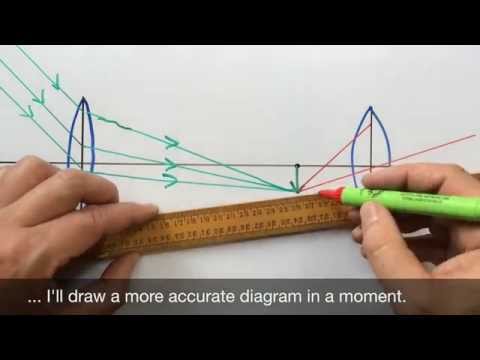
The astronomical telescope (QuantumBoffin). Follow the ray diagram in normal adjustment and the derivation of the angular magnification from the two angles at the objective and the eyepiece.
Practice
Key points
Sources and credits
The derivations, the diagram, the table, the worked examples and the practice exercises are written by Ganzaa.
Quick check