Arithmetic
Senior 4 · Basic Mathematics
Arithmetic
Lesson 2 of 5
25 min
The 2022 Population and Housing Census counted 13 246 394 residents of Rwanda: 6 429 326 males and 6 817 068 females. Saying "there were 387 742 more females" compares by subtraction. Statisticians prefer to compare by division: there were about 94 males for every 100 females, and the City of Kigali held about 13% of the whole population. "94 for every 100" is a ratio; "13%" is a percentage. Both describe a part in relation to something else, which is how newspapers, budgets, recipes and building plans speak.
Definition
Ratio: a comparison of two or more quantities of the same kind by division, written and read " to ". It can also be written as the fraction . A ratio does not change when all its terms are multiplied or divided by the same non-zero number, so it can be put in simplest form.
Proportion: an equality of two ratios, , which holds exactly when .
Example: (same units first, then divide by 150).
Worked example 1: a ratio from the census
Using the 2022 census, express the number of males to females as a ratio in the form (the sex ratio), and find the percentage of the population that was female.
Solution
Source: NISR, 2022 census main indicators, Tables 1 and 4.
To share an amount in the ratio , add the terms to find the number of equal parts, find the value of one part, then multiply. Three partners, Mukamana, Habimana and Uwera, invested 400 000, 600 000 and 1 000 000 Frw in a shop, a ratio of . They agree to share a profit of 750 000 Frw in the same ratio:
There are parts, each worth Frw. Check: . ✓
Worked example 2: a mix and a map
(a) A common concrete mix uses cement, sand and gravel in the ratio by volume. How much of each is needed for of dry mix? (b) On a map with scale , a road measures 7.4 cm. How long is the real road?
Solution
Definition
Percentage: a ratio with 100 as the second term; . So .
Example: 15% of 32 000 Frw is Frw.
Worked example 3: population growth, 2012 to 2022
The 2012 census counted 10 515 973 residents and the 2022 census 13 246 394. Find the percentage increase.
Solution
The population grew by about 26% in ten years. (This is not 2.6% a year: lesson 5 shows why yearly growth compounds.)
Worked example 4: reverse percentages and successive changes
(a) A phone costs 29 500 Frw including an 18% tax. What was the price before tax? (b) A trader raises a price by 20%, then later lowers the new price by 20%. What is the overall change?
Solution
Warning
Two classic errors. (1) In a reverse percentage, taking 18% off the final price: Frw is wrong, because the 18% was calculated on the original price, not on 29 500. Divide by the multiplier instead. (2) Mixing up percent and percentage points: if a pass rate rises from 40% to 50%, it rose by 10 percentage points, which is a 25% increase ().
Tip
Think in multipliers. "Up 7%" is "", "down 15%" is "", "including 18% tax" is "", and undoing a change is dividing by its multiplier. Successive changes simply multiply.
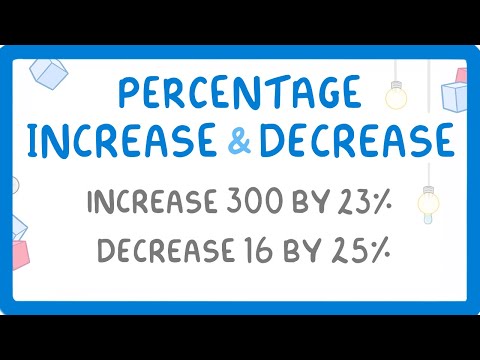
Cognito: Percentage Increase and Decrease (Multiplier Method). Watch how one multiplication replaces 'find the percentage, then add or subtract'.
Practice
Try each one before opening the answers. They get harder as you go.
Key points
Sources and credits
Quick check