Diversity of Specialised Tissues
Senior 4 · Biology
Diversity of Specialised Tissues
Lesson 4 of 4
25 min
In ponds and slow streams lives Volvox, a green alga that forms a hollow ball of hundreds to tens of thousands of cells, each with two flagella. Most of the cells only swim and photosynthesise; a few, inside the ball, specialise in reproduction and grow into the daughter colonies you can see within the parent. Its close relative Chlamydomonas is a single cell that must do everything itself. Between them, the two show the first step of a path that leads to plants and animals with billions of specialised cells.
This lesson puts the cells and tissues of this unit into order, from cell to organism, and asks why multicellular life has been so successful, and what it costs.
Definition
Organ: a structure made of several different tissues that work together to carry out a particular function. Examples: a leaf, the heart.
Organ system: a group of organs that work together to carry out a major function. Examples: the shoot system of a plant; the circulatory system of a mammal.
Organism: a complete living thing, which may be unicellular or multicellular.
Division of labour: the sharing of the body's tasks among different specialised cells, tissues and organs.
Colony: a group of similar cells or organisms living attached together, in which each cell can usually survive on its own.
Each level is built from the one before it and can do things that its parts cannot do alone. A guard cell can open and close a stoma, but only a leaf, with epidermis, mesophyll and veins working together, can photosynthesise efficiently; only the whole maize plant, with roots, stem and leaves, can grow, flower and set seed. Below the cell are organelles and molecules, and above the organism are populations, communities and ecosystems (Unit 1).
| Organ | Tissues it contains | What each contributes |
|---|---|---|
| Leaf | Epidermis, palisade and spongy mesophyll (parenchyma), xylem, phloem, collenchyma or sclerenchyma | Protection; photosynthesis and gas exchange; supply of water; export of sugar; support |
| Heart | Cardiac muscle, connective tissue (valves, fibrous rings), epithelium (lining), nervous tissue, blood vessels | Contraction; strength and one-way flow; smooth lining; control of rate; its own blood supply |
| Stomach | Columnar epithelium with gland cells, smooth muscle, connective tissue, nerves | Secretion of acid and enzymes; churning; support; coordination |

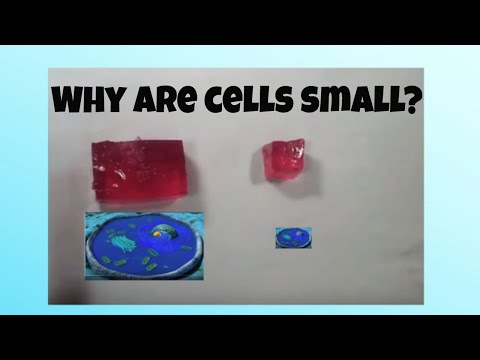
Every cell exchanges oxygen, carbon dioxide, nutrients and wastes across its surface, but uses them throughout its volume. As an object grows, its surface area increases with the square of its length, but its volume with the cube, so its surface area to volume ratio falls (Figure 2). Diffusion is also fast only over short distances: the time taken grows with the square of the distance.
Worked example 1: surface area to volume ratio
Calculate the surface area to volume ratio of cubes of side 1 cm, 2 cm and 4 cm, and state the pattern.
Worked example 2: how far can oxygen diffuse?
The time for a molecule to diffuse a distance is roughly . For oxygen in water, . Estimate for (a) 10 µm, the width of a cell; (b) 1 mm; (c) 1 cm.
| Advantages | Costs and problems |
|---|---|
| Division of labour: specialised cells each do one job very well, so the whole organism works more efficiently | Specialised cells cannot survive on their own; damage to one organ can kill the whole organism |
| Larger size: harder for predators to eat, better able to compete for light (tall plants), to move far and to store food | Small surface area to volume ratio: needs exchange surfaces and transport systems |
| Longer life: worn-out cells are replaced while the organism lives on | Needs coordination by nervous and hormonal systems (animals) or hormones (plants) |
| A stable internal environment (homeostasis): cells inside the body are protected from changes outside | Takes longer to grow and reach the age of reproduction; uses more resources |
| Complex behaviour and structures: eyes, brains, flowers, seeds | Risk of uncontrolled cell division (cancer) and of diseases that attack one organ |
Worked example 3: colony or organism?
Evaluate whether Volvox should be called a colony or a multicellular organism.

MooMooMath and Science: "Why are cells so small?". Watch the cube demonstration and relate it to Worked example 1 and to the need for transport systems.
Warning
Common mistakes
Tip
Memory hook. "Cells Together Organise Our Organisms": Cell, Tissue, Organ, Organ system, Organism. For a cube, SA : V : double the size, halve the ratio.
Practice: levels and multicellularity
Key points
Further reading for this unit
Sources and credits
This lesson adapts CC BY-SA material and is shared under CC BY-SA 4.0.
Quick check
Put the levels of organisation in order, from simplest to most complex.
Tap the cards in the right order.