Trends in Chemical Properties of Group 2 Elements and Their Compounds
Senior 4 · Chemistry
Trends in Chemical Properties of Group 2 Elements and Their Compounds
Lesson 5 of 5
25 min
Acidic soils cover about 45% of Rwanda's arable land and about 60% of its highland farmland. Below a pH of about 5.5, crops struggle: phosphorus becomes less available and aluminium and manganese ions reach toxic levels around the roots. The remedy is a Group 2 compound. Farmers spread crushed travertine, an uncalcined form of limestone (calcium carbonate), and the Rwanda Agriculture Board recommends 2.5 tonnes per hectare once every two years. In this lesson you will see how the properties you have studied in this unit, basic oxides, insoluble sulphates, light and reactive metals, explain the many uses of Group 2 elements and their compounds.
Definition
Agricultural lime: a calcium compound, usually crushed limestone or travertine (), sometimes slaked lime () or quicklime (CaO), spread on soil to neutralise acidity and raise its pH.
Sacrificial protection: protecting iron or steel from rusting by connecting it to a more reactive metal, such as magnesium, which corrodes instead of the iron.
Refractory: a material that keeps its strength at very high temperatures, used to line furnaces and kilns. Example: magnesium oxide, melting point 2852 °C.
Calcium carbonate, calcium oxide and calcium hydroxide are all bases. In soil they remove hydrogen ions:As the pH rises, aluminium ions are precipitated as aluminium hydroxide and stop harming roots, and the calcium is itself a plant nutrient. A study of travertine on Rwandan maize and bean fields found that liming paid off mainly where the soil pH was below about 5.2, and mostly when fertiliser was used as well: testing soil before liming saves money.
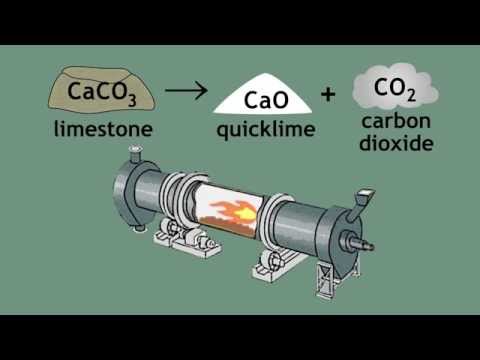
The same three compounds are linked by the lime cycle (Figure 7.10), which you can follow with the reactions from Lessons 2 and 3. Lime mortar, used for centuries in building, is slaked lime mixed with sand and water; it hardens slowly as it absorbs carbon dioxide from the air and turns back into calcium carbonate.
Figure 7.10: The lime cycle. Drawn by Ganzaa.
Cement is made by heating limestone with clay in a kiln at about 1450 °C. The calcium carbonate decomposes, and the calcium oxide combines with silica and alumina from the clay to form calcium silicates and aluminates, ground into cement. CIMERWA, at Bugarama in Rusizi District, is Rwanda's only integrated cement producer: it mines its own raw materials, makes the clinker and sells the cement. Every tonne of limestone decomposed releases about 440 kg of carbon dioxide (Worked example 2), which is why cement making is a major source of this greenhouse gas worldwide.
Table 7.8: Uses of Group 2 elements and compounds, and the properties behind them
| Substance | Use | Property it depends on |
|---|---|---|
| Magnesium alloys | light parts for aircraft, cars, bicycles and laptop cases | low density (1.74 g cm⁻³); strong when alloyed with aluminium and zinc |
| Magnesium metal | sacrificial anodes on steel pipelines, ship hulls and water heaters | more reactive than iron, so it is oxidised instead of the iron |
| Magnesium powder | flares and the white sparks in fireworks | burns with an intense white light |
| Magnesium oxide | lining furnaces and kilns | refractory: melting point 2852 °C |
| Magnesium hydroxide | antacid ("milk of magnesia") | a weak base, almost insoluble, so it neutralises stomach acid gently |
| Calcium carbonate | cement, building stone, agricultural lime, flux in the iron blast furnace | decomposes to CaO on heating; neutralises acids |
| Calcium oxide and hydroxide | mortar, whitewash, liming soil, treating water and acidic waste | cheap, strong bases |
| Calcium sulphate (plaster of Paris, ) | plaster for walls and casts for broken bones | takes up water again and sets hard as gypsum |
| Strontium carbonate and nitrate | red fireworks and red distress flares | crimson flame colour |
| Barium sulphate | "barium meal" for X-rays of the gut; white pigment; dense drilling mud | almost insoluble so not toxic; barium absorbs X-rays; high density |
| Beryllium and its alloys | telescope mirrors; non-sparking copper–beryllium tools; windows in X-ray tubes | light and stiff; keeps its shape when cold; transparent to X-rays |


Worked example 1: an antacid tablet
A tablet contains 0.300 g of magnesium hydroxide. What volume of hydrochloric acid of concentration 0.100 mol dm⁻³ (similar to stomach acid) can it neutralise? .
Solution.
Worked example 2: carbon dioxide from a lime kiln
Calculate the mass of carbon dioxide released when 1.00 tonne of pure calcium carbonate is decomposed. , .
Solution. : 100.09 g of carbonate gives 44.01 g of carbon dioxide, so the mass ratio is fixed.
Worked example 3: evaluating a liming material
A cooperative can buy crushed limestone () or quicklime (CaO). Compare the amount of acid each kilogram can neutralise, and evaluate which is the better choice for smallholders.
Solution. Each mole of either compound neutralises 2 mol of .Quicklime neutralises about 1.8 times as much acid per kilogram, so less has to be carried. But it is caustic, burns skin and eyes, heats up violently with rain, and must itself be made by heating limestone, which costs fuel and releases carbon dioxide. Crushed limestone or travertine acts more slowly but is safe to handle, cheap where it is quarried nearby, and cannot "burn" a crop. For smallholders spreading lime by hand, limestone is the better choice; quicklime suits industry, where it can be handled safely.
Warning
Common mistakes. (1) Saying barium meals are safe because "barium is not toxic": soluble barium compounds are poisonous; only the insolubility of makes it safe. (2) Saying magnesium protects iron by "coating" it: sacrificial protection works because magnesium is more reactive and is oxidised first. (3) Confusing quicklime (CaO) with slaked lime ().
Safety. Quicklime and slaked lime are corrosive to eyes and skin: wear goggles and gloves when spreading lime, and never rub lime dust from your eyes; rinse them with plenty of clean water and get medical help.
Tip
Link every use to a property: light (Mg, Be alloys), reactive (Mg anodes), basic (CaCO₃, CaO, Ca(OH)₂, Mg(OH)₂), insoluble (BaSO₄), coloured flame (Sr). Exam answers that name the property score; a bare list of uses does not.
FuseSchool: Limestone Cycle, limestone, quicklime and slaked lime (5 min). Follow each step of the cycle in Figure 7.10 and note the conditions and the observations at each step.
Practice
Key points
Further reading
Sources and credits
Quick check
Why is barium sulphate, but not barium chloride, safe to swallow before an X-ray?