Rocks in Rwanda
Senior 4 · Geography
Rocks in Rwanda
Lesson 3 of 3
22 min
Look at a house going up in any Rwandan town: stone foundations, walls of fired or sun-dried clay bricks, concrete made of cement, sand and crushed stone, and a road outside built on layers of crushed rock. Almost all of it came out of the ground nearby.

| Use | Rocks involved | Rwandan evidence |
|---|---|---|
| Building stone, aggregate and sand | Quartzite, granite, basalt; river sand | REMA reports that quarrying expanded to sand and stones for the construction boom and road building, and that quarry products made up 11% of internally generated revenues (REMA, 2009) |
| Bricks and tiles | Clay from weathered rock and valley floors | Clay from wetlands is used for bricks and tiles (REMA, 2009) |
| Cement | Limestone, with clay and other rock materials | CIMERWA's main factory is in Muganza Sector, Rusizi District, with a capacity of about 600,000 tonnes a year (Wikipedia, "Cimerwa Cement Limited") |
| Metallic minerals and exports | Pegmatites and quartz veins in the basement | Mineral exports rose to over US$1.1 billion in 2023 (RMB); mining and quarrying were estimated to employ about 50,000 people (REMA, 2009) |
| Ground water | Weathered and fractured basement; alluvium | Weathered basement is the most widespread aquifer; alluvium in valleys is highly productive (BGS, 2018) |
| Soils | All rocks, as parent material | Fertile volcanic soils near the Volcanoes National Park (REMA, 2009) |
| Fuel | Peat (an organic sediment) | Peat is used as fuel in prisons, industries and schools (REMA, 2009) |
| Tourism and landscape | Volcanic rocks; hard rock bands | Volcanoes, caves and waterfalls attract visitors |
Figure 3: from rock to building, and the costs at each step.

Worked example 1: how much rock does a road need?
Problem. A new district road is 10 km long and 7 m wide and needs a base of crushed stone 0.25 m thick. Loose crushed stone has a density of about 1.6 tonnes per m³. How many tonnes are needed, and how many loads for 20-tonne lorries? (Illustrative figures.)
Solution.
One short road means a large quarry face, and 1,400 lorry trips of dust and noise.
Worked example 2: bricks for a wall
Problem. A wall is 10 m long and 3 m high. Each brick, with its mortar joint, covers 0.2 m by 0.1 m of the wall's face and is 0.1 m thick. How many bricks are needed, and what volume of clay? (Illustrative figures.)
Solution. Bricks per square metre: .
About 3 m³ of clay, dug from a valley floor or a hillside pit, for one wall of one house.
| Problem | Explanation and evidence | Possible solution |
|---|---|---|
| Damage from quarrying and sand harvesting | REMA lists resource depletion, energy use, waste, air pollutants, dust, noise, displacement of people and land-use change (REMA, 2009) | Licensing and environmental impact assessment; rehabilitating old quarries by back-filling and tree planting |
| Muddy, polluted rivers | Water used to wash ores at Rutongo and Gatumba carried clay and sand into the Nyabarongo and Nyabugogo (REMA, 2009) | Settling ponds; recycling washing water; buffer zones along rivers |
| Spoil heaps and open pits | Waste rock is eroded into valleys; open pits are dangerous to people and livestock | Back-filling; fencing; replanting spoil |
| Hard rock is costly to work | Quartzite and granite slow down road building, foundations and pit latrines | Proper equipment; route roads along softer valleys where safe |
| Weak, clay-rich regolith | Weathered schist and clay swell, crack walls and fail in landslides | Drainage, deep foundations, avoiding steep sites |
| Little ground water in much of the basement | BGS notes that most basement rocks have low productivity; only quartzite is moderate | Site boreholes on fractures, quartzite and alluvium; harvest rain water |
Warning
"Rocks are only a resource" is half an answer. An exam question on the importance of rocks expects advantages and problems, each with an example. Quote a source and a year for any figure, such as RMB's US$1.1 billion of mineral exports in 2023.
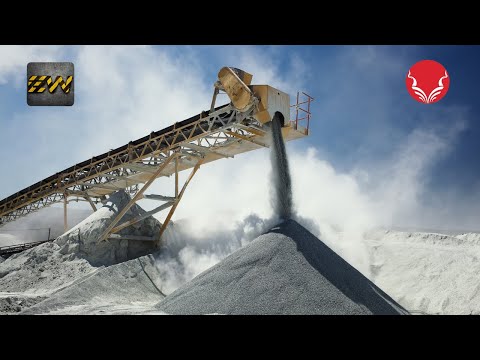
Engineering World: "How Cement Is Made In Factories?". Quarrying and grinding limestone and clay, heating them in a rotary kiln to make clinker, and grinding clinker with gypsum. Compare the kiln with the photograph of the Muganza works.
Practice
Key points
Further reading
Sources and credits
Sources: Rwanda State of Environment and Outlook Report, REMA, 2009 (quarrying, clay, peat, mining impacts, employment); Rwanda's Mineral Export Earnings Surge in 2023, RMB, 15 February 2024; Africa Groundwater Atlas: Hydrogeology of Rwanda, British Geological Survey, 2018, CC BY-SA 3.0, adapted by Ganzaa; Cimerwa Cement Limited, Wikipedia contributors, CC BY-SA 4.0, adapted by Ganzaa (location and capacity).
Photos: Muganza, Rwanda - panoramio, Xiaotong Gao, CC BY-SA 3.0; Umwubatsi, Endikuemmy, CC BY-SA 4.0; via Wikimedia Commons.
Figure 3, the worked examples (illustrative figures) and the exercises were drawn and written by Ganzaa.
Video: "How Cement Is Made In Factories?", Engineering World, embedded from YouTube.
This lesson adapts CC BY-SA material and is shared under CC BY-SA 4.0.
Quick check
Which rock material is the main raw material for making cement?