Combinatorics
Senior 4 · Mathematics
Combinatorics
Lesson 2 of 5
25 min
A combination padlock with 3 wheels, each showing the digits 0 to 9, has possible codes; one with 4 wheels has . Someone who tries one code every 3 seconds needs up to 50 minutes to open the first lock, but more than 8 hours for the second. One extra wheel multiplies the work by 10. That multiplication is the most useful counting rule there is.

Definition
Multiplication principle: if a task is done in successive stages, and the stages can be done in ways, where the number of ways at each stage does not depend on the choices made before, then the whole task can be done in
Addition principle: if a task can be done in one of several separate ways (no overlap), with possibilities, the total is .
Example: a lunch of 1 of 3 starches and 1 of 2 sauces: meals. A drink that is either 1 of 4 juices or 1 of 3 teas: choices.
Tip
"And then" means multiply; "or" (with no overlap) means add. Before you calculate, say the task aloud in stages: "choose the first digit, and then the second, and then…".
Definition
Factorial: for a natural number , , read " factorial". By definition .
Why : the rule with gives , so must be 1 for the rule to hold.
Examples: , , .
An arrangement is an ordered list. Each wheel of the padlock can show any of the 10 digits, whatever the other wheels show: the digits may repeat. Filling ordered places from symbols, with repetition allowed, gives choices for every place.
Important
Arrangements with repetition. The number of ordered lists of length whose entries are chosen from objects, repetition allowed, is
Reason: stages, each with choices, so by the multiplication principle.
Worked example 1: codes and answer sheets
(a) A phone network gives numbers of the form 078 followed by any 7 digits. How many numbers are possible? (b) In how many ways can a 10-question true/false test be answered? (c) How many 3-letter "words" (any strings) can be made from the 26 letters of the alphabet?
Solution
When an object, once used, cannot be used again, the number of choices goes down by one at each stage. Choosing a president, then a secretary, then a treasurer from the 12 members of a club gives ways: whoever is president cannot also be secretary.
Important
Arrangements without repetition. The number of ordered lists of different objects chosen from objects () is
Reason: choices for the first place, for the second, …, for the th. Multiplying and dividing by gives the factorial form.
Notation: also written or ; calculators have an key. For example .
Worked example 2: four-digit numbers
Using only the digits 1, 2, 3, 4, 5, 6, 7, how many four-digit numbers can be formed (a) if digits may repeat, (b) if no digit repeats, (c) if no digit repeats and the number is even?
Solution
So there are even numbers.
Worked example 3: conditions and the addition principle
A club has 12 members, among them Uwase. (a) In how many ways can a president, a secretary and a treasurer be chosen if Uwase must be the president? (b) If Uwase must hold one of the three posts? (c) How many numbers of one, two or three digits can be made from the digits 1 to 5 with no digit repeated?
Solution
Warning
Fill the restricted places first. If you fill the thousands, hundreds and tens first, the number of even digits left for the units depends on what you already used, and the multiplication principle no longer applies directly. Also watch for 0: a number cannot start with 0, so "four-digit numbers from the digits 0 to 9 without repetition" is , not .
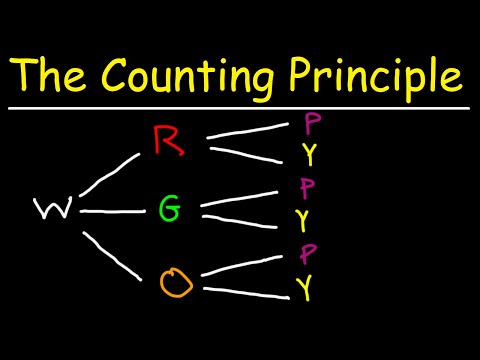
The Organic Chemistry Tutor: The Fundamental Counting Principle. Watch the box method for license plates and codes, with and without repetition.
Practice
Try each one before opening the answers. They get harder as you go.
Key points
Sources and credits
Quick check
A motorbike taxi app lets a rider choose 1 of 4 pick-up points and then 1 of 6 drop-off points. How many different trips are possible?