Physical Exercises and Health
Senior 4 · Physical Education
Physical Exercises and Health
Lesson 3 of 4
25 min
At rest your body needs roughly 5 litres of blood pumped every minute, whether you are a long-distance runner or have never trained. Yet a trained endurance runner's heart may beat 15 or 20 times a minute fewer than an untrained pupil's. How can fewer beats move the same blood? The answer is one of many lasting changes that training makes to the body. In this lesson you look at four kinds of training (for muscle, speed, endurance and relaxation), what each one changes inside the body, and how each change protects your health.
Definition
Muscular strength: the greatest force a muscle group can exert in one effort. Muscular endurance: the ability of a muscle group to repeat or hold a contraction for a long time without tiring.
Hypertrophy: growth in the size of muscle fibres in response to training against resistance.
Speed: the ability to move the body, or part of it, quickly. It includes reaction time, the delay between a signal and the start of the movement.
Aerobic endurance: the ability to keep exercising for a long time using oxygen to release energy. Its best single measure is , the greatest rate at which the body can take up and use oxygen.
Stroke volume (SV): the volume of blood pumped by the left ventricle in one beat. Cardiac output : the volume pumped per minute, .
Relaxation: deliberately lowering muscle tension, heart rate and mental arousal, for example by slow breathing.
| Training | Examples | Changes in the body | Health benefit |
|---|---|---|---|
| Muscular development | Push-ups, squats, lunges, resistance bands, supervised weights | Fibres thicken (hypertrophy); nerves recruit more fibres at once; tendons and bones become stronger and denser | Better posture, fewer joint and back injuries, stronger bones for life, easier daily tasks |
| Speed | Short sprints of 10 to 40 m with full recovery, reaction games, starts | Faster nerve signals and fibre recruitment; better use of fast-twitch fibres; more efficient technique | Quicker reactions in sport and in everyday emergencies, such as stepping out of the way of a vehicle |
| Endurance | Continuous running, cycling, swimming, long games, rope skipping | Larger, stronger heart (higher stroke volume); more capillaries and mitochondria in muscle; lower resting heart rate and blood pressure | Lower risk of heart disease, stroke, type 2 diabetes and obesity; less fatigue in daily life |
| Relaxation | Slow breathing, progressive muscle relaxation, gentle stretching, visualisation | The calming (parasympathetic) nervous system takes over: heart rate, breathing and muscle tension fall | Lower stress and anxiety, better sleep, faster recovery between sessions |
Young people can train for strength safely when the technique is taught, the loads are increased gradually and an adult supervises. The WHO recommends muscle- and bone-strengthening activity on at least three days a week for everyone aged 5 to 17.

Worked example
Worked example 1: why a trained heart beats slower. At rest, Niyonzima's body needs a cardiac output of . Before a year of endurance training his stroke volume was 70 mL; afterwards it is 85 mL. Find his resting heart rate before and after, and the number of beats saved per day.
A bigger, stronger left ventricle pumps more blood per beat, so the heart can do the same job with fewer beats and more rest between them. This is why a falling resting heart rate is one sign that endurance training is working.
Muscles can only use one fuel directly: ATP. They rebuild it in three ways, which differ in speed and in how long they last. Speed training works mainly the first; endurance training mainly the third.
Speed improves partly through faster reactions. A simple ruler-drop test measures reaction time: a partner holds a ruler with its zero mark between your open finger and thumb and lets go without warning; you catch it. Because the ruler falls freely from rest, the distance it falls before you catch it gives the time:
Worked example
Worked example 2: reaction time from a ruler drop. Keza catches the ruler after it falls 20.0 cm. After three weeks of reaction games she catches it after 15.0 cm. Find both reaction times .
Notice that time grows only with the square root of distance: halving the reaction time would need the catch distance to fall to a quarter.
Hard training, exams and competitions all switch on the body's stress response: a faster heart, quick shallow breathing and tight muscles. Relaxation techniques switch it off, and like any skill they improve with practice.
A cool-down that ends with five minutes of slow breathing brings the heart rate down faster and makes it easier to concentrate in the next lesson.

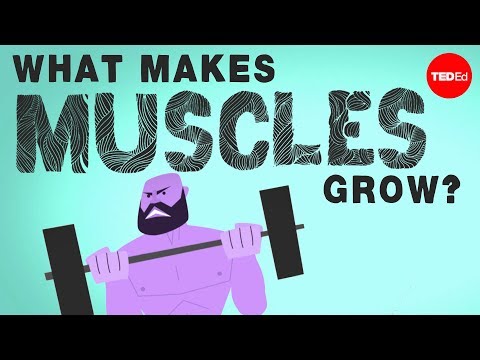
Video: "What makes muscles grow?" by Jeffrey Siegel, TED-Ed. Watch for how resistance training damages and then rebuilds muscle fibres, and why rest, sleep and food are part of the training.
Tip
Memory hook: . The output of a pump is the volume per stroke times the strokes per minute. Endurance training raises SV, so at rest the same needs a lower HR.
Warning
Common mistakes. Training hard every day: muscles grow during recovery, so plan rest days. Sprinting for speed when already tired: speed work needs full recovery between efforts (several minutes for a short sprint). Thinking relaxation is "doing nothing": it is a trained skill with measurable effects. Signs of overtraining include a resting heart rate that stays higher than usual, poor sleep, lasting soreness and falling performance.
Practice
Remember
Sources and credits
This lesson adapts CC BY-SA material and is shared under CC BY-SA 4.0.
Quick check
Stroke volume rises from 70 mL to 80 mL, and resting cardiac output stays at 5.6 L per minute. What happens to resting heart rate?