Support and Locomotion
Senior 4 · Biology
Support and Locomotion
Lesson 1 of 5
25 min
Put a drop of water from a pond, or from a vase where flowers have stood for a week, under a microscope. An amoeba creeps across the slide, its whole body flowing into finger-like bulges. A slipper-shaped Paramecium darts past, spinning as it goes, then suddenly backs away from an obstacle. A tiny green Chlamydomonas zigzags towards the light. None of them has a single muscle, yet all three travel. This unit is about locomotion: what it requires, and how it is done in water, on land and in the air. We begin with the smallest movers.
Definition
Movement: a change in position of the whole organism or of part of it (a leaf turning, an arm bending). Locomotion: movement of the whole organism from one place to another.
Support: holding the body in shape and up against gravity, and giving muscles or other motors something firm to pull or push against.
Drag: the force that resists motion through water or air. Streamlined: shaped so that drag is small.
Pseudopodium (plural pseudopodia, "false foot"): a temporary bulge of cytoplasm used for amoeboid movement and feeding.
Cilia and flagella: hair-like extensions of eukaryotic cells, with the same internal "9 + 2" arrangement of microtubules. Cilia are short and many; flagella are long and few.
Animals and many protists move to find food, water and mates, to escape predators and bad conditions (heat, drought, poisons), and to spread to new places. Plants and fungi cannot travel; they disperse seeds and spores instead.
| Requirement | Why it is needed |
|---|---|
| A propulsive force | By Newton's third law, an organism moves forward only by pushing backwards on something: the water, the air or the ground. The force comes from muscles or, in single cells, from protein motors. |
| Support | A skeleton, a stiff cell surface or fluid under pressure keeps the body in shape and transmits the force. |
| Coordination | Muscles, legs, fins or cilia must act in the right order; in animals the nervous system controls them. |
| Energy | Every contraction or beat uses ATP from respiration. |
| Overcoming resistance | Drag in water and air (reduced by streamlining); friction and gravity on land. |
| Medium | Density | What it means for locomotion |
|---|---|---|
| Water | About | Buoyancy supports most of the body's weight; but water is dense and viscous, so drag is large: streamlining matters |
| Air | About | Almost no support: a flier must make lift; little drag |
| Land | Solid | The full weight must be held up by a skeleton and limbs; the ground gives grip (friction) to push against |
Worked example 1: how much does water hold you up?
A fish's body has a density of without a swim bladder. (a) What fraction of its weight must it still support in fresh water (density )? (b) How many times denser is water than air?
Amoeboid movement is used by amoebae and by human white blood cells moving through tissues. The cytoplasm has a stiff outer layer, the ectoplasm (a gel), and a runny inner part, the endoplasm (a sol). At the front, the cell pushes out a pseudopodium; endoplasm streams into it and turns to gel at its tip, while at the rear gel turns back to sol and is squeezed forward (Figure 1). The pseudopodium sticks to the surface, and the cell flows after it. The forces come from protein filaments of actin that assemble at the front and from myosin that contracts the rear, using ATP.
Figure 1. Amoeboid movement (simplified).

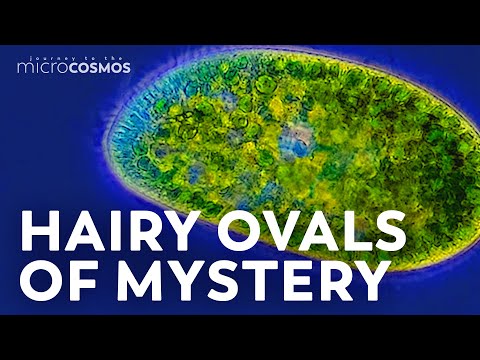
Ciliary movement: Paramecium is covered by thousands of cilia. Each one beats in two phases (Figure 2): a fast, stiff power stroke that pushes water backwards, and a slow, bent recovery stroke close to the cell that pushes little water back. Neighbouring cilia beat slightly out of step, so waves pass over the surface, like wind over a field of grass (a metachronal rhythm). If Paramecium bumps into an obstacle, its cilia reverse their stroke and it swims backwards briefly, then sets off in a new direction. In humans, cilia do not move the body but move fluids over it: mucus up the trachea, and the egg along the oviduct.
Figure 2. The beat of a cilium, and the 9 + 2 structure that bends it.
Flagellar movement: a eukaryotic flagellum has the same 9 + 2 structure as a cilium but is much longer. Waves of bending pass from its base to its tip and push water backwards, driving a sperm cell or Euglena forwards. Chlamydomonas pulls itself through the water with two front flagella in a breaststroke-like beat. In both, dynein arms use ATP to slide neighbouring microtubule pairs past each other, which bends the whole structure. Bacterial flagella are different: a rigid, helical protein filament with no microtubules, spun like a propeller by a rotary motor in the cell wall.


Worked example 2: comparing speeds
Illustrative values: a Paramecium long swims at ; an amoeba long creeps at . (a) Express each speed in body lengths per second. (b) How long would each take to travel 1 cm?
Worked example 3: explaining the backward escape
When a Paramecium hits an obstacle, it swims backwards for a moment, turns, and swims forward again. Explain this in terms of its cilia.
Journey to the Microcosmos: "Paramecium: The White Rat of Ciliates". Watch the living cilia beating and Paramecium backing away and turning when it meets an obstacle.
Warning
Common mistakes
Tip
Exam technique. For any kind of locomotion, answer the same four questions: what pushes (cilia, flagellum, fins, legs, wings), against what (water, air, ground), what supports (cell surface, skeleton, fluid pressure) and what supplies energy (ATP). Then add how drag or gravity is overcome.
Practice: locomotion and movement without muscles
Key points
Sources and credits
Quick check
Match each organism to its main way of moving.
Tap one on the left, then its partner on the right.