Major European Events Between 1789 and 1835
Senior 4 · History
Major European Events Between 1789 and 1835
Lesson 5 of 5
25 min
On 23 March 1819 a student, Karl Ludwig Sand, murdered the conservative writer August von Kotzebue. Prince Metternich of Austria used the killing to call a meeting of German governments at the spa town of Carlsbad. On 20 September 1819 the Diet of the German Confederation passed the decrees it had prepared. Two extracts, in the English translation quoted in Wikipedia's article on the decrees:
"The confederated governments mutually pledge themselves to remove from the universities or other public educational institutions all teachers who [...] by propagating harmful doctrines hostile to public order or subversive of existing governmental institutions, shall have unmistakably proved their unfitness for the important office entrusted to them."
"[...] no publication which appears in the form of daily issues, or as a serial not exceeding twenty sheets of printed matter, shall go to press in any state of the union without the previous knowledge and approval of the state officials."
The Carlsbad Decrees, 1819: the university law, article 2, and the press law, article 1.
Analyse it. Who is the enemy here? Not a foreign army, but ideas: teachers with "harmful doctrines" and short printed papers, the cheap pamphlets and newspapers that ordinary readers could buy. The decrees also banned the student fraternities (Burschenschaften) that campaigned for a united Germany. The source shows what Metternich feared most, and the method he trusted: censorship and surveillance, agreed by all the German governments together. It stayed in force until April 1848.

Definition
Conservatism: the belief that existing institutions (monarchy, Church, nobility) should be kept and change should be slow. Liberalism: the belief in individual rights and limited government, through a written constitution, an elected parliament, a free press and equality before the law. Nationalism: the belief that people who share a language, culture and history form a nation that should govern itself.
Metternich system: Metternich's way of preserving the order of 1815 at home and abroad: congresses, intervention, censorship and police spies. July Monarchy: the reign of Louis-Philippe in France (1830 to 1848), created by the July Revolution.
Metternich (born 15 May 1773) became Austria's foreign minister in 1809 and was also State Chancellor from 1821 to 1848. He served an empire held together not by one people but by one dynasty, the Habsburgs. Look at the chart.
In this estimate Germans, the language of the court and the government, were only about 18% of the people. Slavs were about 45%, and Hungarians and Italians had their own proud histories. For such a state, nationalism was deadly: if every nation demanded its own state, the empire would break into pieces. Liberalism was dangerous too, because elected parliaments would give these nations a voice. That is why Metternich's foreign and home policies were one policy.
| Metternich's aim | His method | Example |
|---|---|---|
| Keep the balance of power in Europe | Congresses and alliances | Chairing the Congress of Vienna (1814 to 1815); resisting Russian expansion |
| Stop revolutions spreading | Intervention by the great powers | Troppau Protocol (1820); Austrian army in Naples (1821) and in central Italy (1831) |
| Control Germany | Austria presided over the German Confederation | Carlsbad Decrees (1819) |
| Silence opposition at home | Censorship and a wide network of police spies | Banning nationalist student societies; inspectors in universities |
Verdict. For about thirty years Metternich helped keep Austria intact and peace among the great powers; historians generally see his era as one of stability for the empire. But he offered no answer to the demands of the peoples he governed. When revolution reached Vienna on 13 March 1848, students and workers turned on him, troops fired on the crowd, and he resigned and fled to England. Repression delayed the crisis; it did not solve it.
Fifteen years after Vienna, the settlement cracked. The spark was in Paris.
France. King Charles X (from 1824) favoured the old nobility and the Church. On 25 July 1830 he signed the July Ordinances: they dissolved the newly elected Chamber of Deputies, suspended the freedom of the press and removed the commercial middle class from future elections. Printers, students and workers built barricades, and after three days of fighting, 27 to 29 July (the "Three Glorious Days"), Paris was theirs. Charles abdicated on 2 August. The liberal deputies chose his cousin Louis-Philippe, who became "King of the French", a title meaning that his power came from the nation, not from God.
| Where | Causes | What happened | Result |
|---|---|---|---|
| France | Charles X's absolutism; the July Ordinances | The July Days, 27 to 29 July 1830 | Success: a constitutional monarchy under Louis-Philippe. But only rich men voted: the electorate grew from 94,000 under Charles X to just over 200,000 by 1848, about 1% of the population |
| Belgium | Catholic, mostly French- and Flemish-speaking south joined to the Protestant Dutch north in 1815 without being asked | Rising in Brussels on 25 August 1830, begun by an audience leaving a patriotic opera; independence declared on 27 September | Success: the London Conference of the great powers backed independence (20 December 1830); Leopold I became king (21 July 1831); the Dutch accepted it only in 1839 |
| Poland | Russia broke the constitution Congress Poland had been promised in 1815; censorship and secret police | Officer cadets rose in Warsaw on 29 November 1830; war with Russia | Crushed: Warsaw fell in September 1831; the Organic Statute of 1832 ended Polish self-government |
| Italian states | Austrian domination; nationalist secret societies (Carbonari) | Risings in Modena, Parma and the Papal States in February 1831 | Crushed by the Austrian army in the spring of 1831 |
| Germany and Switzerland | Demands for constitutions | A successful revolution in Brunswick; mass meetings in the Swiss cantons | Swiss cantonal governments quickly amended their constitutions |

Charles X had tried to win popularity abroad. His fleet sailed from Toulon in May 1830 and French troops entered Algiers on 5 July 1830. Three weeks later he lost his throne, but France kept Algiers: it was the beginning of the conquest of Algeria, which France ruled until Algerian independence on 5 July 1962. And the Belgium born in 1830 to 1831 is the same state that would rule Rwanda from 1916 to 1962 (units 7 and 8). The son of its first king, Leopold II, would take the Congo Free State as his personal property in 1885 (unit 5).
Warning
Do not write that the revolutions of 1830 "failed everywhere" or "succeeded everywhere". Sort them by result: success where the great powers did not or could not intervene (France, Belgium), defeat where Russia or Austria could send an army (Poland, Italy). And "liberal" in 1830 did not mean democratic: Louis-Philippe's France let about 1% of the people vote.
Tip
Metternich's enemies were the two "-isms" (liberalism and nationalism); his weapons were the three C's: Congresses, Censorship and Coercion. For 1830, remember "two won, two lost": France and Belgium won, Poland and Italy lost.
Important
Discuss. Metternich believed that free newspapers and free universities would destroy a state of many peoples. Rwanda today is a nation of one people with one language, Kinyarwanda, yet it lived through a history in which ideas taught and printed were used to divide Rwandans (units 7 and 8). What responsibilities do teachers and journalists carry? Who should judge when words become dangerous, and how can that power itself be abused?
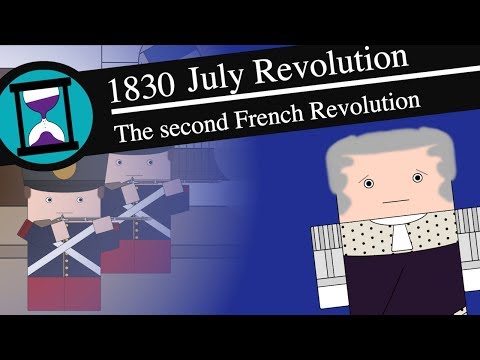
History Matters, "The 1830 July Revolution", a short animated documentary. Watch for what Charles X's ordinances did and why the outcome satisfied the liberal middle class more than the people who fought on the barricades.
Practice
Key points
Further reading
Sources and credits
Written by Ganzaa: the chart, the timeline, the tables and the exercises. This lesson adapts CC BY-SA material and is shared under CC BY-SA 4.0.
Quick check
Why did Metternich see nationalism as a deadly threat to the Austrian Empire in particular?