Colonial Agents in Africa
Senior 4 · History
Colonial Agents in Africa
Lesson 4 of 4
25 min
Europeans called West Africa "the white man's grave". Study the figures from three British expeditions up the River Niger, all collected from accounts of the voyages.
Worked example: what explains the change?
Definition
Malaria: a disease carried by mosquitoes, the biggest killer of early European visitors to tropical Africa. Quinine: a drug from the bark of the cinchona tree that treats and helps prevent malaria. Sleeping sickness: a disease spread by the tsetse fly, which also kills cattle and horses. Cataract: a large waterfall or rapids that blocks boats on a river.
Partition: the division of Africa among European powers, mostly between 1880 and 1914. Maxim gun: the first fully automatic machine gun, invented in 1884 and heavily used in the conquest of Africa.
| Problem | Example | How it was later overcome |
|---|---|---|
| Disease (malaria, sleeping sickness) | Bishop Mackenzie of the Universities' Mission died of malaria near Lake Malawi on 31 January 1862; Livingstone was ill for most of the last four years of his life | Quinine; better medical knowledge |
| Transport | Rapids blocked the lower Congo, so Stanley had to build a wagon trail around them; tsetse flies killed pack animals, so goods went on the heads of porters | Steamers on rivers and lakes, then railways (the Uganda Railway reached Lake Victoria in 1901) |
| African resistance | The coastal revolt of 1888 against the German East Africa Company; Mwanga's executions of converts in Buganda; rulers who refused entry | Treaties, alliances with African rivals, and superior weapons such as the Maxim gun |
| Language and knowledge | Speke and his guide Bombay could only talk in Hindi; every treaty depended on interpreters | Missionaries learned and wrote down African languages; African interpreters and clerks |
| Terrain and climate | Deserts, swamps, dense forest and long rainy seasons | Local guides; better maps from earlier explorers |
| Money and rivalry | The Imperial British East Africa Company nearly went bankrupt; Burton and Speke quarrelled; Catholic and Protestant missions fought in Buganda | Governments took over from companies; agreements between powers such as the Berlin Act of 1885 |

| Area | Consequences |
|---|---|
| Political | Maps and treaties turned into claims; explorers' reports fed the rivalry that led to the Berlin Conference (1884 to 1885) and the partition of Africa; African states lost their independence |
| Economic | Routes and resources became known to European investors; "legitimate trade" and later cash crops grew; African economies were tied to Europe's needs; in the Congo Free State, Leopold's search for profit led to forced labour and terrible violence |
| Religious and social | Missions, schools and clinics spread; African languages were written down; but African beliefs were attacked as "pagan" |
| Against the slave trade | Explorers' reports strengthened campaigns against the East African slave trade, which Europeans later used to justify conquest |
| Ideas and names | Explorers spread false racial theories about Africans, such as Speke's; African places were renamed after Europeans: Lake Victoria, Victoria Falls, Léopoldville (named by Stanley in 1881, renamed Kinshasa in 1966) |
| Rwanda | Götzen's 1894 journey and Kandt's explorations prepared German rule: Götzen became governor of German East Africa, Kandt the first Resident of Rwanda (1907); Speke's theory later shaped colonial policy in Rwanda (units 7 and 8) |
Weighing the consequences. Some older books list "positive" results such as maps, schools or the end of the slave trade. A careful historian asks: positive for whom, and at what cost? The maps were made for the Europeans who used them to conquer; schools came with the loss of self-government. And the people who knew Africa best, its own inhabitants, were rarely asked.
Warning
Do not treat technology as the whole story. Quinine, steamers and the Maxim gun explain how Europeans could conquer Africa after 1880, not why they wanted to. Combine the "how" (technology, divisions among Africans) with the "why" (economic, political and ideological motives) in your answers.
Tip
Problems: "DR TLM". Disease, Resistance, Transport, Language, Money (and rivalry). For each one, learn one example and one way it was overcome.
Important
Discuss. Léopoldville became Kinshasa in 1966, and many African countries have renamed places named after colonisers. Should places keep the names Europeans gave them, such as Lake Victoria, or return to African names? What does a name say about who owns a place's history?
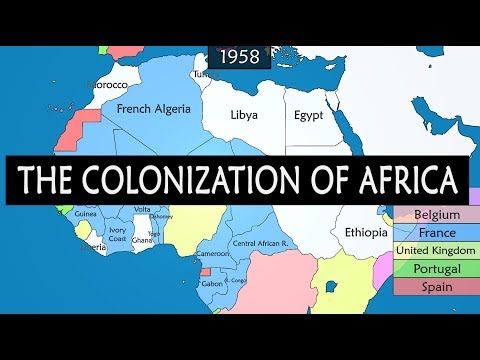
Geo History, "Colonization of Africa: Summary on a Map". Watch how quickly the map changes after 1880, and link each stage to the explorers' routes and treaties you have studied.
Practice
Key points
Further reading
Sources and credits
Written by Ganzaa: the chart, the worked example, the tables and the exercises. This lesson adapts CC BY-SA material and is shared under CC BY-SA 4.0.
Quick check
The 1841 expedition carried quinine but lost 42 of its 150 Europeans. What is the best conclusion?