Trends in Chemical Properties of Group 13 Elements and Their Compounds
Senior 4 · Chemistry
Trends in Chemical Properties of Group 13 Elements and Their Compounds
Lesson 3 of 4
25 min
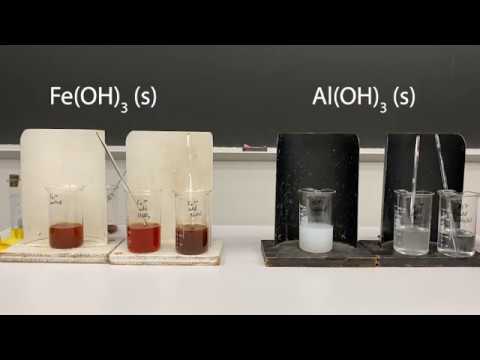
Bauxite is red-brown because, besides hydrated aluminium oxide, it contains iron(III) oxide, silica and titanium dioxide. To make pure aluminium, the alumina must first be separated from all of these, and the method that does it, used at every alumina refinery in the world, depends on one property: aluminium oxide dissolves in hot sodium hydroxide solution, while iron(III) oxide does not. An oxide that reacts with acids and with alkalis is called amphoteric. This lesson explains why aluminium and gallium form amphoteric oxides and hydroxides, and how the same property gives a simple test for aluminium ions.
Definition
Amphoteric: describes an oxide or hydroxide that reacts both with acids, acting as a base, and with alkalis, acting as an acid. Example: dissolves in hydrochloric acid to give , and in sodium hydroxide solution to give .
Aluminate ion: , tetrahydroxoaluminate(III), the soluble form of aluminium in alkaline solution. The gallium analogue is , gallate.
Hydrolysis of a cation: the reaction of a hydrated metal ion with water in which a water ligand loses a proton, making the solution acidic. Example: .
As a base, with acids:
As an acid, with alkalis:
Gallium(III) oxide and hydroxide behave in the same way, for example . Strongly heated (calcined) aluminium oxide, such as corundum, reacts only slowly with both, because its lattice is very strong; freshly precipitated aluminium hydroxide reacts quickly.
In water, is surrounded by six water molecules, . The small, highly charged ion pulls electron density from the O–H bonds of these water ligands, so they lose protons easily. The hexaaqua ion is a weak acid, with , about as strong as ethanoic acid, which is why solutions of aluminium salts are acidic.
Adding hydroxide ions removes protons one at a time (Figure 8.4). When three have gone, the neutral , aluminium hydroxide, comes out of solution as a white, jelly-like precipitate. With excess hydroxide a fourth proton is removed and the charged, soluble aluminate ion forms. Adding acid reverses every step. Amphoteric behaviour is simply this ladder being climbed in either direction.
Figure 8.4: Each step down removes one from a water ligand. Only the neutral species, , is insoluble.
Table 8.4: Acid–base character of the oxides and hydroxides
| Element | Oxide | Hydroxide | Character |
|---|---|---|---|
| Boron | (boric acid) | acidic (weak acid) | |
| Aluminium | amphoteric | ||
| Gallium | amphoteric | ||
| Indium | basic; does not dissolve in alkali | ||
| Thallium | (+1) | TlOH (+1) | strongly basic; TlOH is soluble |
The oxides become more basic down the group, as the elements become more metallic and their cations larger and less polarising. The pattern is the same one you met in Period 3: a non-metal oxide is acidic, a metal oxide basic, and an element on the borderline gives an amphoteric oxide.
Because gallium is chemically so like aluminium, it dissolves along with it; it builds up in the recycled liquor, which is the world's main source of gallium.

Solutions of aluminium salts are colourless, and aluminium gives no colour in a flame test, so it is identified with hydroxide precipitates.
Figure 8.5: The sodium hydroxide test for .
Zinc and lead(II) ions also give white precipitates that dissolve in excess sodium hydroxide, so one test alone is not enough. Use the flowchart in Figure 8.6: zinc hydroxide dissolves in excess ammonia (forming ), and lead(II) gives a yellow precipitate of lead(II) iodide with potassium iodide; aluminium does neither.
Figure 8.6: Identifying a white hydroxide precipitate.
Worked example 1: how much alkali?
Sodium hydroxide solution, 0.500 mol dm⁻³, is added from a burette to 25.0 cm³ of 0.100 mol dm⁻³ aluminium chloride solution. Calculate (a) the volume added when the mass of precipitate is greatest, (b) that mass, and (c) the total volume needed to dissolve the precipitate completely. .
Solution. .
Worked example 2: why aluminium salts are acidic
Estimate the pH of 0.100 mol dm⁻³ aluminium chloride solution, taking for and treating only the first step.
Solution. As for any weak acid, assuming little dissociation: So the solution is distinctly acidic even though no acid was added: blue litmus turns red, and adding sodium carbonate gives bubbles of carbon dioxide.

Warning
Common mistakes. (1) Saying the precipitate dissolves in excess ammonia: aluminium hydroxide does not; zinc hydroxide does. (2) Concluding "aluminium" from the sodium hydroxide test alone: zinc and lead(II) behave the same way. (3) Writing the aluminate ion as in a solution equation: in water it is . (4) Adding one large portion of alkali at once: the precipitate may form and redissolve before you see it, so add it drop by drop.
Safety. Sodium hydroxide solution is corrosive, even at 0.5 mol dm⁻³, and can blind: wear goggles. Aqueous ammonia gives off an irritating gas, so use it in a well-ventilated room. Lead compounds are toxic: use dilute solutions, avoid skin contact and wash your hands after the practical. If a solution splashes into your eyes, rinse them at once with plenty of running water for several minutes and get medical help.
Tip
Remember the aluminium test as "NaOH: comes and goes; NH₃: comes and stays." Then rule out the look-alikes: zinc goes in ammonia, lead turns yellow with iodide.
Chemistry and Biochemistry Demo Lab at Oregon State University: Amphoteric Hydroxides (3 min). Watch aluminium hydroxide and iron(III) hydroxide being treated with acid and with excess base: both dissolve in acid, but only aluminium hydroxide dissolves in excess base.
Practice
Key points
Sources and credits
Quick check
A colourless solution gives a white precipitate with sodium hydroxide that dissolves in excess. With aqueous ammonia the white precipitate stays in excess, and potassium iodide gives no precipitate. Which ion is present?