Trends in Chemical Properties of Group 16 Elements and Their Compounds
Senior 4 · Chemistry
Trends in Chemical Properties of Group 16 Elements and Their Compounds
Lesson 1 of 4
25 min
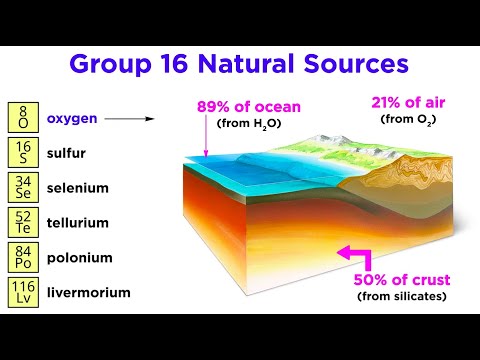
Oxygen is almost half of the Earth's crust by mass, about a fifth of the air, and eight-ninths of the mass of water; every cell in your body burns food with it. Sulphur, directly below it, is a yellow solid that has been dug from volcanic deposits for thousands of years and is now made in huge amounts from natural gas and crude oil, most of it to be turned into sulphuric acid. Like nitrogen and phosphorus in Unit 10, the two top members of Group 16 are strikingly different: oxygen is a gas of small molecules, sulphur a solid of eight-membered rings. This lesson explains the difference and the trends down the group.

Definition
Group 16 (the chalcogens): oxygen (O), sulphur (S), selenium (Se), tellurium (Te), polonium (Po) and the artificial element livermorium (Lv). Each atom has the outer configuration and needs two electrons to complete its octet, so the common oxidation state in compounds with metals is −2 (, ). Sulphur and the heavier elements also show +4 and +6 (as in and ).
Allotropy: the existence of an element in two or more different structural forms. Example: dioxygen and ozone ; rhombic and monoclinic sulphur.
Table 11.1: The Group 16 elements
| Property | O | S | Se | Te | Po |
|---|---|---|---|---|---|
| Atomic number | 8 | 16 | 34 | 52 | 84 |
| Outer configuration | |||||
| Covalent radius / pm | 63 | 103 | 116 | 136 | 145 |
| First ionisation energy / kJ mol⁻¹ | 1313.9 | 999.6 | 941.0 | 869.3 | 812.1 |
| Electronegativity (Pauling) | 3.44 | 2.58 | 2.55 | 2.1 | 2.0 |
| Melting point / °C | −218.8 | 115.2 | 220.5 | 449.5 | 254 |
| Boiling point / °C | −183.0 | 444.6 | 685 | 988 | 962 |
| Structure | molecules | rings | long chains (grey Se) | long chains | metallic |
| Type | non-metal | non-metal | non-metal (grey form semiconducts) | metalloid | metal |
Figure 11.1: First ionisation energies down Group 16.
Figure 11.2: Melting points down Group 16.
The same idea you met in Units 9 and 10 applies. A small oxygen atom forms a strong π bond, so two oxygen atoms complete their octets with one O=O double bond, and molecules attract each other only weakly: oxygen is a gas. Sulphur's larger 3p orbitals overlap poorly sideways, so each sulphur atom forms two single bonds to two different atoms, giving rings of eight (Figure 11.3) with stronger London forces between them: sulphur is a solid.
Figure 11.3: , and .

Worked example 1: reading a trend and an anomaly
Use Table 11.1 to (a) explain why the first ionisation energy of sulphur (999.6 kJ mol⁻¹) is lower than that of phosphorus (1011.8 kJ mol⁻¹, Unit 10), even though sulphur has one more proton, and (b) explain the large drop from oxygen to sulphur.
Solution. (a) Phosphorus is : three unpaired 3p electrons, one in each orbital. Sulphur is : one 3p orbital holds a pair, and the two electrons in it repel each other, so one is removed more easily. This outweighs the extra proton. (b) Sulphur's outer electron is in the third shell, further from the nucleus and shielded by eight more inner electrons than oxygen's second-shell electron, so it is much more easily removed (1313.9 down to 999.6 kJ mol⁻¹).
Worked example 2: how much ozone?
An ozone generator converts 6.0% of the oxygen molecules passing through it into ozone, . How many moles of ozone are made from 50.0 dm³ of oxygen at room temperature and pressure (24.0 dm³ mol⁻¹)?
Solution. (about 0.083 mol; two significant figures, because 6.0% has two).
Warning
Common mistakes. (1) Writing sulphur as S or when asked for the formula of the molecule: it is (S alone is fine in most equations). (2) Calling ozone "a compound of oxygen": it is an allotrope, an element. (3) Expecting the first ionisation energy to rise from P to S: the paired 3p electrons in S make it lower. (4) Saying sulphur melts at 115 °C "because its covalent bonds break": melting separates molecules; the S–S bonds stay intact.
Safety. Liquid oxygen makes almost anything burn fiercely and causes frostbite. Ozone irritates the lungs. Molten sulphur causes severe burns, and burning sulphur gives toxic sulphur dioxide, so plastic sulphur is made only as a teacher demonstration in a fume cupboard. Polonium is intensely radioactive and never handled outside specialist laboratories.
Tip
Across Groups 14 to 16 the same rule appears three times: Period 2 makes π bonds and small molecules (, , ); Period 3 makes single bonds and bigger structures (, , ).
Professor Dave Explains: Periodic Table Part 7, the Chalcogens (9 min). Watch for the allotropes of oxygen and sulphur, how the elements become more metallic down the group, and the uses of selenium and tellurium.
Practice
Key points
Sources and credits
Quick check
Why is oxygen a gas at room temperature while sulphur is a solid?