Trends in Chemical Properties of Group 17 Elements and Their Compounds
Senior 4 · Chemistry
Trends in Chemical Properties of Group 17 Elements and Their Compounds
Lesson 1 of 5
25 min
Most groups of the periodic table are hard to tell apart by eye, but the halogens announce themselves: fluorine is a pale yellow gas, chlorine a yellow-green gas, bromine a dark red-brown liquid that gives off orange fumes, and iodine a shiny grey-black solid that turns into a violet vapour when warmed. You meet their compounds every day: chloride in table salt, fluoride in toothpaste, iodine added to salt to protect the thyroid gland, chlorine in the water that comes out of a tap. "Halogen" means "salt-former", and all four combine with metals to make salts. This lesson describes where the halogens come from and how their physical properties change down the group.

Definition
Halogens (Group 17): fluorine (F), chlorine (Cl), bromine (Br), iodine (I), astatine (At) and the artificial element tennessine (Ts). Each atom has seven outer electrons, , one short of a noble gas. The elements exist as diatomic molecules, , and gain an electron to form halide ions, . Example: is ; is .
First electron affinity: the energy change when one mole of gaseous atoms each gain one electron to form one mole of gaseous 1− ions. Example: , .
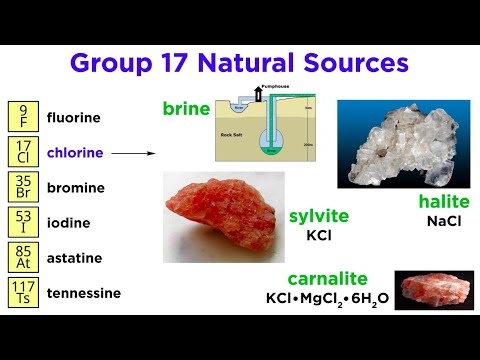
The halogens are too reactive to occur free; they are found as halide ions, or in the case of iodine also as iodate.
| Element | Main sources |
|---|---|
| Fluorine | fluorite (fluorspar), ; fluorapatite; cryolite, |
| Chlorine | sodium chloride in sea water, salt lakes and underground rock salt |
| Bromine | bromide ions in sea water and salt-lake brines |
| Iodine | brines; seaweed; sodium iodate in Chilean nitrate deposits |
| Astatine | only tiny, short-lived traces from radioactive decay |
Table 12.1: The halogens
| Property | F | Cl | Br | I |
|---|---|---|---|---|
| Atomic number | 9 | 17 | 35 | 53 |
| Outer configuration | ||||
| Appearance at 25 °C | pale yellow gas | yellow-green gas | red-brown liquid, orange vapour | grey-black solid, violet vapour |
| Covalent radius / pm | 64 | 99 | 114 | 133 |
| First ionisation energy / kJ mol⁻¹ | 1681.0 | 1251.2 | 1139.9 | 1008.4 |
| Electronegativity (Pauling) | 3.98 | 3.16 | 2.96 | 2.66 |
| First electron affinity / kJ mol⁻¹ | −328.2 | −348.6 | −324.5 | −295.2 |
| X–X bond energy / kJ mol⁻¹ | 159 | 243 | 193 | 151 |
| Melting point / °C | −219.6 | −101.5 | −7.2 | 113.7 |
| Boiling point / °C | −188.1 | −34.0 | 58.8 | 184.4 |
Figure 12.1: Melting and boiling points of the halogens.
The X–X bond energy falls from chlorine to iodine as the atoms get larger and the shared electrons are further from both nuclei (Figure 12.2). On that trend, the F–F bond should be the strongest of all. Instead it is weaker than Cl–Cl. The F–F bond is so short that the lone pairs on the two fluorine atoms are very close together and repel each other strongly, weakening the bond. This weak bond is one reason fluorine is so violently reactive: very little energy is needed to split into atoms.
Figure 12.2: X–X bond energies of the halogens.


Worked example 1: light that splits chlorine
A mixture of hydrogen and chlorine explodes in bright sunlight, because light splits into atoms. Using the Cl–Cl bond energy of 243 kJ mol⁻¹, calculate the longest wavelength of light that can break one Cl–Cl bond. , , .
Solution. Energy per bond: Any light with a wavelength shorter than about 492 nm (blue, violet and ultraviolet) can split chlorine molecules, so sunlight starts the chain reaction.
Worked example 2: predicting astatine
Use the trends in Table 12.1 to predict, with reasons, the state at room temperature, the colour, and the electronegativity of astatine compared with iodine.
Solution.
Warning
Common mistakes. (1) Explaining the rise in boiling point by "stronger covalent bonds": boiling separates molecules; the X–X bonds do not break, and they actually get weaker. (2) Saying fluorine has the highest electron affinity: chlorine's is larger. (3) Writing halogens as single atoms ("Cl") in equations for the element: they are diatomic, . (4) Confusing halogen (the element) with halide (the ion).
Safety. Fluorine is too dangerous for school laboratories. Chlorine and bromine are toxic and corrosive: chlorine attacks the lungs, and liquid bromine causes severe burns and its vapour is poisonous; both are used only in a fume cupboard, with gloves and goggles, and in small amounts. Iodine stains skin and its vapour irritates the eyes. If someone breathes in chlorine, move them to fresh air and get medical help.
Tip
Halogen trends in one line: down the group, bigger molecules (higher m.p./b.p., darker colour), less pull on electrons (lower IE, EN, electron affinity). Fluorine breaks two rules: a weak F–F bond and a smaller electron affinity than chlorine, both caused by its tiny, crowded atom.
Professor Dave Explains: Periodic Table Part 8, the Halogens (7 min). Watch for the colours and states of the halogens, why they are so reactive, and where their compounds are used.
Practice
Key points
Sources and credits
Quick check
Why do the boiling points of the halogens increase from fluorine to iodine?