Electric Force and Electric Field
Senior 4 · Physics
Electric Force and Electric Field
Lesson 5 of 5
25 min
A camera flash needs a burst of several thousand watts for about a thousandth of a second, far more power than its small battery can give. So the battery spends a few seconds charging a capacitor, a store of separated charge, to a high voltage, and the capacitor then empties through the flash tube almost at once. Capacitors are in nearly every electronic circuit: they smooth the output of phone chargers, set the timing of blinking lights, sense your finger on a touchscreen and store the bits in computer memory. In this lesson you define capacitance, combine capacitors, find the energy they store and describe how they charge and discharge through a resistor.
A capacitor is two conductors separated by an insulator. Connected to a supply, it takes charge on one plate and on the other; no charge crosses the gap. The charge stored is proportional to the voltage, and the ratio is the capacitance:
The unit is the farad (F), one coulomb per volt. A farad is very large: practical capacitors range from picofarads () to thousands of microfarads.
The parallel-plate capacitor. For plates of area a distance apart (Figure 5.1), the uniform field between them is , so the voltage is , and
Large plates, close together, with a dielectric of high relative permittivity, give a large capacitance. The dielectric's molecules are polarised by the field and partly cancel it, so the same charge needs a smaller voltage.
Figure 5.1: A parallel-plate capacitor and its circuit symbol.
Definition
The capacitance of a capacitor is the charge stored on either plate per unit potential difference between the plates: , in farads (). A dielectric is an insulator placed between the plates; it multiplies the capacitance by its relative permittivity . Example: a capacitor storing at 12 V has .
Worked example 1: a parallel-plate capacitor
Two plates of area are 1.0 mm apart in air. Find the capacitance and the charge at 100 V. What is the capacitance if the gap is filled with a dielectric of ?
With the dielectric, .
Parallel. Capacitors connected side by side (Figure 5.2) all have the same voltage , and the total charge is the sum: . So
Series. Capacitors in a line all carry the same charge : the charge on the inner plates is only moved, not added. The voltages add: . So
These are the opposite of the rules for resistors: parallel capacitors add like resistors in series. A series combination always has less capacitance than its smallest member.
Figure 5.2: Capacitors in series and in parallel.
Worked example 2: a network across 12 V
Capacitors of and are connected in parallel, and this pair is connected in series with a capacitor across a 12 V supply. Find the total capacitance and the charge on each capacitor.
Parallel pair: . In series with : .
Total charge , which is the charge on the capacitor and on the pair as a whole. Voltage across the : ; across the pair: . So and (check: ).
Charging a capacitor means pushing each extra bit of charge onto the plates against the voltage already there, which takes work . On a graph of against , a straight line through the origin, this work is the area under the line: a triangle of area . So the energy stored is
The energy is stored in the electric field between the plates. Only half the energy taken from the battery is stored; the other half is dissipated as heat in the circuit while charging.
Worked example 3: a camera flash
A flash capacitor of is charged to 300 V (typical values) and discharged through the flash tube in 1.0 ms. Find the energy stored and the average power of the flash.
The energy is small, but delivered so quickly that the power is thousands of watts. That is what capacitors are good at; batteries store far more energy but release it slowly.
Connect a charged capacitor across a resistor . The current is largest at the start; as charge flows off, falls, so the current falls, so the charge flows off more slowly. The rate of loss is proportional to what is left, , which gives an exponential decay:
The product is the time constant (in seconds, since ). After one time constant the charge, voltage and current have fallen to of their starting values; after the capacitor is practically empty. The time to halve is .
When an uncharged capacitor is charged from a supply through , the voltage rises as , reaching 63% of after one time constant, while the current falls exponentially from (Figure 5.3).
Figure 5.3: Discharging and charging a capacitor through a resistor; time is measured in time constants RC.
Worked example 4: how long does it take to discharge?
A capacitor charged to 9.0 V is discharged through a resistor. Find the time constant, the voltage after one time constant, and the time for the voltage to fall to 1.0 V.

Warning
Safety and common mistakes. (1) Large capacitors in televisions, microwave ovens and power supplies can hold a dangerous charge long after the appliance is unplugged: never open such equipment. (2) Using the resistor rules for capacitors: parallel capacitors add; series capacitors combine as reciprocals. (3) Forgetting that capacitors in series share the same charge, not the same voltage. (4) Writing the stored energy as : it is . (5) Mixing μF and F, or kΩ and Ω, in .
Tip
The 37–63 rule. In one time constant a discharging capacitor loses 63% of what it had (37% is left); a charging one gains 63% of the way to full. Five time constants is "practically finished".
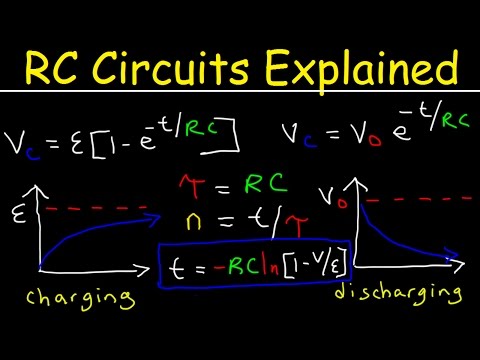
RC Circuits: Time Constant Explained, Capacitor Charging and Discharging (The Organic Chemistry Tutor). Watch how the time constant RC is used to find the voltage and current at any time, as in Worked example 4.
Practice
Key points
Further reading
Sources and credits
Written by Ganzaa: the lesson text, derivations, diagrams, graphs, worked examples and practice exercises.
Quick check